

The AI Operating System: How to Layer Intelligence Around Your Business
Most businesses that try AI skip straight to automation and wonder why nothing works. The ones that succeed build in layers — context, data, intelligence, communication, then automation. Here's the methodology.
Here's a pattern we see over and over: a business buys an AI tool, plugs it in, and watches it sit unused within three months.
The tool works fine. The AI is capable. The problem is that the system doesn't know anything about the business. It doesn't know the scheduling exceptions, the team constraints, the pricing rules that live in the owner's head, or the customer preferences that never got written down. All the knowledge that makes the business run is locked in sticky notes and tribal memory.
They bought the roof before building the foundation.
The failure rate for AI projects sits around 95%, and the root cause is almost never the technology. It's the order of operations.
What an "AI Operating System" Actually Means
An AI operating system isn't a product you buy. It's a way of thinking about how intelligence gets layered around your business — one piece at a time, each piece building on the one before it.
Think of it like building a house. You don't pick out kitchen cabinets before pouring the foundation. You don't wire the electricity before framing the walls. There's an order, and skipping steps means tearing things out later.
The same logic applies to AI. There are five layers, and they stack:
- Context — Teach AI how your business actually works
- Data — Connect what you already use so you can see the full picture
- Intelligence — Get automated summaries, alerts, and recommendations
- Communication — Turn meetings and conversations into action
- Automation — End-to-end workflows that run without you
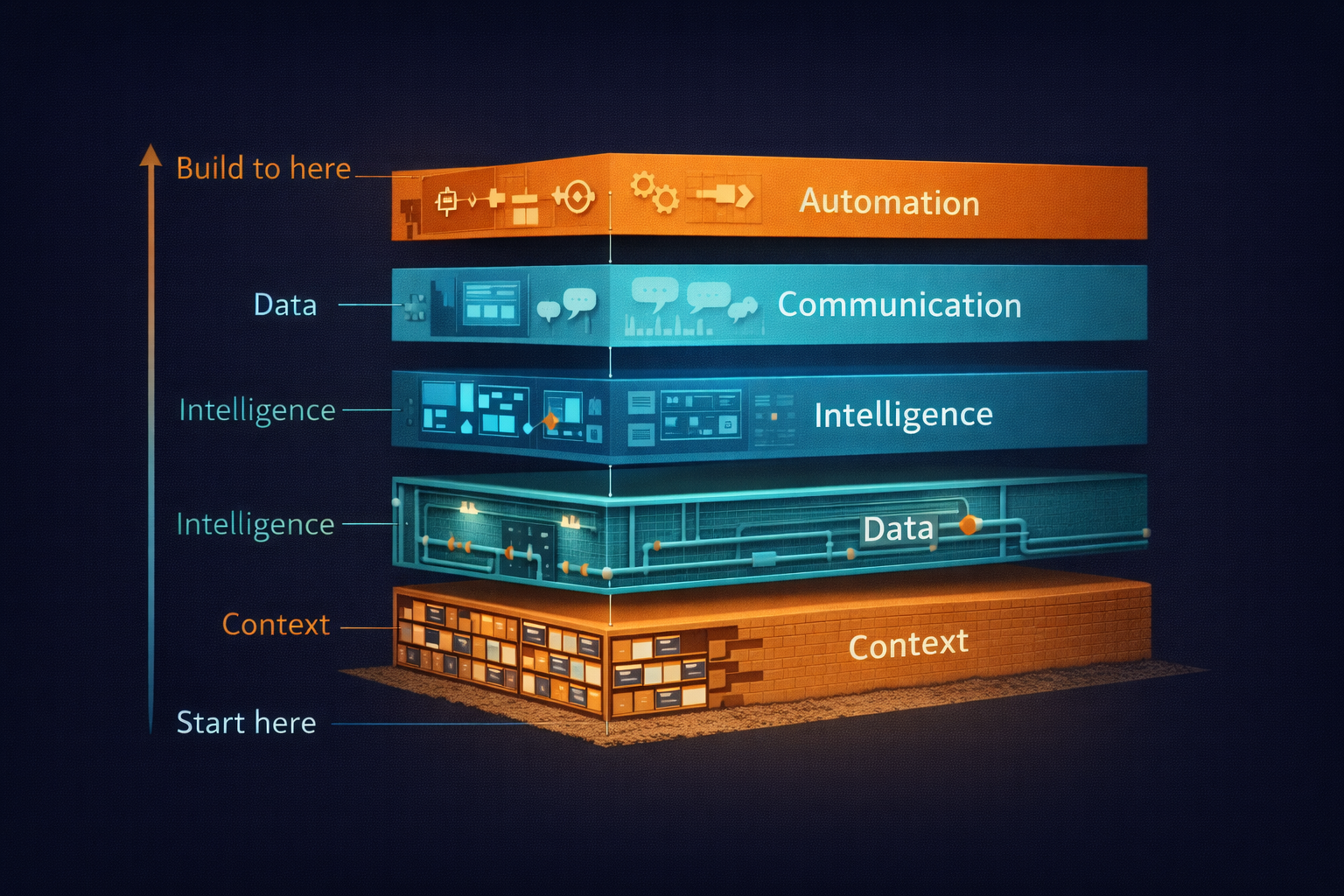
Each layer makes the next one faster and cheaper to build. And you can't skip to layer five without layers one through four — not without buying a tool that collects dust.
Layer 1: Context — The Foundation Nobody Thinks About
Before AI can do anything useful for your business, it has to understand your business. Not your industry in general — your business specifically.
That means documenting things like:
- Your services and how you describe them to customers
- Your pricing rules, including the exceptions
- Your team structure and who handles what
- Your seasonal patterns and scheduling constraints
- The vocabulary your customers use (which is probably different from industry jargon)
Most of this knowledge lives in people's heads. The owner knows it. The office manager knows some of it. The senior technician knows the rest. None of it is written down in a way that a machine — or a new employee — could use.
We wrote a full guide on how to package your business knowledge for AI. The short version: if you had to hand your entire operation to someone tomorrow, what would you need to write down? That's your context layer.
This step isn't glamorous. There's no dashboard, no AI magic, no automation. It's documentation. But it's the single most valuable step in the entire process, because every other layer depends on it.
Layer 2: Data — Connect What You Already Use
The average small business runs on somewhere between eight and fifteen different software tools. A CRM here, accounting software there, a scheduling app, email, maybe a project management board. None of them talk to each other.
Your data is scattered across a dozen apps, and that fragmentation means nobody — human or AI — can see the full picture.
Layer 2 is about connecting those tools so information flows between them. That doesn't mean ripping everything out and starting over. It means building bridges:
- Your CRM talks to your scheduling tool, so new customers automatically get their first appointment
- Your accounting software pulls job completion data, so invoices go out the same day
- A simple dashboard shows you this morning's numbers — jobs scheduled, revenue collected, outstanding quotes — in one place instead of four
This is where most businesses start seeing real value. Not because AI is doing anything fancy, but because the plumbing is finally connected. You can see your business in one view instead of logging into five apps every morning.
If your data is a mess, no AI tool in the world will produce useful results. Clean the pipes before you turn on the water.

Layer 3: Intelligence — AI That Reads the Room
Once you have context and connected data, AI can start doing something genuinely useful: reading the patterns you don't have time to spot yourself.
Layer 3 is automated intelligence — not artificial intelligence in the sci-fi sense, but practical business intelligence customized to your operation:
- A daily summary that tells you what happened yesterday and what needs attention today
- Alerts when something looks off — a sudden drop in booked appointments, a customer who usually reorders every month but hasn't, a crew that's consistently running over on time estimates
- Trend reports that would take you hours to compile manually, delivered to your inbox before you finish your coffee
The key word here is "customized." Generic AI tools give you generic answers. But because you built layers 1 and 2 first, your AI knows that a 20% drop in bookings in March is normal (it's your slow season), while a 20% drop in June means something is wrong.
This is where the layered approach pays off. An AI that knows your context and can see your data produces intelligence that's actually relevant. An AI that has neither just produces noise.
Layer 4: Communication — Meetings That Produce Follow-Through
Every business owner has been in this situation: a meeting happens, good ideas come up, decisions get made, everyone leaves — and then nothing changes. The follow-up falls through the cracks because nobody captured the specifics.
Layer 4 uses AI to close that gap:
- Meeting transcription that captures what was actually said (not what someone remembered to write down)
- Automatic extraction of action items, deadlines, and commitments
- Updates pushed to your project management tool or CRM so nothing gets lost between the meeting and the work
This isn't futuristic technology. Transcription tools exist today that are accurate and affordable. The difference is that with your context layer in place, the system knows that when someone says "follow up with the Johnson project," it can identify which Johnson project, what the last status was, and who's responsible.
Without context, transcription gives you a wall of text. With context, it gives you a to-do list that's already tied to the right customer, the right project, and the right person.
Layer 5: Automation — The End Game (When It's Earned)
This is where most people want to start. Full automation — AI handling intake, routing, scheduling, follow-ups, and exception handling without human involvement.
And it does work. Eventually.
A practical AI setup for a small business can handle an enormous amount of the repetitive operational work that eats up your days. Customer inquiry comes in, gets categorized, gets routed to the right person or handled automatically if it's straightforward. Job completes, invoice goes out, follow-up scheduled. Quote requested, preliminary estimate generated from historical data, sent to the customer within minutes instead of days.
But — and this is the part the AI vendors don't emphasize — this only works when the previous four layers are in place.
Automation without context means the AI doesn't know your business rules, so it makes decisions that don't make sense. Automation without data means it's working blind. Automation without intelligence means it can't spot when something is going wrong. Automation without good communication practices means the humans in the loop don't trust the system and override it constantly.
Layer 5 is the payoff for the patience of building layers 1 through 4. It's not where you start. It's where you arrive.
Why the Order Matters
The 95% failure rate for AI projects isn't a technology problem. It's a sequencing problem.
Businesses buy automation tools before they've documented their processes. They plug AI into data that's scattered and inconsistent. They expect intelligence from systems that have no context about how the business actually operates.
Then when it doesn't work, the conclusion is "AI isn't ready for our business." But AI was never the issue. The foundation was.
Here's what changes when you follow the layers in order:
-
Layer 1 costs the least and reveals the most. Documenting your business context takes a week or two and no special tools. But it immediately shows you where your knowledge gaps are, where processes are inconsistent, and what you'd need to hand off to anyone — human or machine.
-
Each layer reduces the cost of the next. Context makes data integration faster because you know what to connect and why. Connected data makes intelligence setup trivial because the information is already flowing. Intelligence makes communication tools smarter because they have business awareness. And all four layers make automation reliable because the system has everything it needs.
-
You get value at every step. You don't have to build all five layers before seeing results. Layer 1 improves your onboarding for new employees. Layer 2 saves you thirty minutes a day on reporting. Layer 3 catches problems before they become expensive. You're not waiting for a big-bang payoff — you're stacking small wins.
Every business that buys automation before building context and data ends up in the same place. If they'd spent a fraction of the budget on documentation and integrations first, the AI tool would have worked. The AI was ready. The business wasn't.
Where to Start
If you're reading this and wondering which layer your business is on, here's a simple test.
Could you write a two-page document that explains how your business operates — services, pricing rules, team roles, common customer scenarios — clearly enough that a smart stranger could make good decisions on your behalf?
If yes, you have a context layer. Move to data.
If no, that's where you start. Not with a tool, not with a platform, not with a vendor. With a document.
The AI operating system isn't a product anyone sells you. It's a discipline — building the foundation before the walls, the walls before the roof. The businesses that approach AI this way don't make the news. They just quietly get faster, more efficient, and harder to compete with.
One layer at a time.
If you're trying to figure out where your business sits in this framework — or you've already bought the roof and need help building the foundation underneath it — let's talk.
Blue Octopus Technology helps small businesses build AI capabilities that actually work — starting with the foundation, not the hype.
Keep reading
More from the field.
Stay Connected
Get practical insights on using AI and automation to grow your business. No fluff.