
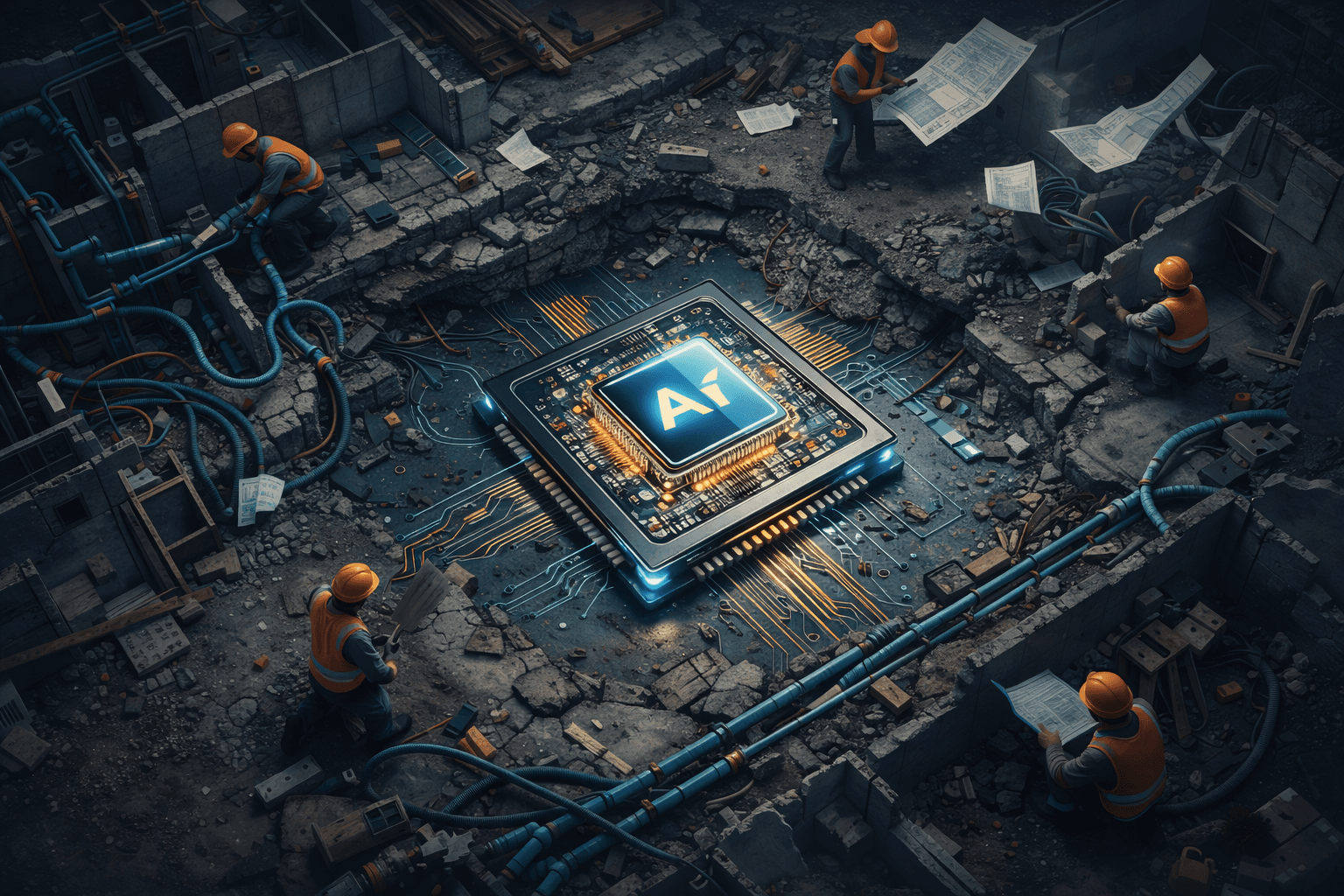
95% of AI Projects Fail — And It Has Nothing to Do With AI
Most businesses that try to adopt AI fail. Not because the technology doesn't work, but because 80% of the real work has nothing to do with AI. Here's what the successful 5% do differently.
A consulting agency that has built AI systems for hundreds of businesses shared a number recently that stopped us cold: 95% of the companies they work with that try to adopt AI fail.
Not 50%. Not "most." Ninety-five percent.
This is from Morningside AI, a firm that has spent three years in the trenches of AI implementation — not selling courses or writing threads, but doing the actual work of making AI function inside real businesses. Their observation lines up with what we see on a smaller scale, and it points to a problem that almost nobody is talking about honestly.
The technology works. It works really well, actually. The failure isn't in the AI. It's in everything around it.
The 80% Nobody Mentions
Here's the insight that changes how you should think about AI adoption: in Morningside's experience, 80% of the work in a successful AI project is not AI work. It's data cleanup. It's mapping existing processes. It's building integrations between systems that were never designed to talk to each other. It's training people. It's change management.
Eighty percent.
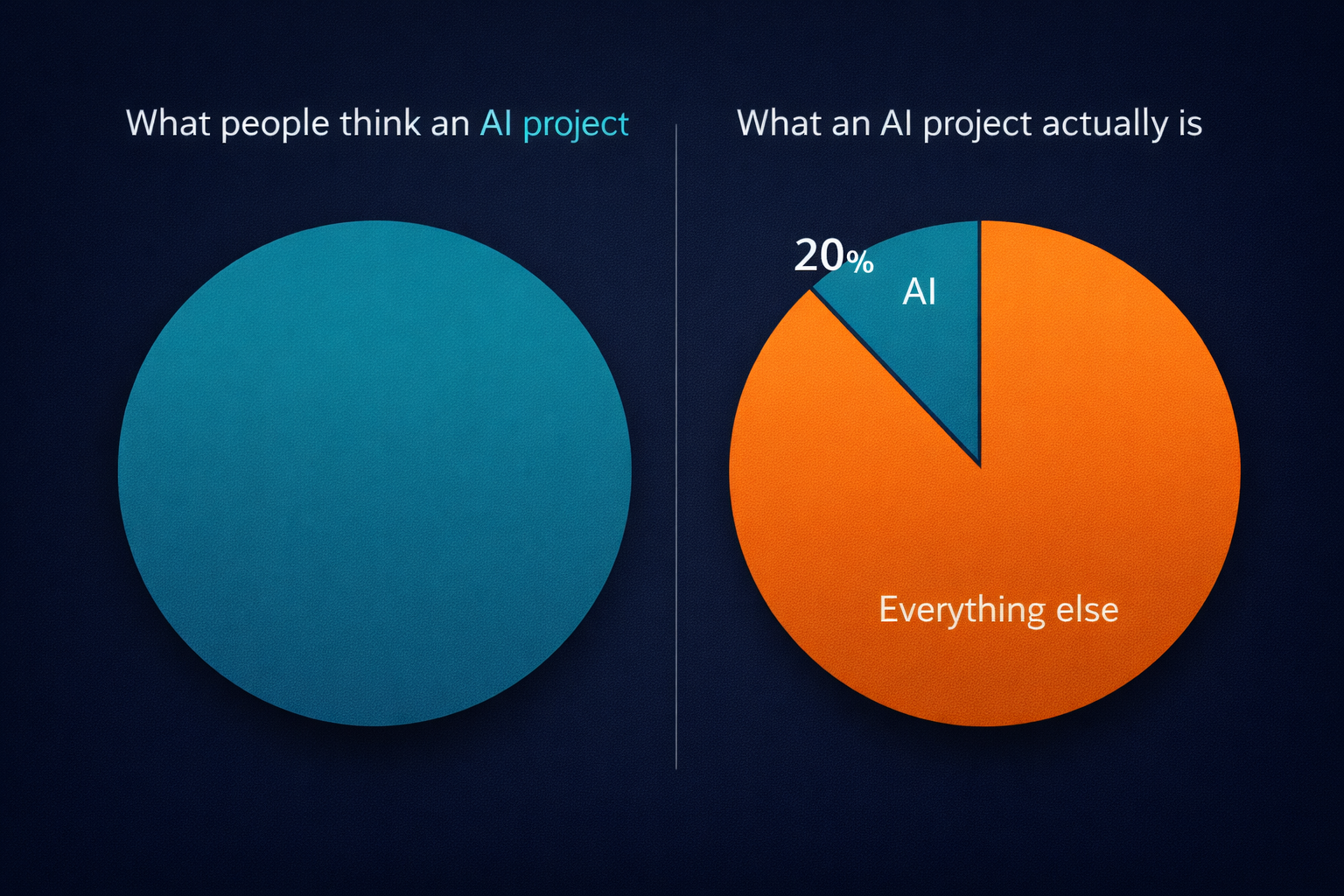
That means when a business owner decides to "implement AI," only one-fifth of the project is actually about artificial intelligence. The other four-fifths is plumbing — connecting pipes, cleaning out the gunk, and making sure water flows where it needs to go.
We wrote about why most AI implementations fail from a project management perspective — the five specific mistakes that kill AI projects. This is the deeper layer underneath all five of those mistakes. The reason businesses start with technology instead of problems, skip user input, underestimate data quality, forget metrics, and treat it as a project instead of a process is the same: they think they're buying AI when they're actually buying organizational change.
What 80% Non-AI Work Actually Looks Like
Let's make this concrete. Say you run a property management company and you want AI to handle maintenance request triage — reading incoming requests, categorizing them by urgency, and routing them to the right vendor.
The AI part of that project is straightforward. Modern language models can read a maintenance request and categorize it accurately. That's a solved problem. A competent developer could have the AI piece working in a day.
Here's what takes the other 80% of the time:
Data cleanup. Your maintenance requests come in through four channels — email, a web form, phone calls that your receptionist logs, and text messages that tenants send to individual property managers' personal phones. Before AI can triage anything, all of those channels need to feed into a single system, in a consistent format. Some of your property managers have been logging requests in a shared spreadsheet. Others use the CRM. One person has been using sticky notes.
Process mapping. Your current triage process lives in the head of your most experienced property manager. She knows that when a tenant at the Oak Street property reports a leak, it goes to Mike because he's the only plumber who has keys to that building. She knows that "urgent" for the commercial properties means four hours, but "urgent" for residential means 24 hours. None of this is written down. Before AI can do the job, a human has to extract these rules and document them.
Integration work. Your vendor management system doesn't have an API. Your CRM has one, but it was built in 2019 and doesn't support the fields you need. Your accounting software needs to create a work order when a request is approved, and it uses a completely different vendor ID format. These are not AI problems. These are plumbing problems.
Training and adoption. Your property managers have been doing triage their own way for years. Some of them are good at it. Telling them that a machine is going to do it now — and that they need to change how they submit and track requests — is a conversation about trust, not technology. If you skip this part, your team will quietly route around the new system within a month.
Ongoing adjustment. The AI categorizes a request incorrectly. A new vendor comes on board. A building changes ownership and the routing rules need to update. Someone needs to maintain this. Who? If the answer is "nobody," the system will degrade until someone turns it off.
That's the reality of AI adoption. The AI is the easy part.

Why the 95% Fail
The businesses that fail don't fail because they chose the wrong model or the wrong vendor. They fail because they underestimate the non-AI work — or they skip it entirely.
They skip the data cleanup because it's boring and expensive. They try to bolt AI onto messy data and get garbage results. We've seen this enough times to write a whole post about it.
They skip the process mapping because they assume their processes are simpler than they are. Every business has invisible complexity — workarounds, exceptions, tribal knowledge that lives in one person's head. AI doesn't know any of it unless someone takes the time to document it.
They skip the change management because they assume good technology sells itself. It doesn't. People resist change, especially when they think the change is designed to replace them. We covered the human side of this in our piece on how AI replaces busywork, not people — but the businesses in the 95% never have that conversation with their teams.
They skip the maintenance plan because the project was sold as a one-time implementation. The vendor built it, delivered it, and moved on. Six months later, the system is making bad decisions because the world changed and nobody updated the rules.
Every one of these is a people problem, not a technology problem.
What the 5% Do Differently
The businesses that succeed with AI don't have better technology. They don't have bigger budgets. They have better process discipline. Here's the pattern:
They start painfully small. Not "let's transform our customer service with AI." More like "let's automate the Tuesday morning report that takes Sarah three hours." One process. One person's pain point. One measurable outcome. Our guide to building your first AI workflow walks through this exact approach.
They do the boring work first. Before any AI enters the picture, they clean up their data, document their processes, and fix the integrations between their existing systems. Sometimes this takes longer than the AI implementation itself. That's fine. The boring work is the foundation. Without it, the AI has nothing solid to stand on.
They involve the people who do the work. Not just as testers after the system is built — as designers from the beginning. The receptionist who handles maintenance calls knows things about the process that no manager does. The bookkeeper who categorizes expenses has built shortcuts that no one else understands. These people aren't obstacles to automation. They're the experts.
They plan for maintenance from day one. Who reviews the AI's decisions weekly? Who updates the rules when something changes? Who is the person that gets called when the system does something weird? If these questions don't have answers before launch, the project is already on the path to the 95%.
They measure before and after. Not feelings. Numbers. How many hours did this task take before? How many now? How many errors? What's the cost per transaction? Real business metrics, not vibes. When the numbers show a win, they expand. When they don't, they adjust or stop.
The Uncomfortable Implication
If 80% of AI work is non-AI work, then the value of an AI consultant isn't in knowing AI. It's in knowing how businesses operate — how data flows, how people work, where the invisible complexity hides, and how to manage the change when you rearrange it all.
That's why the AI agency market is so uneven. Plenty of people can connect an API to a chatbot. Very few can sit with a business owner, understand what their operation actually looks like on a Tuesday morning, and design a system that fits the reality instead of the sales deck.
This is also why starting with the problem instead of the technology matters so much. The businesses in the 5% didn't start by asking "how can we use AI?" They started by asking "what's costing us the most time, money, or frustration?" Sometimes the answer involved AI. Sometimes it didn't. Either way, they solved the actual problem.
What This Means for You
If you're thinking about AI for your business, here's the honest version:
The AI part will probably work. The models are good. The tools are mature. The costs are reasonable. That's no longer the hard part.
The hard part is everything else. Cleaning up your data. Documenting your processes. Getting your team on board. Building the integrations. Planning for ongoing maintenance. Doing the unglamorous work that makes up 80% of a successful implementation.
If you're willing to do that work — or hire someone who understands that the work needs doing — you can be in the 5%.
If you're looking for a magic button that transforms your business without changing how your business operates, you'll be in the 95%. Not because the technology failed you, but because technology was never the problem.
Blue Octopus Technology builds AI systems for businesses that are ready to do the real work — not just the AI work. If you want to be in the 5%, start with a conversation.
Keep reading
More from the field.
AI Agents on a Budget: A Cost Optimization Guide for Small Businesses
Read AI Strategy & Business DecisionsYour Business Needs an Intelligence System, Not More Bookmarks
Read AI Architecture & MethodologyThe Agent Complexity Trap: Why Your Business Needs Level 2, Not Level 5
ReadStay Connected
Get practical insights on using AI and automation to grow your business. No fluff.