
What Golf Broadcasts Just Taught Us About 3D Capture for Client Work
56 iPhones. Private 5G. A 24-hour turnaround. The 2026 PGA Championship aired live Gaussian Splatting of pro golfer swings — and the production write-up is the most honest tour of the new 3D capture economy we've read. Here's what it changes for the rest of us.
The director was skeptical. He'd been told he was going to look at 3D videos of professional golfers, and the words "3D video" don't mean what they used to. He'd seen them. They were always almost right and always a little wrong.
Then he watched the playback. Pro golfer, mid-swing, suspended in space — and he could fly the camera around it. From any angle. At any speed. From a fixed point in the corner of the room, slowed to one-quarter speed, watching the wrists rotate through impact. The kind of analysis a coach pays thousands of dollars and a week of motion-capture work to get, except this was the actual broadcast, captured at a live tournament that morning.
That moment is described in a long, technical write-up from Radiance Fields, the trade publication of record for the new 3D capture industry. The shoot was the 2026 PGA Championship at Aronimink Golf Club. The crew was Radiant Images and Gracia.ai. The pipeline aired on the T-Mobile-sponsored broadcast.
It's the cleanest production write-up of a Gaussian Splatting shoot we've seen, and it answered three questions we've been chewing on for a while. We've been running our own splat pipeline on the side — small scale, single operator, Cybertruck-in-a-parking-lot — and it's been clear the technology is real but the commercial shape of the work was still developing. The PGA shoot makes the commercial shape visible.
The rig is iPhones
This is the part that broke our priors hardest.
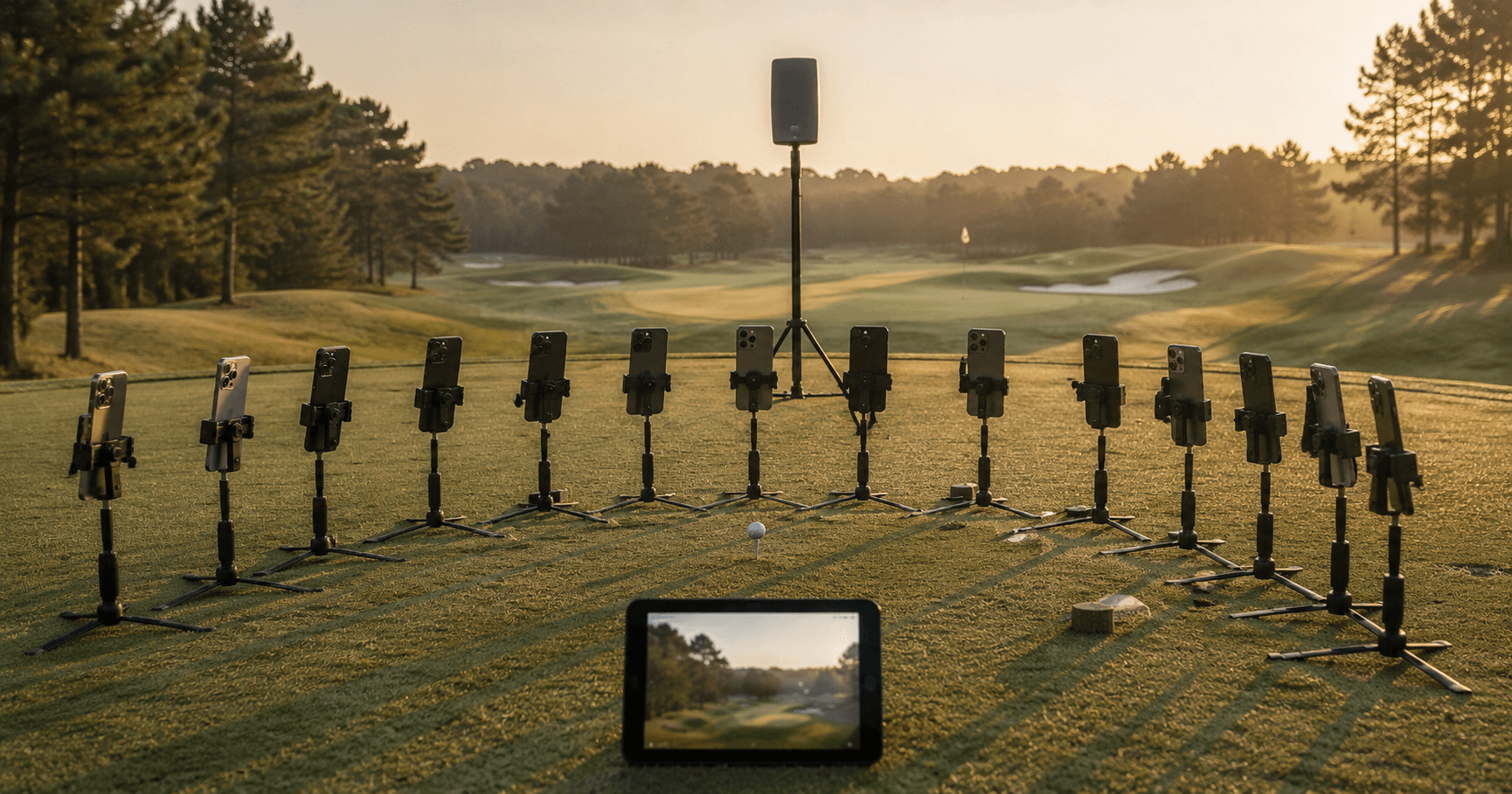
When the team showed up at 5:30 AM on shoot day, they were carrying 56 iPhone 17 Pros.
Not a single broadcast camera. Not a custom volumetric-capture array. Not a million-dollar motion-capture rig. iPhones, off the shelf, networked together. The reason: the iPhone 17 Pro has genlock support (synchronized frame timing across cameras) and a vapor chamber (which means it doesn't thermally throttle during sustained ProRes RAW capture). Those two specs make it the cheapest production-grade synchronized camera you can buy, and they're the specs nobody talks about because they read like footnotes.
Capture format: ProRes RAW, 4K Open Gate, 60 frames per second. Across four golfers and a morning's work, the rig generated about 20 terabytes of raw footage.
The other piece of the hardware story: no cable bundle. A conventional 56-camera array runs hundreds of feet of cable between cameras and a switching center, and moving the rig means breaking that down and rebuilding it — hours of work. Radiant networked all 56 cameras over a private 5G connection (T-Mobile Business is the sponsor partner, and the 5G backhaul is the actual product). Repositioning the rig takes about ten minutes. Untether the rig and the network goes with it.
For anyone still running cable in 2026: this is what private 5G enabled. The cameras stayed where they needed to be. The cable economy died on the floor of Aronimink Golf Club.
The pipeline is on-device
The other thing the conventional production playbook says: download all the footage, sync it, trim it, color-grade it, transcode it, then start the 3D work. The math gets ugly fast. Two hours minimum per ten-second clip in that flow, multiplied by four golfers and roughly 240 seconds of usable swing footage each, before you've even started offloading 20 TB.
Radiant's workaround is the move that's going to ripple through every multi-camera production over the next two years.
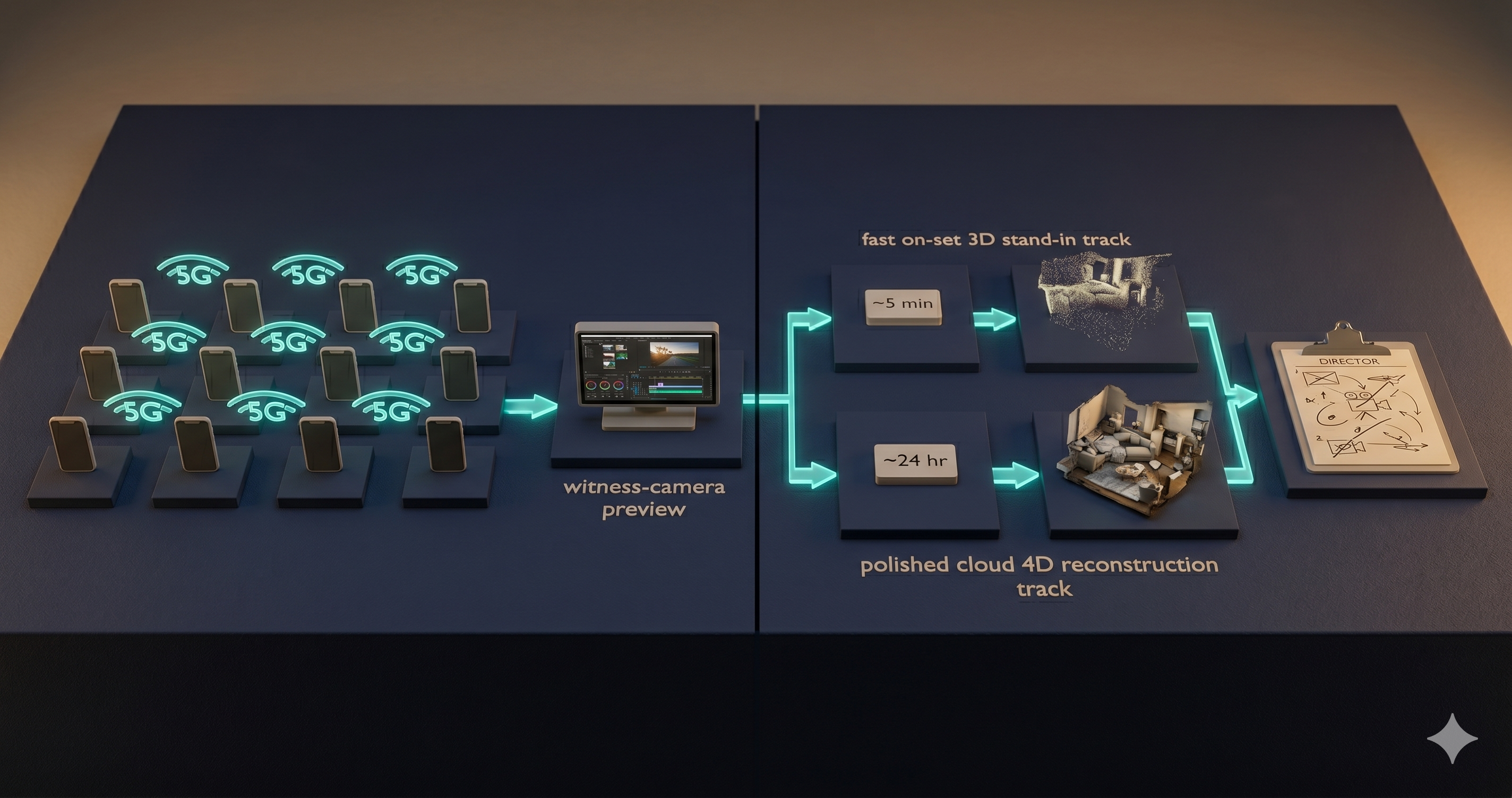
Each of the 56 iPhones runs a proprietary app. After the operator gives a single in/out command on a controller, every phone independently trims, rotates, color-grades, and transcodes its own clip. A low-bitrate witness camera streams playback to the operator in real time, so the team can pick selects on set instead of in post. The high-bitrate ProRes RAW stays on the phone until the cut is approved.
In a 5 GHz Wi-Fi shop test, this step took about ten minutes. In the field over private 5G, it ran closer to five. All four golfers delivered to Gracia.ai's cloud processor — the company that builds the 4D Gaussian Splatting pipeline — in about twenty minutes of total handoff time.
This is the same architectural move we've been writing about for two years in the AI context space: the work goes to where the data lives, not the other way around. Edge processing, on-device trimming, witness cameras for human-in-the-loop curation. The pipeline isn't faster only because it's parallel. It's faster because the data never had to move anywhere it didn't need to be.
The reconstruction is 24 hours
Gracia receives the clips. Gracia produces the 4D Gaussian Splat reconstructions. From receipt to deliverable: about 24 hours.
That's enough time for the director to design camera moves against the result. Almost. The director's actual problem is that the network broadcast goes live in a fraction of that window, and he needs to know what to do with the captures before the splats come back from Gracia. So Radiant added a second pipeline that runs on set:
For every approved take, they pull a single frame from the 56-camera rig and run a normal 3DGS reconstruction immediately — same machine, same operator, no cloud round-trip. The output isn't airworthy. It's a stand-in. But it's a 3D stand-in, with all the camera positions locked in correctly, and the director can design camera moves against it. When the polished 4DGS comes back from Gracia 24 hours later, the camera moves drop in clean.
Nine iterations of camera work got locked in this loop before the cloud version of any of the four golfer takes arrived. The on-set 3DGS doubles as a validation step: if it builds cleanly, the genlock held and no cameras were lost. If it doesn't, you find out while the golfers are still on site, not the next day.
This pattern is going to spread to every multi-camera production in 2026. Two pipelines, one on set, one in the cloud, both producing 3D scenes, the on-set one as a stand-in for the cloud one. The on-set machine never stops running.
The 4DGS is not 60 fps
The piece that broke our intuition: a 4DGS reconstruction isn't a sequence of 60 separate 3DGS reconstructions per second. That's what we assumed it would be — frame-by-frame 3D, like a flipbook of 3D pages.
It isn't. A 4DGS reconstruction is a single set of Gaussian primitives, each with a velocity and a direction. The same splats move through the scene over time. Position evolves; the splats themselves don't get regenerated.
This matters because once you have splats with motion attached, you can ramp the speed. Slow them. Speed them up. Stop them. The original capture was 60 fps. Some of the broadcast pieces are slowed to 240 fps (four times slower than real time). Some are 120. Some are freeze-frames in the middle of a swing with the camera dollying around the still pose.
A coach watching this — pause on the moment of impact, walk around the golfer at hip height, look at how the leading hip is rotated, look at how the trailing foot is loaded — is doing the kind of analysis that used to require a motion-capture suit and a dedicated session.
The production direction here, the one we want to underline: Radiant pitched this to PGA and T-Mobile as performance analysis first, fan spectacle second. Not "watch the pros from any angle for fun." Watch the pros from any angle to learn from them. The fan view is the layer on top. The defensible value is in the coaching room.
We wrote a companion post on why this positioning move is the one we're going to steal.
The background is one drone window
The other piece worth knowing: the rig captures the golfer. It doesn't capture the course. For the course, Radiant had less than ten minutes of allowed drone time, with other crews working the same airspace and live balls in the air.
A 360-degree drone wasn't on the FAA-cleared list for the event. A standard drone was, but only for a brief window — not enough for a full reconstruction-grade flight. So they used XGRIDS PortalCam, a handheld scanner, to scan the surrounding environment from ground level during the sunset before the shoot day. Player captures the next morning. Final composite produced in Postshot, with rotated environment scans aligned by shadow direction to the player positions.
That's the part of the pipeline most relevant to our work. We don't have an FAA cleared event. We have a drone (Mavic) and an Insta360 and a willingness to walk a course before the customer signs the contract. The two-pipeline pattern — capture the subject one way, capture the environment another, composite — is exactly the workflow for our golf flyover offering for course architects and small broadcasters.
We are not going to compete with Radiant. We are not going to put 56 iPhones on a tee box. We are going to take the shape of their pipeline — separated subject and environment captures, on-set 3DGS as stand-in for cloud 4DGS, performance analysis as the positioning frame — and run it at the scale of one operator with consumer gear for the part of the golf market that doesn't have a $200K production budget.
What changes for the rest of us
The 56-iPhone tee box is not the news. The news is what the 56-iPhone tee box rules out:
Multi-camera arrays no longer require multi-camera-array vendors. If you can put 56 phones on a stand and they all sync, the rig isn't a moat. The pipeline is. Specifically: the witness-cam-curated on-device processing pipeline is the moat. That's the part that took Radiant years to build.
The 24-hour cloud turnaround sets a customer expectation. Once a production studio learns the words "we can have the 3D back to you tomorrow," every adjacent vendor has to compete with that. The five-day quote dies. (We can hit 24-hour turnaround for single-operator subject captures, and we're going to make that explicit in proposals.)
The on-set stand-in pattern is a transferable architectural move. It applies to every production where the cloud step is slow but a "good enough" local step is fast. Construction documentation: on-site rough scan stands in for the cloud-processed scan tomorrow. Real estate showings: on-site rough scan stands in for the polished walkthrough later in the week. Engineering inspection: on-site rough scan stands in for the dimensional analysis the next day. The pattern is everywhere once you see it.
Performance analysis is the wedge into industries that wouldn't have bought a "tour." Coaches buy what they couldn't get from video. Construction documentation buyers pay for what they couldn't get from photos. Real estate buyers pay for what they couldn't get from a virtual tour. The new 3D capture isn't a better photo. It's a measurement instrument that happens to look photographic. We have a separate post on AprilTag-scaled splats about turning that measurement angle into a sellable line item.
The honest part
The PGA shoot was good. It was professionally executed by people who have been thinking about volumetric capture for years. Most clients will not need to compete with that level of production.
Most clients need a 3D capture of their property, their event, their installation, their product on a turntable — small in scope, fast to deliver, embeddable on the web. The PGA work proves the upper bound is real. The market we operate in is the lower 95% of the market that isn't going to put 56 iPhones on a tripod but will pay for the workflow that scales down from it.
Two pipelines (on-set + cloud), single subject (the asset), single operator (us), one workflow (the cybersplat pipeline we just published), priced for businesses that don't write quotes in six figures.
If you operate a venue, a property, an event, or a piece of equipment that would benefit from being a navigable 3D scene rather than a folder of photographs, get in touch. We have a pipeline now. We're looking for the right first customer to ship a production deliverable for.
Related reading:
- Cybertruck to Walkable 3D Model in Two Hours: What We Just Shipped — our own end-to-end run of the pipeline at single-operator scale
- Performance Analysis Beats Spectacle: The 3D Capture Positioning Pitch We're Stealing — the deeper positioning unpacking
- AprilTag-Scaled Gaussian Splatting: Photo-Realistic 3D With Real-World Dimensions — adding metrology to the visual-fidelity story
- Walkable Splats: 418KB Makes Any 3D Scene a Video Game — the navigation layer that completes the deliverable
Stay Connected
Get practical insights on using AI and automation to grow your business. No fluff.