
AprilTag-Scaled Gaussian Splatting: Photo-Realistic 3D With Real-World Dimensions
Put a $50 printed paper tag in your shot. The photo-realistic 3D model you get back is dimensionally accurate to within a centimeter. This is the move that turns Gaussian Splatting from a marketing artifact into a measurement instrument — and opens an entire offering vertical we couldn't sell two months ago.
A Japanese 3DGS researcher who goes by kotohibi released a small tool this month that solves the biggest unsold problem in Gaussian Splatting.
The unsold problem: a splat is a picture of a thing, not a measurement of it. If you scan a building, the splat looks like the building, but it doesn't know how tall the building is. There's no scale. Doors might be six feet or fifty feet, the math doesn't know. Any time you've seen a splat-based "tour" or "marketing piece," it's been visually impressive and dimensionally meaningless.
That's been fine for marketing. It's been useless for anything operational. Engineering, inspection, insurance, surveying, fabrication, real estate appraisal — the buyers with the deepest pockets in 3D scanning all need measurable models, and Gaussian Splatting hasn't given them one.
Until this month.
The trick is a paper square
An AprilTag is a piece of paper. A printed black-and-white square with a specific pattern on it — the AprilTag library, developed at the University of Michigan around 2011, is the open-source workhorse of robotics and augmented reality computer vision. Robots use AprilTags to localize themselves in factories. AR glasses use them to anchor virtual overlays to real surfaces. The library is mature, free, and has been deployed in millions of devices.
What kotohibi's tool does is treat the AprilTag as a unit of measurement. The user puts a tag of known size — say, 25 centimeters on a side — somewhere in the scene during capture. The tag shows up in some of the splat training images. After the splat is trained, the tool detects the tag in the trained scene, measures how big the tag is in the splat's internal coordinate system, and computes the scale factor needed to convert splat-units into centimeters.
Apply that scale factor to the entire splat. The whole scene is now dimensionally accurate. Doors are however many centimeters tall they actually are. Distances between two points in the scan match distances between the same two points in reality.
The cost: one paper tag in the shot. The accuracy: subject to the resolution of the splat itself, sub-centimeter on real-world objects within a few meters of the tag. The work: about ten seconds of post-processing math after the splat finishes training.

What this unlocks
The deliverable shape changes. We've covered the single-operator splat pipeline and the navigable-environment layer. Add an AprilTag to the capture and the same deliverable becomes:
An industrial measurement tool. A 3D scan of a piece of equipment, dimensionally accurate, that an engineer can take measurements off of in CAD. A fabricator can use it to model replacement parts. A maintenance team can use it to plan an upgrade.
A construction documentation tool with appraisal-grade backing. Every milestone scan is now a measurable record. Disputes about as-built dimensions can be settled by opening the splat and measuring. An insurance adjuster can use it as the dimensional reference for a claim.
A real estate listing with appraiser-grade measurements. The listing scan includes the AprilTag in a foundation corner or a closet floor. The same scan that buyers browse is what the appraiser pulls measurements from. The 3D tour and the appraisal data come from one capture session.
A surveying capture for situations a total station can't reach. Industrial piping interiors. The undersides of bridges. The cluttered backs of equipment installations. Mining and tunneling work. Anywhere the surveying gear can't physically fit, but a drone or a handheld camera can.
The new buyer profile here is the engineer, the inspector, the appraiser, the fabricator — not the marketing department. Different budget. Different sales motion. Different price point.
Why this is a different sale
A marketing splat is a discretionary purchase. The buyer wants something cool. The price is whatever feels right for "cool."
A measurement-grade splat is replacement spend. The buyer is already paying someone — a surveyor, an engineer, a CAD modeler — to produce dimensional data about the same physical asset. The pitch isn't "buy this new thing." It's "replace that line item on your operating budget with a faster, cheaper, more visually informative version of the same data."
That's a different conversation. It happens at the project budget level, not the marketing slush fund. It's recurring (every project needs the dimensional data again). It's defensible (the buyer can audit the savings against the previous spend).
We unpacked the underlying positioning move in last week's piece on Performance Analysis vs Spectacle. The AprilTag layer is what unlocks the performance-analysis sale specifically in the measurement-grade category.

The use cases we're actively pitching
We are deliberately not going after the high-end engineering scanning market in this first wave. Companies that already buy Leica BLK or FARO scanners are not the right early customer for us. Those buyers have an existing tool, an existing workflow, and a deep skepticism of any new vendor that hasn't shipped 100 projects.
Our first wave is the part of the market that should have measurement-grade 3D scanning but currently doesn't, because the existing tools are too expensive or too operationally heavy for their project scale.
Industrial piping documentation. A reply to kotohibi's release post explicitly raised this case — "could this enable real-scale 3DGS of industrial piping with accurate measurements?" The answer is yes. A facility with miles of process piping has every reason to need a dimensional scan and almost no practical way to get one short of a full survey crew. We can produce one with a 360-degree camera, a drone, a couple of AprilTags on accessible elbows, and a Tuesday afternoon.
Custom fabrication QA. A small custom shop — metal fabrication, woodworking, prosthetics, anything where a one-off product is shipped to a customer — can use the same capture to verify dimensional conformance to spec and generate a marketing-grade visual asset. One scan, two deliverables.
Mid-tier surveying for situations the total station can't reach. Asphalt overlay projects. Yard layout work. Equipment placement in industrial sites. Anywhere a property owner needs a measured layout and the existing surveying option is overkill or geometrically inaccessible.
Real estate inspection documentation. A pre-purchase inspection scan that's both navigable (for the buyer) and measurable (for the lender's appraiser). Two outputs from one capture; the AprilTag is the bridge that turns one into the other.
Insurance claim and dispute resolution. A measured snapshot of a property at the moment of a claim, or a measured before/after pair documenting damage. The dimensional accuracy is what makes the scan admissible as evidence in a way an unscaled splat isn't.
The pricing for these jobs is on the order of $1,500 to $5,000 per single-asset capture, depending on scope and accuracy requirements — comfortably below what a survey crew would bill for the same dimensional data, comfortably above what a "3D tour" pricing model can support. It's the right margin band for a small specialized firm.
How we do it
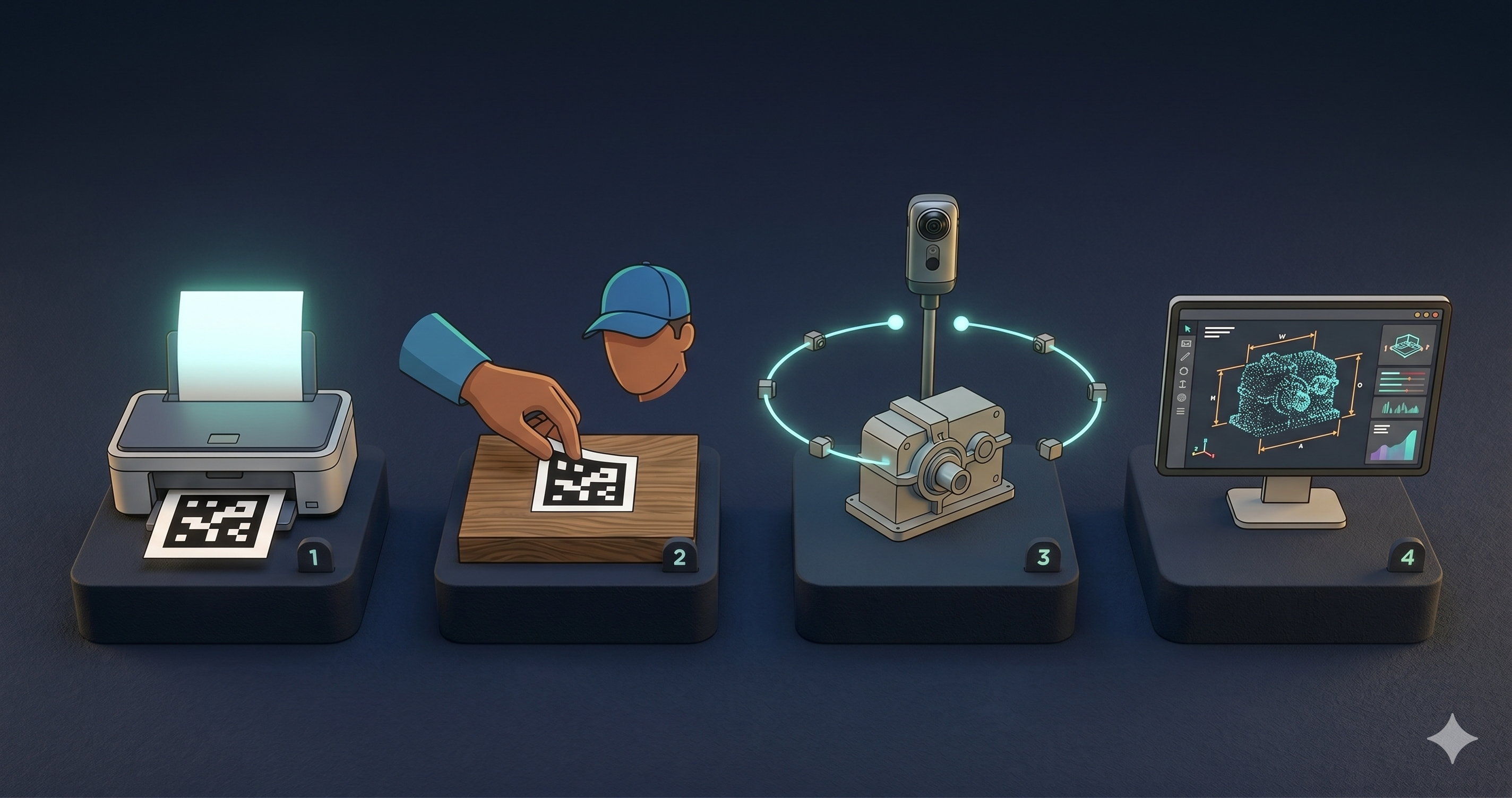
The capture protocol is short. Here's the version we now write into every scope of work:
Step 1: Print one or more AprilTags of known size. We use 25 cm tags for indoor and small-asset work, 100 cm tags for buildings and yards. Standard printer paper, glossy stock, mounted on a rigid backing. AprilTag library tag36h11 family.
Step 2: Place tags strategically in the capture area. At least three tags spread across the scan, with at least one tag visible in any given capture orbit. Tags should be on flat, non-reflective surfaces (paper on metal is bad; paper on a foam-core panel is good). Tags in shadow are fine; tags in direct overhead sun get glare and become unreliable.
Step 3: Capture as normal. The cybersplat pipeline runs unchanged. The tags get included in some of the training images; the splat trains them as part of the scene.
Step 4: Run the rescaling pass. Tool detects the tags in the trained splat, computes the scale factor from tag size in splat-units to known real-world size, applies the factor to the entire scene. The output is the same .ply file as before, with every coordinate now in centimeters or meters.
Step 5: Verify against ground truth. We include at least one known-distance measurement in the scene — a tape measure on the ground, a marked-out 1-meter calibration line, a vehicle of known wheelbase — and compare it against the scan's reading. Sub-centimeter accuracy is the target. If we're off, we either re-scan or document the deviation as a known limitation of that particular capture.
The whole protocol adds about ten minutes of work to a standard capture session. The deliverable becomes a dimensionally accurate 3D scene. The price point doubles or triples.
The honest part
A few caveats worth naming up front:
Sub-centimeter accuracy holds within a few meters of the tag. Farther from the tag, accuracy degrades as splat-density drops. For building-scale work, place multiple tags spread across the structure to maintain accuracy at distance.
Reflective surfaces are still the weakest case. Stainless, chrome, water, glass — these are the splat's hardest reconstruction conditions, and dimensional accuracy on those surfaces will be lower than on matte surfaces. Match the spec to what's actually scannable.
This isn't a substitute for a Class I survey. Legally and contractually, a Class I survey is what gets accepted in property boundary disputes and major construction approvals. An AprilTag-scaled splat is a supplementary tool for the use cases between "I need a rough measurement" and "I need a legally surveyed boundary."
The tool is brand new. kotohibi released it this month. The first commercial deployments are happening right now. Specific tooling will mature over the next 12 months; the underlying technique (AprilTag-based scale recovery in computer vision) is two decades old and well-understood.
Where we go from here
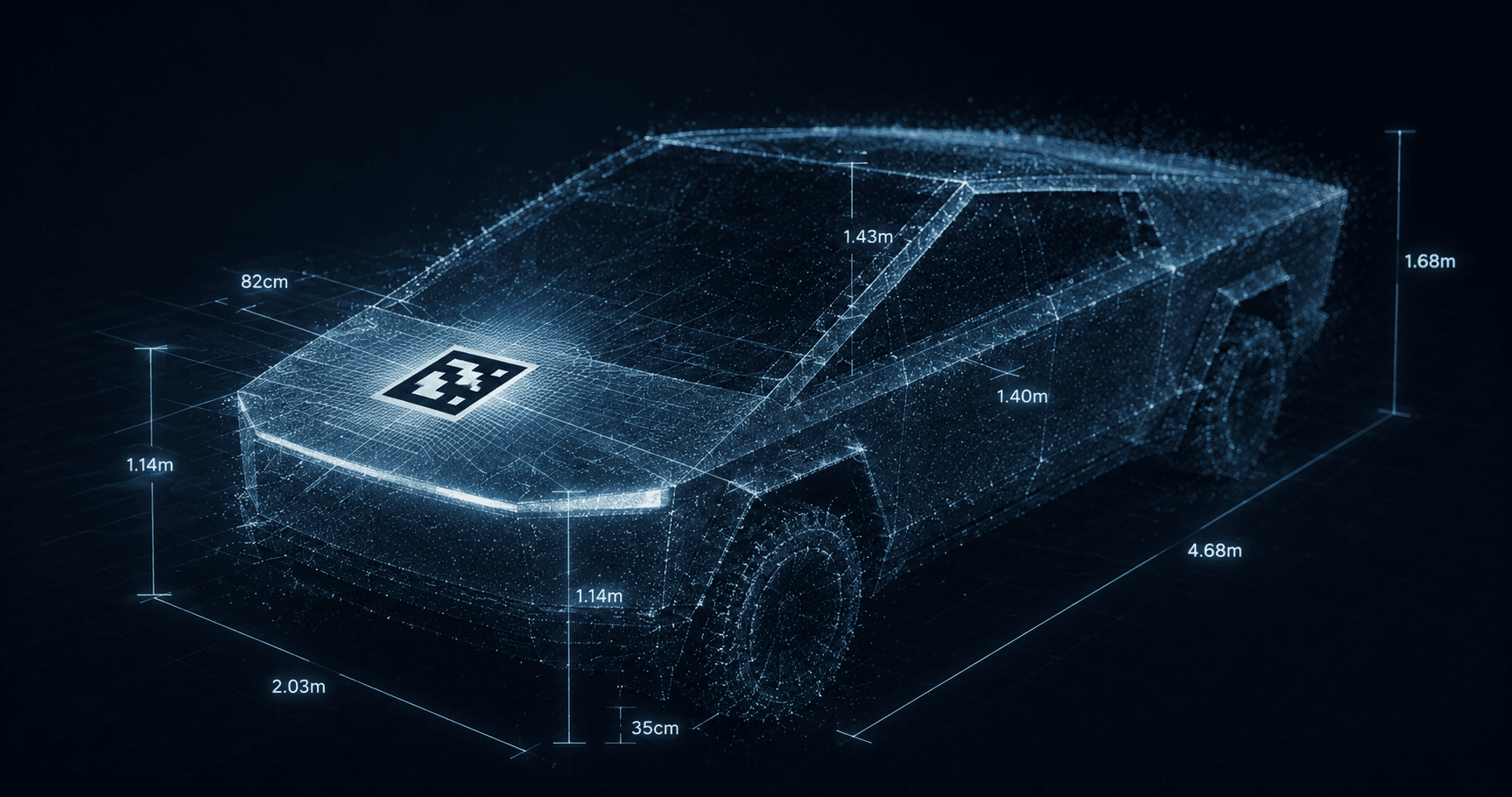
We're producing a dimensionally accurate version of the Cybertruck capture from last week as our first internal proof. The tag goes on the hood. The output should give us a Cybertruck splat where every panel measurement matches Tesla's published spec sheet to within a centimeter. If it does, that becomes the demonstration asset for our first metrology pitch.
After that, we're pursuing two customers: a custom fabrication shop and an industrial site with documentation needs. Both are local to Western North Carolina, both fit the "underserved by existing surveying" pattern, both are small enough to be a fast yes-or-no on a single conversation.
If you operate a business that pays for dimensional documentation of any kind — engineering scans, surveying, fabrication QA, inspection records, claim documentation — and you'd like to talk about replacing or supplementing that line item with a measured 3D capture, get in touch. The pipeline is real, the tool is real, and we're looking for the right early projects to validate the offering on.
Related reading:
- Cybertruck to Walkable 3D Model in Two Hours: What We Just Shipped — the underlying splat pipeline this metrology layer adds onto
- Walkable Splats: 418 KB Makes Any 3D Scene a Video Game — the navigation layer that pairs with the measurement layer for inspection workflows
- Performance Analysis Beats Spectacle: The 3D Capture Positioning Pitch We're Stealing — why the measurement angle sells where the visual angle doesn't
- What Golf Broadcasts Just Taught Us About 3D Capture for Client Work — the production benchmark that anchors the new 3D capture category
Stay Connected
Get practical insights on using AI and automation to grow your business. No fluff.