
Walkable Splats: 418 KB Makes Any 3D Scene a Video Game
The single most important update PlayCanvas shipped this month is a tiny one. A 418-kilobyte file that turns any Gaussian Splat from a thing you can look at into a thing you can walk through — with no extra capture, no extra training time, no extra cost. Here's why that matters.
The PGA Championship shoot we wrote about last week was the headline-grabbing 3D capture story of the month. Buried in the same news cycle was a much smaller release from PlayCanvas, and for the rest of us — the part of the market that isn't running a 56-iPhone array — it's the more important one.
PlayCanvas shipped voxel collision generation in SuperSplat, their open-source Gaussian Splat editor. The update was a tweet from Will Eastcott, the PlayCanvas CEO. It's six sentences long, and you could miss what it actually means.
Here's what it means. Up until this month, a Gaussian Splat was a thing you looked at. You could spin a camera around it. You could fly through it. You could pause it. But you could not walk through it, because a splat is a cloud of fuzzy 3D blobs and a cloud of fuzzy 3D blobs has no surfaces. If you tried to put a navigable avatar into the scene, the avatar would fall through the floor or pass through the walls. There was nothing for the avatar to bump into.
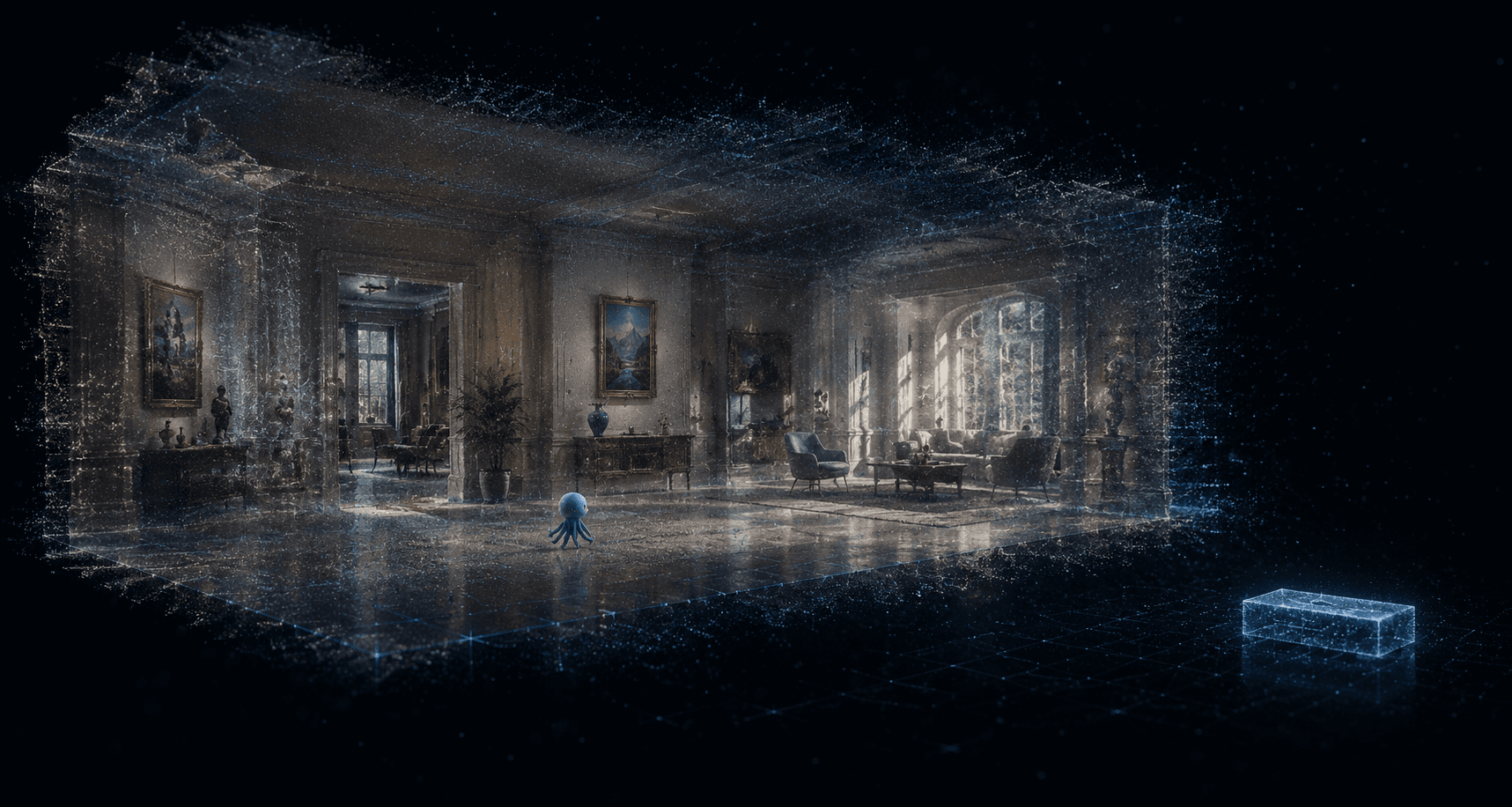
This month's update changes that with a single command. SuperSplat now takes any splat and generates a voxel collision representation of it — a low-resolution grid of small invisible cubes that line up with the splat's actual geometry, providing collision data for any navigation system that wants it.
The size of this file, for a typical scene: about 418 kilobytes. The splat itself, for the same scene, is roughly 30 megabytes. The walkability layer adds under 2% overhead.

Why it matters
This is the difference between publishing a 3D photograph and publishing a navigable environment. In delivery terms, those are different products at different price points to different buyers.
A 3D photograph is what we've been selling. The buyer looks at it. Maybe they orbit. Maybe they zoom in on a detail. Then they're done. It replaces a photo gallery or a virtual tour video. The value is in the visual fidelity, which is real but bounded — the buyer has been "looking at" 3D scenes for two years, the novelty is gone, the market clearing price is settling.
A navigable environment is a different thing entirely. The buyer enters it. They walk through it. They interact with it. They invite a colleague into it. The deliverable becomes a space the buyer's business operates in, not an artifact the buyer's business has on file.
The same 30 megabytes of splat data, with a 418-kilobyte addition, becomes:
- A real estate listing the buyer can walk through on their phone — pausing on appliances, opening rooms, returning to the kitchen — instead of clicking through a photo carousel.
- A wedding venue the couple can tour from their living room — with the planner joining them in the scene, pointing at where the ceremony arch would go.
- A construction site the owner can revisit at every milestone — walking the same path each time, comparing the current state to the previous month's scan.
- A retail store the buyer's friend can join, two people in the same 3D space, deciding which booth they're meeting at.
We've covered the single-operator pipeline that produces the underlying splat. The 418-kilobyte addition is the deliverable shape change that justifies a different price point.
How it works (briefly)
Voxel collision is the simplest possible 3D collision system. The scene is divided into a 3D grid of small cubes (the default in SuperSplat is 5 centimeters per side). For each cube, the tool checks: is there enough splat density in this region of space to count as "solid"? If yes, the cube is marked as a collision volume. If no, the cube is empty.
The avatar's physics engine treats those marked cubes as immovable obstacles. The avatar walks on top of cubes, can't pass through them, and gets blocked by walls.
Voxels are unfashionable in high-end real-time graphics — they're a 1990s solution to a 1990s problem — but they're exactly right here for three reasons.
First, they're cheap to compute. PlayCanvas generates the entire voxel grid on the GPU in seconds.
Second, they're cheap to store. A scene that occupies 30 MB of splat data fits its entire collision grid in under half a megabyte.
Third, they're forgiving. The splat itself, especially on first-pass training, often has a few floating splats outside the actual geometry — small visual artifacts that would confuse a more precise collision system. The voxel grid quietly absorbs those. The avatar walks past the artifacts and they don't matter.
This is the same engineering pattern as MP3 audio compression: a slightly lossy representation that's dramatically cheaper than the alternative, with losses calibrated to be imperceptible to the user. Voxel collision is splat-walking's MP3.
The companion piece: the walkthrough cam
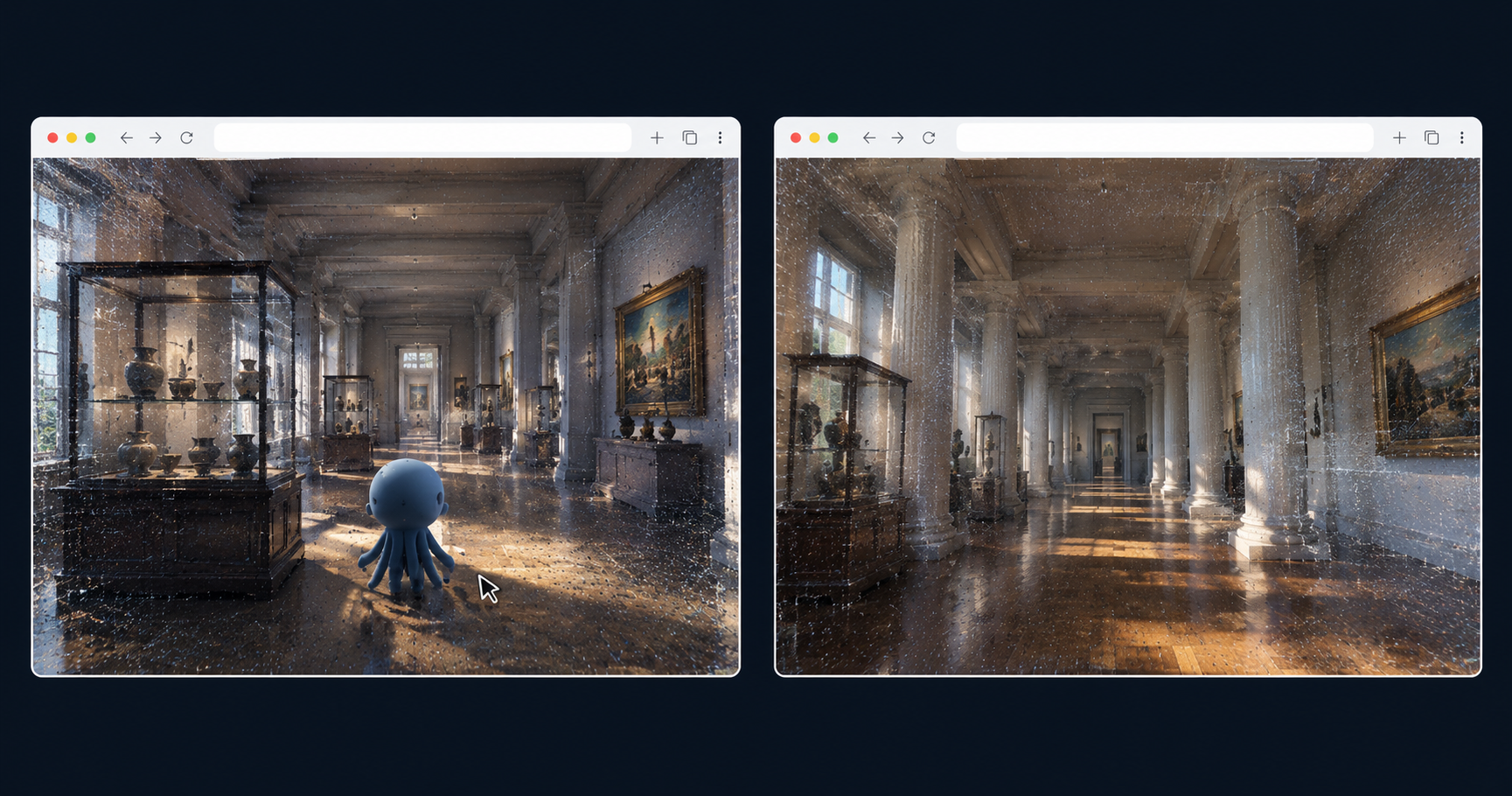
A voxel collision system on its own does nothing without a camera controller to drive an avatar through it. The same week PlayCanvas shipped voxel collision, Martin Valigursky — also on the PlayCanvas team — shipped a reusable third-person walkthrough camera controller designed for exactly this case.
The features are short enough to list:
- Mouse orbit (rotate the camera around the avatar)
- Wall-collision avoidance (the camera doesn't clip through walls; it slides along them)
- Scroll-wheel zoom (closer / farther)
- Animations (the avatar walks, idles, occasionally does a small dance — the last part is gratuitous and we love it)
- Shadow catcher (the avatar casts a soft shadow on the floor; the rest of the scene's lighting is from the splat)
He demonstrates it on a publicly licensed splat of Sunnyvale Heritage Park Museum. It runs in a browser tab. You move with WASD keys, look around with the mouse, and the avatar walks the museum. There's no app to install. The whole experience loads in under five seconds on a desktop browser, somewhat slower on a phone.
The first-person variant is the same controller minus the avatar. You're inside the scene yourself.
Both are open source. The source code is, in Valigursky's words, "very short."
What this means for client work
We're going to write voxel collision and a walkthrough camera into the default deliverable for every splat-capture project from now on. Cost: zero engineering hours (the pieces are open source, the integration is a configuration file). Cost increase to the client: zero (we're already running the SuperSplat upload step; this is one extra checkbox). Deliverable upgrade: from a 3D photograph to a navigable environment.
Specifically:
Real estate listings. Click a link on a listing site. Wake up inside the kitchen. Walk to the living room. Pause in front of the fireplace. Wander into the master suite. The agent's branding overlays in one corner; the listing-specific information panel slides in when you click on a fixture; the contact form opens when you reach the back door. Same 3D scene as before, navigable.
Wedding venues and event spaces. The couple walks the venue from anywhere in the world. The planner joins them — same scene, different cursor, conversation. They mark where the seating will be. The venue's calendar embeds in the corner.
Construction documentation. Every milestone gets a new walkable scan. The owner walks the same path through their building, month over month. The architect annotates each scan in place. The general contractor's project manager opens last month's scan side by side with this month's and shows the owner what's different.
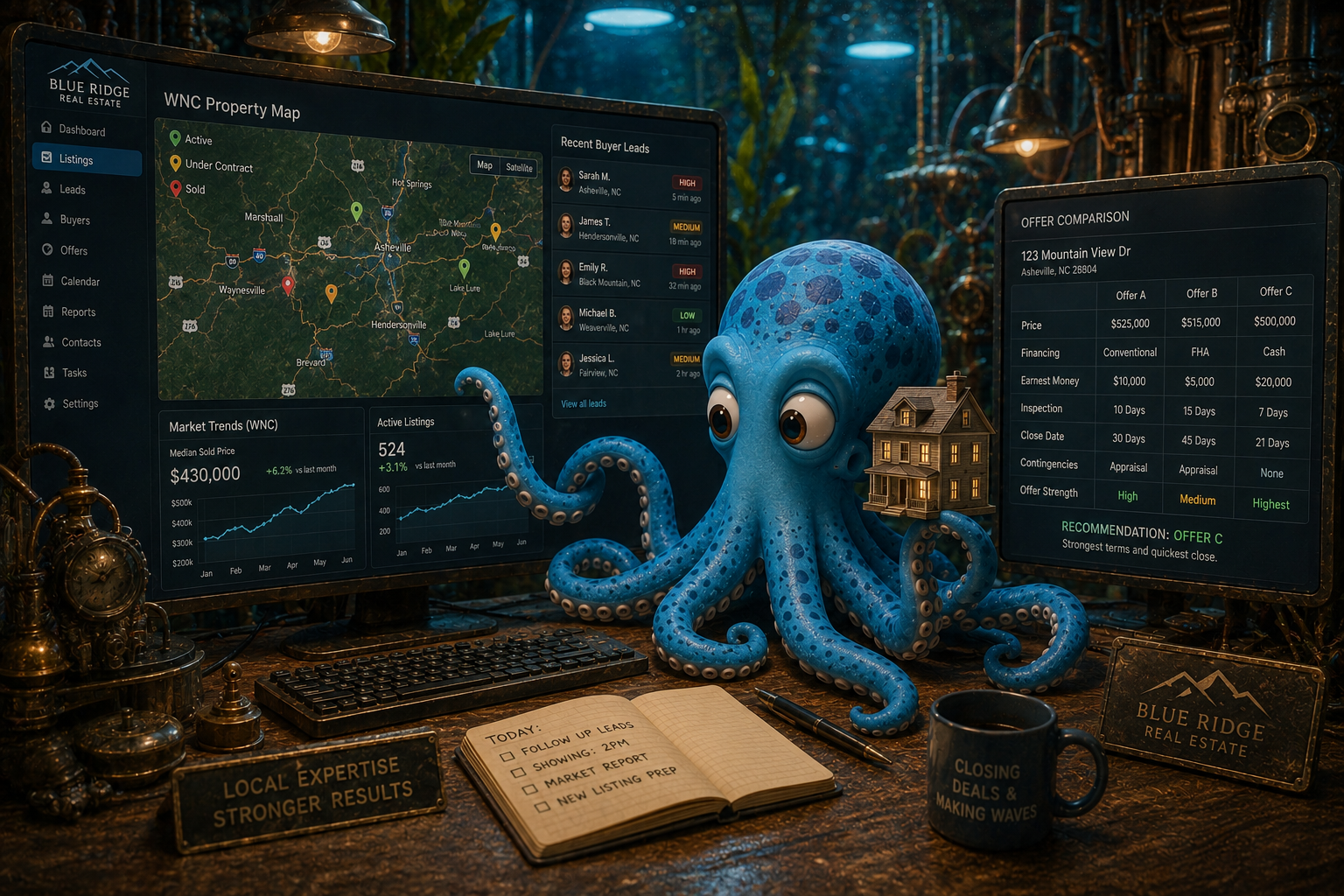
Industrial inspection and field service. The technician opens the same scan the install team produced on day one. Walks to the panel. Pulls up the maintenance procedure for the specific breaker in front of them. Closes the panel. The 3D scene is the navigation surface, not the documentation index.
This is the deliverable shape we've been waiting for and is now real. The technology gating it isn't gone, it was 418 kilobytes the whole time.
What's still missing
Two things to be honest about.
The avatar physics are basic. Walk forward, walk backward, no stairs, no jumping. For real estate and construction documentation that's fine; for sports broadcast or game-like scenes it isn't. The PlayCanvas team is working on this; we don't have a date.
Multi-user is browser-tab-by-browser-tab. You can hand someone a link and they can be in the scene at the same time as you, but the cursors aren't aware of each other. Real synchronous walkthrough requires WebRTC or a server, neither of which ships with the default SuperSplat publish path. Spatial Studio (Real Horizons) is building this; we're watching.
Both of these are solvable. Neither blocks the deliverable. The walkable layer is real, the deliverable shape is shippable, and the pricing decision in front of every 3D capture vendor right now is whether to call the navigable version a separate line item or a default upgrade.
We're calling it a default upgrade. The cost differential is too small to defend a separate price.
If you operate a property, venue, site, or facility that would benefit from being navigable — not just viewable — get in touch. The walkable deliverable is what we're shipping from this month forward.
Related reading:
- Cybertruck to Walkable 3D Model in Two Hours: What We Just Shipped — the pipeline that produces the splat we're now adding walkability to
- What Golf Broadcasts Just Taught Us About 3D Capture for Client Work — the production-scale reference shoot from the same news cycle
- AprilTag-Scaled Gaussian Splatting: Photo-Realistic 3D With Real-World Dimensions — the measurement layer that pairs with the walkable layer
- Performance Analysis Beats Spectacle: The 3D Capture Positioning Pitch We're Stealing — why the navigable version sells where the spectacle version doesn't
Keep reading
More from the field.
Stay Connected
Get practical insights on using AI and automation to grow your business. No fluff.