

Performance Analysis Beats Spectacle: The 3D Capture Positioning Pitch We're Stealing
Radiant Images put 56 iPhones on a tee box and aired the result on live television. The interesting move wasn't the technology. It was the sales angle they led with — and it's the one we're stealing for every 3D capture deliverable we ship from now on.
There's a moment in the Radiance Fields write-up of the 2026 PGA Championship 4DGS shoot — buried near the end, after thousands of words about the rig and the pipeline — that's worth more than the rest of the article combined. It's the part where they describe how Radiant pitched the project to PGA and T-Mobile in the first place.
"The pitch Radiant brought to PGA and T-Mobile deliberately led with human performance rather than entertainment spectacle. The argument was that the most defensible immediate value of capturing a swing in 4DGS is for the athlete, the coach, and the broadcaster doing performance analysis, with full control over time. The fan facing interactive view is the layer that comes after."
Read that twice. The defensible value is not "your fans can watch the swing from any angle for fun." The defensible value is the coaching room.
This is the positioning move we're stealing.

The spectacle pitch is the loser
Here's the conversation everyone in 3D capture has had at some point.
A client looks at a Gaussian Splatting demo. They orbit a camera around a building, slow it down, pause on a corner. They say, "That's incredible."
Then they go quiet. Then they say, "And what would we use it for?"
The honest answer most of the industry has been giving is: "Marketing. Fan engagement. Immersive experiences." Variations of people will think it's cool.
It's not a lie. People do think it's cool. But it's also not a sales pitch. "Cool" is not a budget line item. "Cool" comes out of the marketing slush fund, gets approved at the end of the quarter when there's spare money, and dies the next time someone needs to cut something.
Radiant didn't pitch cool. Radiant pitched the swing analysis a coach pays $5,000 for, available from a single capture session.
That's a budget line item. That comes out of training and development. That gets approved at the start of the season, not the end of the quarter. And once the coach proves the analysis is useful, every athlete on the team becomes a recurring capture customer.
The same move, in three other industries
Once you see this move, you start seeing it everywhere.
Real estate
The spectacle pitch: "Buyers can virtually tour your listing from anywhere in the world."
That's true and it does almost nothing. Buyers already toured the listing on Zillow. The video walkthrough is on YouTube. The interest is already qualified by the time they're touring.
The performance-analysis pitch: "The 3D scan tells the listing agent exactly what each prospect lingered on — and gives the appraisal team a measurement-grade reference of the property's condition at the moment of sale."
That's a different sale. The listing agent's pitch to the homeowner is now data-driven, not visual. The appraisal angle is a separate revenue line that didn't exist before. The capture is an intelligence instrument the listing team uses to understand the buyer pool, not just a marketing artifact.
Construction documentation
The spectacle pitch: "Investors can walk through the building before it's finished."
The performance-analysis pitch: "At every milestone, the contractor produces a measurement-grade 3D snapshot the owner, the architect, and the inspector all reference the same way."
That's a payment-milestone documentation tool. That's an insurance-claim photo. That's an as-built reference that survives turnover, when the original contractor's project manager retires and the building owner needs to remember why the conduit goes around that particular column.
Industrial / field operations
The spectacle pitch: "Your sales team can show prospects what your installation looks like."
The performance-analysis pitch: "The technician working on the equipment three years from now opens the same 3D scan the install team produced on day one, with every component dimensionally tagged and the maintenance procedure linked to each one."
That's a service-contract upsell. That's a training material. That's a warranty-claim defense exhibit. It pays for itself once.
Why the move works
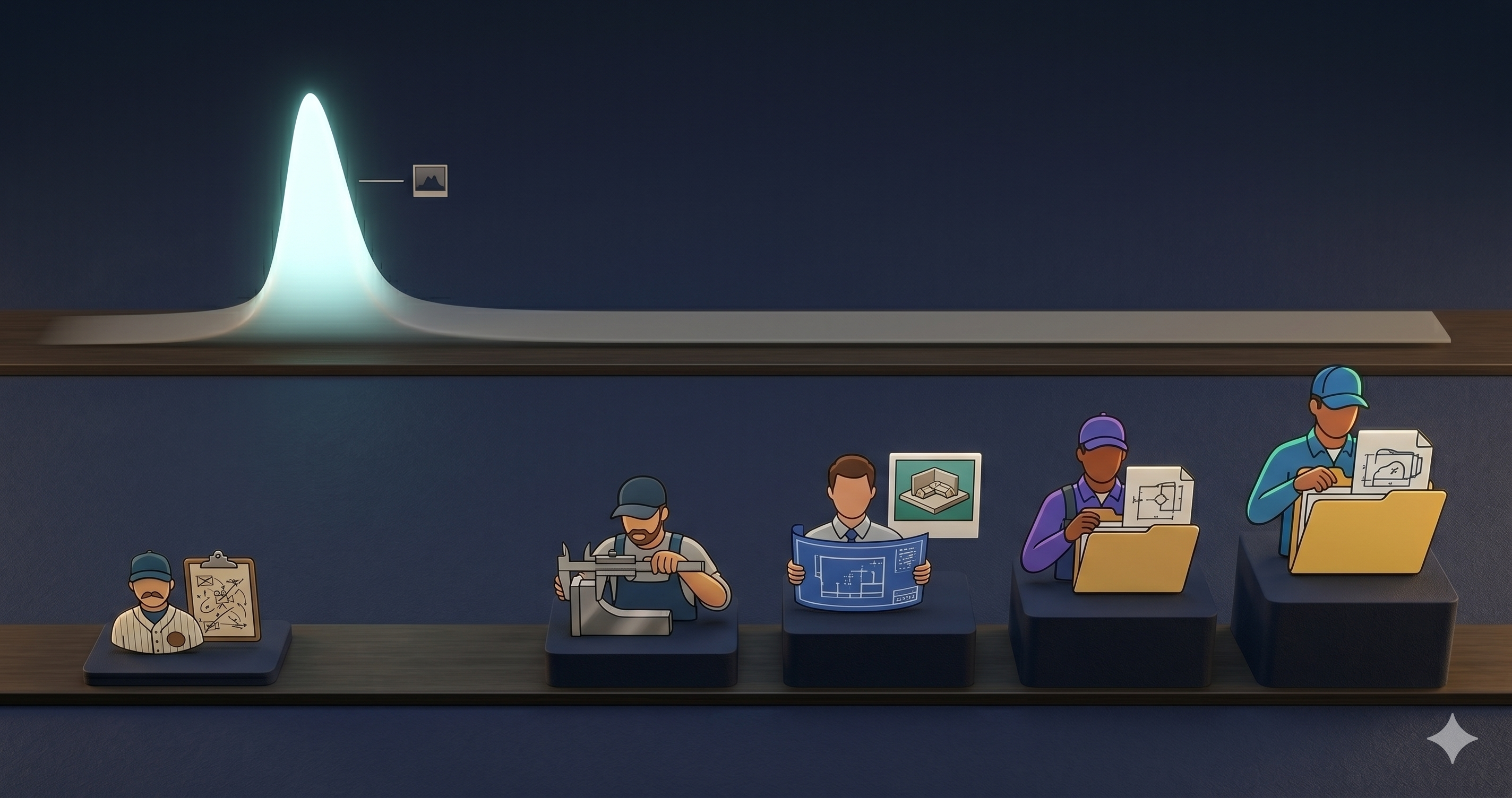
The pattern under all three: performance analysis is recurring revenue. Spectacle is one-time revenue.
The coach doesn't capture a swing once. They capture every swing for the entire season, and the season after. The listing agent doesn't scan one property. They scan their entire portfolio, and the appraisal team becomes a downstream subscriber to the data. The contractor doesn't document one milestone. They document every milestone, and the owner buys the year-end portfolio, and the inspector pays for read-access for the next decade.
Spectacle sells a deliverable once and then needs to find a new customer. Performance analysis turns the same customer into a permanent revenue stream by giving them something operationally useful that compounds in value the longer they use it.
This is also why the right sales motion is different. Spectacle requires us to find an excited buyer. Performance analysis requires us to find a buyer with an existing budget line that performs poorly today. The first is harder; the second is everywhere.
How we say it
When we write proposals for 3D capture work from now on, the first sentence on the page is not going to be about how beautiful the result is. It's going to be one of these:
- "This deliverable replaces three line items on your current operating budget."
- "This deliverable becomes a reference document the next ten people who touch this work all open."
- "This deliverable becomes a piece of evidence the next time the audit / inspection / appraisal / lawsuit needs one."
The visual fidelity is the table stakes. We don't lead with it. The buyer doesn't care that the splat looks photographic — by 2026, they assume it does. They care what they can do with it that they couldn't do with the medium they're using today.
That's the pitch. The same one Radiant brought to PGA and T-Mobile. The one we're stealing.
We have a free pipeline for the deliverable. We have a metrology layer for the measurement claim. We have a walkable layer for the navigation claim. The only thing left is to put it on a page in front of the right buyer.
If you operate a coaching practice, a property portfolio, a construction site, or a field-service business — and you want to talk about what the performance-analysis version of your 3D capture line would look like, get in touch. Bring an existing budget line that's underperforming. We'll bring the pipeline.
Related reading:
- What Golf Broadcasts Just Taught Us About 3D Capture for Client Work — the full PGA Championship production write-up that prompted this positioning piece
- Cybertruck to Walkable 3D Model in Two Hours: What We Just Shipped — the pipeline that runs at single-operator scale
- AprilTag-Scaled Gaussian Splatting: Photo-Realistic 3D With Real-World Dimensions — the measurement layer that turns spectacle into a measurement instrument
Keep reading
More from the field.
Stay Connected
Get practical insights on using AI and automation to grow your business. No fluff.