
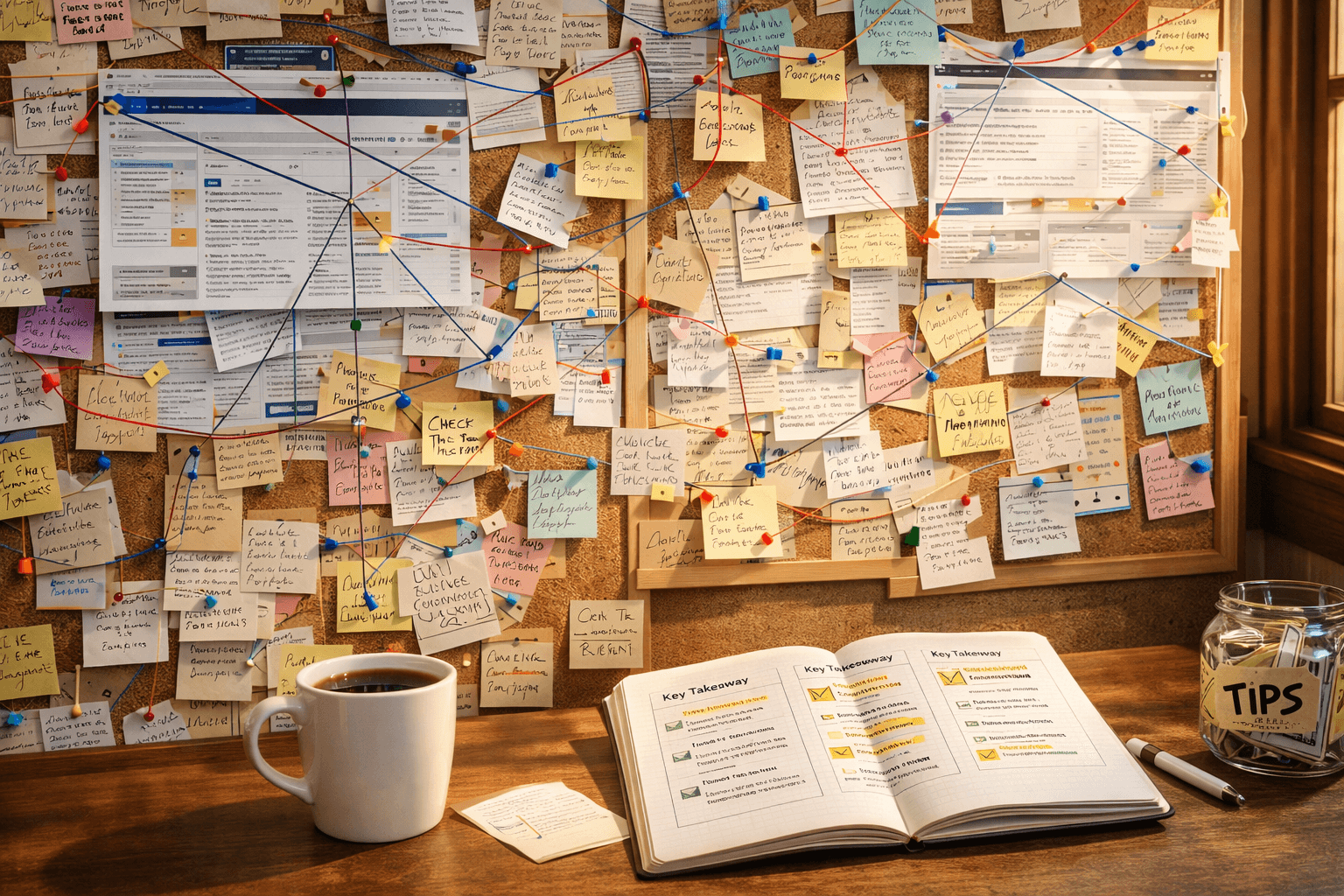
Your Business Needs an Intelligence System, Not More Bookmarks
You have hundreds of bookmarks you never revisit. An intelligence system turns information into decisions. The difference is structure, analysis, and connection — and it's simpler to build than you think.
You have 847 bookmarks. You've looked at maybe 12 of them twice. None of them have changed how you run your business.
We know because we had the same problem.
We saved articles about competitors. Tools that looked interesting at 11 PM on a Tuesday. Industry reports someone shared in a Slack channel. A tweet thread about a trend that felt important.
They piled up. They got buried. Six months later, we couldn't remember why we saved half of them.
Then we built a system that actually does something with the information. Not a better bookmarking app. Not a fancier folder structure. An intelligence system — one that turns raw information into decisions. And the difference has been significant enough that we think every business needs one.
The Bookmark Graveyard
Here's what happens with bookmarks in most businesses.
Someone reads an article about a competitor's new pricing model. They bookmark it. Someone else sees a tool that could automate their invoicing. They bookmark it. The owner reads an industry report predicting market shifts. They bookmark it.
A week later, none of those bookmarks have led to a conversation, a decision, or an action. They sit in a browser sidebar alongside recipes, vacation ideas, and an article about sleep hygiene from 2024.
This isn't a discipline problem. It's a systems problem. Bookmarks are designed to save things. They're not designed to do anything with them. There's no analysis step. No connection between one bookmark and another. No mechanism to turn "I found something interesting" into "here's what we're going to do about it."
The average knowledge worker saves 50-100 links per month. Over a year, that's over a thousand pieces of potentially valuable information sitting in a list that nobody reviews. That's not a knowledge base. That's a landfill.
What an Intelligence System Does Differently
The word "system" matters here. A system has structure. It has steps. It has outputs. A bookmark folder has none of those things.
Here's what an intelligence system does that bookmarks don't.
Every piece of information gets logged with a timestamp and source. This sounds trivial, but it's the foundation. When someone asks "what was the last thing we saved about competitor pricing?" you can answer instantly. When you need to trace how an idea evolved, you have a timeline. Our intake log has 168 entries with dates, sources, and statuses. We can tell you exactly what we learned on any given day and where it came from.
Every piece of content gets analyzed through a consistent framework. Not "is this interesting?" That's the question bookmarks answer. The real questions are: Should we implement this in our operations? Could we sell this as a service? Should we adopt this tool? Is this a trend worth monitoring? Could we create content about this?
Those five questions — implement, offer, tool, monitor, content — turn a passive bookmark into an active evaluation. When you force yourself to answer them for every piece of information that comes in, you stop collecting and start thinking.
Individual pieces get combined into signals. This is where intelligence systems pull ahead of even well-organized bookmark collections. When five different sources say the same thing independently, that's not five bookmarks. It's one signal with five data points.
We track 16 key signals in our intelligence brief right now. Each one represents a pattern we spotted across multiple sources. Signal #6, for example, started as a single article about AI agent platforms. Then a second source confirmed the pattern. Then a third. Then we found pricing data, architectural blueprints, and revenue numbers from independent developers. What started as one bookmark became a fully researched business thesis with implementation steps.
A bookmark folder would have shown us six unrelated links. The intelligence system showed us a trend.
Every insight that could become a project, a tool, or a service gets logged in a backlog. Ideas don't die in bookmarks. They enter a pipeline. Each one gets categorized — build it, adopt it, sell it as a service, or engage with the community around it — and tracked through statuses: idea, exploring, in progress, done. Our backlog has 276 entries. Not all of them will get built. But none of them will get forgotten.
A living document answers "what matters right now?" This is the capstone. We maintain an intelligence brief — a single document that synthesizes everything we've learned into actionable intelligence. It gets updated every time we process new information. It doesn't tell us everything we've read. It tells us what we should do next.
That brief is the difference between a business that reads a lot and a business that acts on what it reads.
How One Bookmark Became a Business Strategy
Here's a concrete example of the system in action.
It started with a single tweet. Someone posted about AI agents replacing traditional software for small businesses. Interesting, but not exactly breaking news. In a bookmark-only world, that link gets saved and forgotten within a week.
Instead, it entered our intelligence system. The system flagged it for analysis, connected it to four other sources we'd already processed — a Mark Cuban interview making a similar argument, a real estate automation case study, a plumber in the UK who replaced three SaaS subscriptions with a single AI agent, and an essay from the CEO of Vercel about the future of software.
Five sources, collected over three weeks, all pointing at the same thesis: generic software is losing ground to custom AI solutions for small businesses. That's not five bookmarks. That's a signal.
That signal became entry #16 in our intelligence brief, with a clear "our position" assessment and specific next steps. It informed a blog post that we published — "Software Is Dead. Custom AI Is What Comes Next." — which will generate a week of social media content once it goes live, which will drive traffic to our site, which will bring in prospects who are thinking about exactly this problem.
One tweet. Multiplied by structure.
Without the system, we would have bookmarked the tweet, maybe mentioned it in a meeting, and moved on. With the system, it became a documented pattern that shaped our content strategy, our service offerings, and our sales conversations.

The Three Levels
Not every business needs what we built. But every business is currently at one of four levels, and moving up even one level changes things.
Level 0: No system. Bookmarks scattered across browsers, tabs left open as reminders, articles shared in chat that nobody can find later. This is where most businesses live. Information comes in, nothing comes out.
Level 1: Organized bookmarks. A spreadsheet, a Notion page, or even a well-maintained browser folder. You can at least find things when you need them. This is better than nothing. The act of organizing forces a minimum level of review, and being able to search your saved information means you'll actually use it occasionally.
Level 2: Analyzed bookmarks. Each saved item has been evaluated for business relevance. You have notes on what it means, not just what it says. You've answered the question "so what?" for every piece of information. This is where individual items start becoming useful. But they're still individual items.
Level 3: Connected intelligence. Patterns across sources. Living briefs that synthesize what you know. Action tracking that turns insights into projects. Cross-referencing that surfaces connections you wouldn't have spotted manually. This is where information becomes a competitive advantage.
Most businesses are at Level 0. Getting to Level 1 takes an afternoon and a spreadsheet. Getting to Level 2 takes a habit — 10 minutes of analysis per item instead of a quick save-and-forget. Getting to Level 3 is where the real advantage lives, and it's where AI makes the biggest difference.
You Don't Need Our Exact System
We built our intelligence system using AI-powered pipelines, markdown files, and automated analysis tools. It processes 168 links through an 8-step pipeline, maintains 23 strategy documents, tracks 19 active projects, and cross-references everything against each other.
You probably don't need that.
Here's what you might need instead.
The simplest version: One Google Doc that you update every Friday. Title: "The 5 Most Important Things I Learned This Month." Force yourself to write five bullet points. If you can't, you either didn't learn anything worth acting on, or you learned things and didn't capture them. Either way, you've identified the problem.
A better version: A spreadsheet with five columns. Source. Date. What It Says. What It Means for Us. What We Should Do. Fill in one row for every article, report, or insight that crosses your desk. Review it monthly. You'll be surprised how quickly patterns emerge when you force yourself to answer "what it means" instead of just "what it says."
The full version: An AI-powered pipeline that ingests links, analyzes them through a business framework, cross-references against your existing knowledge, and maintains a living intelligence brief. This is what we run. It processes information in minutes that would take hours manually. But the tool isn't the point.
The habit of structured analysis is the point. A disciplined person with a spreadsheet will outperform a lazy person with the most sophisticated AI pipeline ever built. The system just removes the friction so the habit sticks.
Why This Matters Right Now
Information is accelerating. AI generates more content in a week than entire industries produced in a year a decade ago. Your inbox is fuller. Your feeds are noisier. The gap between "what's available to know" and "what you actually process" is widening every month.
This creates two kinds of businesses.
The first kind is drowning. They see more articles, more reports, more tools, more trends than they can possibly process. They save everything and act on nothing. They feel busy but don't feel informed.
The second kind is building systems. Not necessarily fancy systems. Sometimes it's a weekly review meeting with a structured agenda. Sometimes it's one person whose job includes synthesizing industry trends. Sometimes it's an AI pipeline that does the analysis automatically. The format varies. The principle doesn't: they have a way to turn information into action.
The businesses that win in the next five years won't be the ones with the most information. Everyone has access to everything. The winners will be the ones that turn information into action fastest. That process from "I read something interesting" to "here's what we're doing about it" is the bottleneck now. Not access. Processing.
Your competitors are either building systems to handle this or they're drowning in the same bookmark graveyard you are. The ones who figure it out first will spot trends earlier, adopt tools faster, and make decisions with better context. Not because they're smarter. Because they have a system and you have a folder.
Building Your First Intelligence System
Three steps you can take this week.
1. Audit your current information flow. Where does industry information come from? Email newsletters, social media, industry publications, conferences, peer conversations? Write them down. Then ask: what happens to that information after you see it? If the answer is "nothing" or "I bookmark it," you've confirmed the problem.
2. Pick a framework and use it. Take our five questions — implement, offer, tool, monitor, content — or make your own. The specific questions matter less than the act of asking them consistently. Every time you encounter a piece of industry information, run it through your framework before you save it. If it doesn't answer at least one question, don't save it.
3. Start a living brief. One document. Updated weekly. It answers: what are the most important trends in our industry right now? What should we be doing about them? What changed since last week? Keep it short — a single page is enough. The discipline of writing it forces synthesis. The act of updating it forces review. Over time, this document becomes the most valuable asset in your business that nobody outside your team ever sees.
From Bookmarks to Decisions
We built our intelligence system from scratch. It started as a way to organize our own research and turned into the backbone of how we run our business — from content strategy to service development.
Now we're helping other businesses build theirs. Not necessarily the same tools. But the same principles: structured intake, consistent analysis, pattern recognition, action tracking, and living documents that answer "what should we do next?"
If you're tired of bookmarks you never revisit and industry knowledge that never makes it into a decision, let's talk about what a structured intelligence system could look like for your industry.
Blue Octopus Technology builds AI-powered business systems for companies that don't have engineering teams. See what we build.
Keep reading
More from the field.
AI Agents on a Budget: A Cost Optimization Guide for Small Businesses
Read AI Infrastructure & The BoxRunning AI Agents Across Three Machines for Under $50/Month
Read AI Architecture & MethodologyHow We Built an AI Research Pipeline That Processes 20 Links in 10 Minutes
ReadStay Connected
Get practical insights on using AI and automation to grow your business. No fluff.