
What AI Actually Takes From a Business — And What It Can't
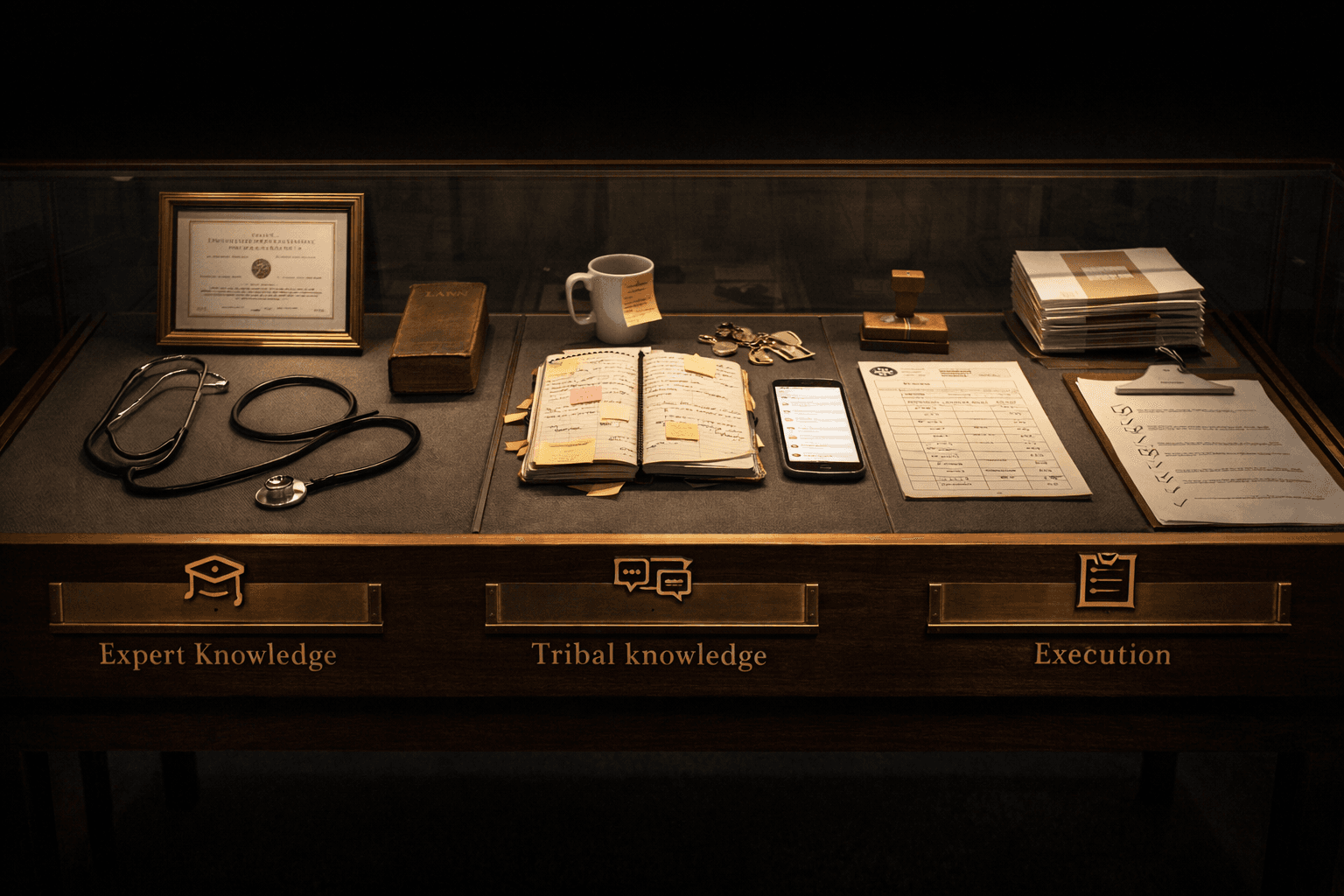
Chamath Palihapitiya recently described AI as stripping companies down to three core elements. It's the cleanest framing we've seen for what AI actually does to a business — and what it leaves alone. Here's what each layer means in practice.
A small property management company in Asheville has been operating for eight years. The owner knows which tenants pay reliably, which contractors show up on time, which county forms have which deadlines, and which of three local plumbers is willing to take a 9 PM call.
None of that is written down anywhere.
When the owner takes a vacation, the company runs at half capacity. When she trains a new hire, she explains things for the first six months — and the new hire still gets things wrong because the explanations aren't comprehensive. They can't be. The owner doesn't have the time or the inclination to write down every piece of knowledge she's accumulated.
This is most small businesses. It's also exactly the kind of thing AI reveals when it shows up.
The Three-Element Frame
In a recent post that's been circulating, the venture capitalist Chamath Palihapitiya described what he sees AI doing to companies in 2026. His framing:
AI is stripping companies down to three key elements:
1) Expert Knowledge — vertical-specific understanding of what to do.
2) Tribal Knowledge — fuzzy, undocumented details that create dispersion in performance.
3) Execution.
We think this is the cleanest one-sentence version of what's actually happening. It's also a useful diagnostic any business owner can apply to their own company in about ten minutes.
The frame is useful because it separates three things that usually get bundled together when people talk about AI. Expert knowledge, tribal knowledge, and execution are all "knowing how to do something," but they have completely different relationships with AI. Knowing the difference is most of what separates an AI deployment that works from one that doesn't.
Expert Knowledge: What Stays Yours
Expert knowledge is the formal, vertical-specific understanding of your industry. For a CPA, it's the tax code. For an HVAC technician, it's how refrigerants behave at different pressures. For a wedding planner, it's the choreography of a reception. For a property manager, it's landlord-tenant law in your state.
This knowledge isn't going anywhere. AI knows the IRS code about as well as a junior tax preparer. It does not know how to navigate the IRS code as a senior CPA at a firm with twenty years of relationships with auditors at the Atlanta district office. The knowledge that lives in trade publications, certifications, continuing education courses, and your own years of practice — that's expert knowledge, and it remains the durable thing you offer.
The implication: if your business is built on expert knowledge that's truly hard to acquire — credentials, licensure, lived experience in a specialized vertical — AI is a force multiplier, not a replacement. It can help you do the routine parts of your work faster. It cannot do the work itself, because the routine parts aren't where your expertise actually lives.
This is the bucket most people focus on when they ask "will AI take my job." For most business owners, the honest answer is no, with respect to expert knowledge. AI is not credentialed. It is not licensed. It does not show up to court hearings. It will not be the responsible party on a permit. The expert knowledge you've earned is yours.
Tribal Knowledge: What Gets Codified
Tribal knowledge is the second bucket, and it's the one that matters most for what AI is actually doing to small businesses right now.
Tribal knowledge is everything you know about how your specific business runs that isn't written down anywhere.
- Which customers pay on Net 30 in practice and which Net 30 means Net 60.
- Which supplier's "available" actually means available next Tuesday.
- The specific phrasing that gets the building inspector to approve a permit on the first round.
- Why you stopped offering one of your services three years ago even though you still get inquiries about it.
- The order of operations for onboarding a new client that you've never written down because it's "obvious."
This is the layer where AI is doing real work, and it's also the layer almost everyone misses when they think about AI. The reason is that tribal knowledge feels invisible until someone tries to do your job without it. Owners often don't think of it as knowledge — they think of it as just "how things are." It only becomes visible when a new employee asks why something is done a certain way, and the owner realizes they don't have a documented answer.
What AI does, when it's deployed well, is codify the tribal knowledge. Not by replacing the owner — by capturing what the owner already knows in a form that scales. We've written before about the orchestration layer that makes AI actually work for a business, and what the orchestration layer is, mostly, is tribal knowledge written down.
This is what makes the difference between an AI tool that produces generic outputs and one that sounds like it works for your company. The generic version uses expert knowledge. The good version uses expert knowledge plus tribal knowledge — your tribal knowledge, captured deliberately.
The implication for a business owner: the value of writing down what's in your head has just multiplied. Before AI, undocumented tribal knowledge was a productivity tax — it slowed down hiring, made you indispensable, and capped your ability to scale. After AI, undocumented tribal knowledge is the difference between AI tools that work and AI tools that don't. The work was always worth doing. Now it's also strategically urgent.
Execution: What Becomes Cheap
The third bucket is execution. The actual doing.
Drafting the email. Filling out the form. Generating the invoice. Pulling the report. Following up with the prospect. Posting the listing. Sending the reminder. Compiling the data. Updating the spreadsheet.
This is the bucket that's getting hollowed out by AI right now. Not in the dramatic "AI takes your job" way that headline writers love — most jobs are not pure execution. But the parts of every job that are pure execution are now genuinely cheap. The accounting clerk doesn't disappear; the time the accounting clerk spends pasting data between systems disappears. The marketing manager doesn't disappear; the time she spends writing first drafts of routine social posts disappears.
Where this bites small businesses: most small businesses underinvested in execution because hiring was expensive. You couldn't justify a full-time scheduler when you're a 6-person HVAC company. So scheduling either fell to the owner (poor use of time), the techs (interrupted their actual work), or just didn't happen consistently (lost revenue). AI doesn't replace a full-time scheduler — but it dramatically lowers the bar for what's worth automating, which means the work that fell through the cracks now gets done.
For more on what this looks like in a specific vertical, we've covered the common pattern with HVAC scheduling specifically. But the same dynamic applies anywhere small businesses have been understaffed in the back office. The execution work that used to require a person you couldn't afford now requires a workflow you can.
What This Frame Tells You to Do
If you accept the three-bucket frame, the to-do list for any small business gets clearer:
Stop worrying about expert knowledge being threatened. It's not. Your credentials, licensure, and years of pattern recognition in your specific industry are durable. Don't let AI hype panic you into thinking the substantive thing you offer has changed. It hasn't.
Start codifying tribal knowledge before you scale. Every undocumented "this is how we do it" is a brick in the wall between your current size and your next size. Walk through one process this week — onboarding a new client, opening a new project, closing the books for the month — and write down everything that lives only in your head. The output is useful as a training document. It's also the raw material for any AI tool you'll deploy.
Audit where execution is currently a bottleneck. Where in your business does work fall through the cracks because nobody has time? Those are the places AI deployment will produce the biggest ROI. Not the strategic decisions. Not the customer-facing creative work. The grinding, boring, undone execution work that's currently costing you money you can't see.
Blue Octopus helps businesses do this kind of audit — taking the three buckets seriously, separating what's at risk from what's not, and figuring out what to write down first. Most businesses going through this exercise for the first time are surprised by how much of their value lives in the second bucket and how little of it has been captured anywhere they could find it.
The AI conversation has been hijacked by the wrong question. The right question isn't "will AI replace my business." It's "of the three things my business does — expert work, tribal knowledge, and execution — which two should I be investing in deliberately, and which one should I let AI take off my plate?"
Blue Octopus Technology helps small businesses identify what's worth codifying, what's safe to automate, and what should stay in human hands. If your tribal knowledge has never been written down — and you're starting to feel that hurt — let's talk.
Keep reading
More from the field.
Stay Connected
Get practical insights on using AI and automation to grow your business. No fluff.