
AI Won't Replace Your HVAC Tech. It Will Replace Your Scheduler.
If you run a field service business — HVAC, plumbing, electrical, landscaping — the AI question isn't whether your techs are at risk. They're not. The question is what AI does to the work that happens between trucks. The answer is: a lot.
Suppose you're running a four-truck HVAC business doing about $1.4 million in annual revenue. You, your spouse who runs the office, four field technicians. You've been getting AI emails for two years promising to "transform your business." You delete them.
You're right to delete them. The AI marketing aimed at field service is mostly nonsense. Most of it imagines a world where AI chatbots replace human technicians. That world is not coming. An HVAC technician on a service call is doing physical work in a real space, dealing with refrigerants, electrical systems, ductwork, and a homeowner who wants the problem explained in plain language. None of that is what AI does.
What the marketing gets wrong is where in the business AI actually changes things. It's not the technicians. It's everyone and everything between the technicians.
The Work Between the Trucks
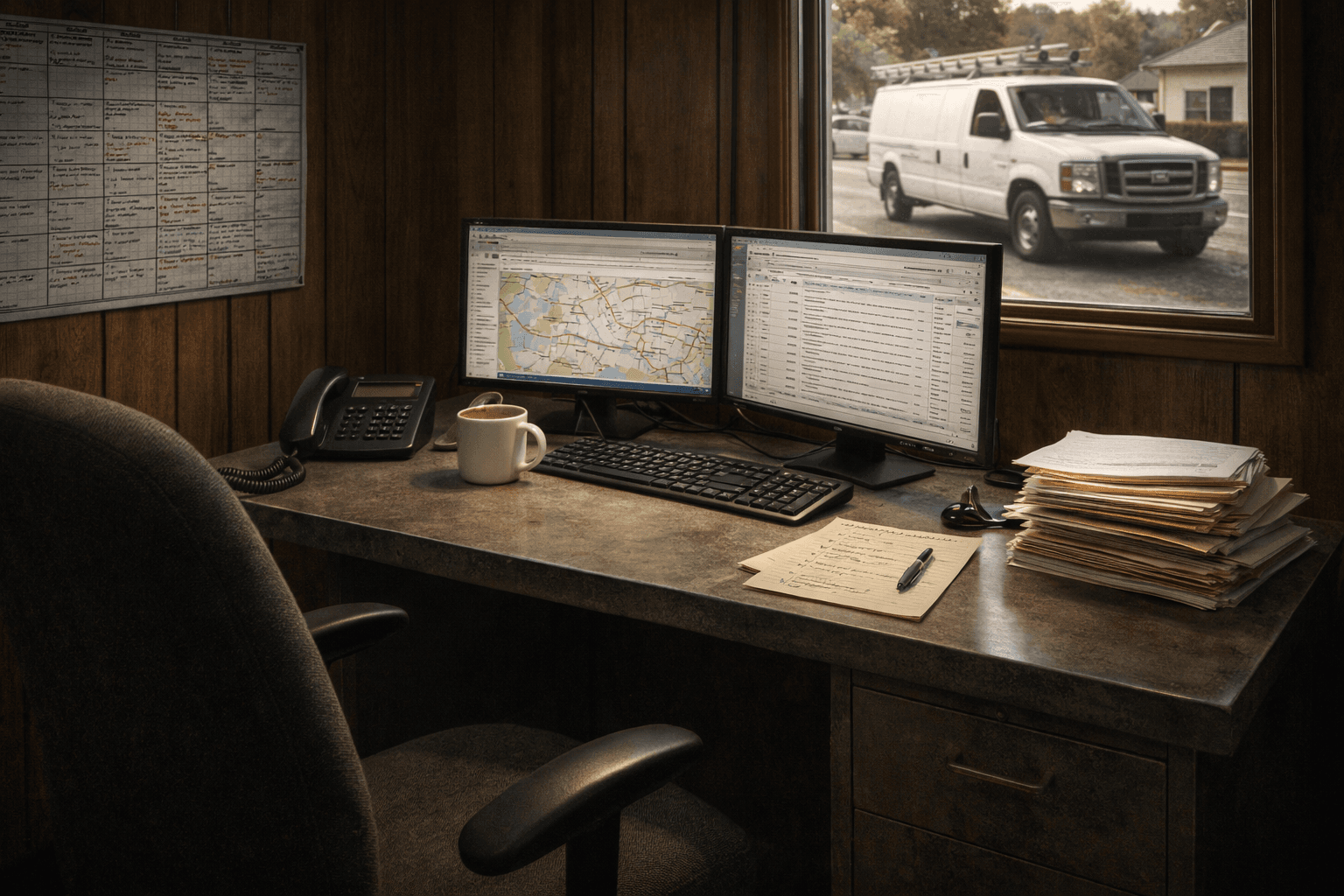
A field service business is shaped like a clock. The hands of the clock are the technicians — they're the visible work, the customer-facing work, the billable hours. But the clock face, the gears, the spring — all of that is the work that happens between trucks. Scheduling. Dispatch. Quoting. Invoicing. Follow-up. Inventory. Compliance. Training new hires. Returning calls. Sending estimates.
This work doesn't get done by the technicians. It gets done by the office — usually a small office, often just one or two people, frequently the owner's spouse. And in most field service businesses at this size, this is where the bottleneck lives. The techs could handle more calls per day if the office could keep up with the calls. The office can't keep up because the office is two people doing the work of four.
That's where AI lives in field service. Not in the trucks. In the office.
What AI Actually Does in a Field Service Office
Set aside the marketing language for a second. Look at what an office staffer in a small HVAC business actually does in a Tuesday morning:
- Take the 7:13 AM call from a customer whose system stopped working overnight. Look up their service history. Find the closest tech with the right skill set. Call the tech. Confirm the time. Call the customer back with an arrival window.
- Take the 7:31 AM call from a different customer asking about an estimate from last week. Look up the estimate. Read it back. Answer questions about line items.
- Take the 7:48 AM call from the parts supplier confirming a Wednesday delivery. Update the inventory log. Reschedule a maintenance call that was waiting on those parts.
- Take the 8:02 AM text from a tech in the field saying the diagnostic is more complicated than expected. Get the customer on the phone. Walk them through the upgraded scope. Get verbal approval. Send a written quote for sign-off.
- Take the 8:14 AM call from a homeowner asking when the technician will arrive. Look up the schedule. Check with the tech. Call the customer back.
That's forty-five minutes. Almost none of it is decision-making. Most of it is information retrieval, scheduling logic, and customer communication. The exact kind of work that AI agents handle well — without complaint, without ever forgetting, twenty-four hours a day.
Where AI Actually Helps in Field Service
Here are the workflows that change when AI is deployed properly in a small-to-mid HVAC, plumbing, or electrical business.
Scheduling and Routing
The "where is my next job" question your techs ask three times a day stops being a question. The dispatching tool sees their location, sees the open job board, sees the skill match, and sends the next assignment to their phone. Route optimization happens in the background — the system shaves drive time without anyone in the office building the route by hand.
The real win isn't the time savings on building the schedule. It's the elimination of the interruption pattern that breaks office focus all day.
"Where Is My Tech" Customer Updates
Customers want to know when the technician is going to arrive. Most small HVAC companies handle this with text messages from the office, sent manually. Tools that do this automatically — based on the tech's GPS and the next scheduled job — cost typically under $100 per month per truck. The customer stops calling to ask. The office stops getting interrupted. Reviews improve because customers feel informed.
This isn't AI in the headline-grabbing sense. It's automation that depends on having clean data. But it's the highest-impact change for the smallest cost in most field service operations.
Quote and Invoice Drafting
Quotes are one of the slowest parts of the office workflow because they require the office to translate the tech's verbal field notes into a written document a customer will read. AI is excellent at this translation. Tech dictates the scope and the parts and the labor estimate into a phone. The AI drafts the formatted quote. The office reviews and sends.
Same pattern works for invoices, work orders, and warranty documentation. Drafting drops to seconds. Review takes minutes. The office is no longer the bottleneck on customer-facing paperwork.
Service Call Triage
Inbound service calls follow a pattern. The customer describes a symptom. Someone in the office decides whether it's an emergency, a scheduled call, or something the customer can troubleshoot themselves. AI tools that handle the first-pass triage — listening to the customer, asking follow-up questions, categorizing the urgency — let your office staff handle three times the call volume without adding a person.
This is the closest thing to "AI replacing a job" in field service, and even here, the human stays in the loop. The AI does the categorization. The human confirms and dispatches.
Service History and Recall Management
A customer calls in. You have ten years of service history on their equipment buried in a software system that requires four clicks to surface. AI agents that read the customer ID and pull the relevant history before the call connects let your office staff start the conversation already informed. Maintenance reminders, parts under warranty, prior diagnostic notes — all surfaced automatically.
This was previously a "we'd love to do that someday" feature. It's now a setup-once-and-forget configuration.
Where AI Doesn't Help (Yet)
The vendors won't tell you this, so we will.
AI cannot diagnose a refrigerant leak from a phone call. Some marketing implies otherwise. It's wrong. Diagnostics in HVAC require physical access to the equipment, gauges, sometimes refrigerant detection. AI can route the right tech with the right skills. It can't replace the tech.
AI cannot manage your customer relationships. A long-term customer trusts your business because of your reputation, your techs, and your communication style. AI-drafted communication helps with the volume, but the relationship still depends on a human being responsive and trustworthy. If you outsource the relationship to a chatbot, you'll lose the customer.
AI cannot fix bad data. If your scheduling system is held together with phone calls and sticky notes, AI on top of that will not magically organize it. The data foundation has to be in place — usually a real field service management platform — before the AI layer adds value.
AI cannot make decisions you should be making. Pricing changes, customer concessions, refunds, complaints requiring escalation — these stay with humans. AI tools that promise otherwise are setting you up for the kind of customer service incident that makes the local news.
The Real Question for Field Service Owners
The right question isn't "should I use AI in my HVAC business." The right question is "where in my office is the bottleneck, and is the bottleneck a human-decision problem or an information-flow problem?"
If it's a human-decision problem — pricing, scope, customer relationships — AI doesn't help. Hire smart people. Train them. Pay them.
If it's an information-flow problem — scheduling logistics, drafting paperwork, routing calls, surfacing customer history, sending status updates — AI helps a lot. The right configuration of an AI agent on top of your field service software can collapse the office workload by a factor of three or four.
The techs aren't at risk. The scheduler is. The dispatcher is. The office admin who spends their day routing phone calls is. And that's not because AI is replacing those people — it's because those people are about to become reviewers and decision-makers instead of typists and switchboard operators.
For a four-truck operation looking to grow to eight without doubling office headcount, that's the actual unlock. For a twenty-truck operation drowning in inbound call volume, same answer at larger scale.
Related reading:
- AI Tools for Home Service Contractors — broader cross-trade guide for home service operations
- AI for Construction and Trades: What Actually Works in 2026 — the documentation side of the same problem, for general contractors
- Blue Octopus AI Hygiene — the operational standard we ship every AI engagement with
Blue Octopus Technology works with HVAC, plumbing, electrical, and other field service businesses to identify where AI fits in the office without disrupting the field. Let's talk if your office is the bottleneck on growth.
Stay Connected
Get practical insights on using AI and automation to grow your business. No fluff.