
What a Real AI Strategy Looks Like (vs What You're Being Sold)
Most AI strategies are PowerPoint decks with the word 'AI' pasted over last year's digital transformation slides. Here's what a real one looks like.
Most "AI strategies" are PowerPoint decks with the word "AI" pasted over last year's digital transformation slides.
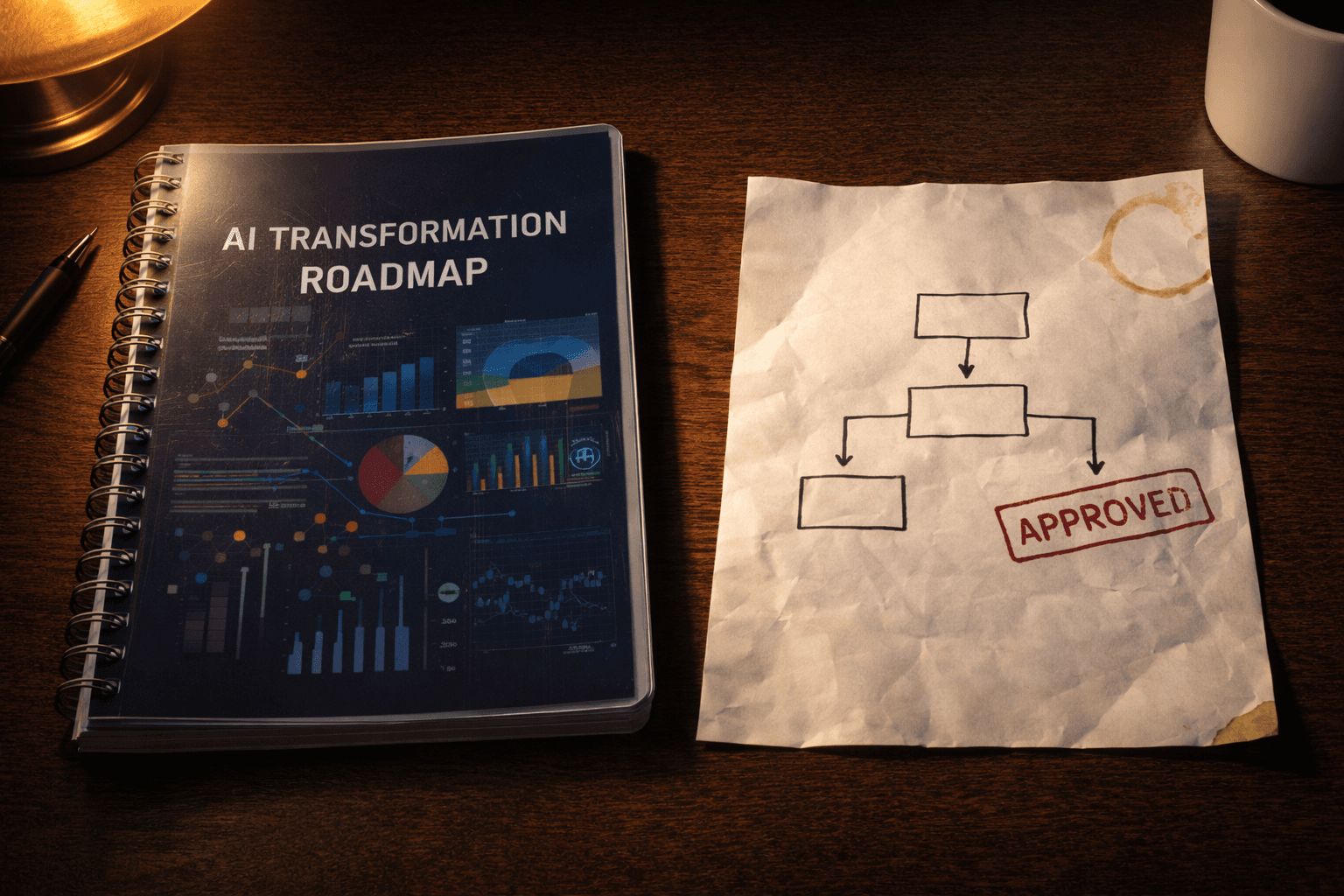
We can say this because the pattern is everywhere. A 47-page AI strategy document from a mid-sized consulting firm, produced for $25,000. Quadrant charts, maturity models, a "phased roadmap" with no dates, and the phrase "AI-powered transformation" on 31 of the 47 pages. The recommended first step is a six-month assessment.
The business doesn't need a six-month assessment. It needs someone to automate its invoice processing, which would take two weeks and save 15 hours of staff time per week. But that's not a $25,000 deliverable, so nobody proposes it.
This is the state of AI strategy consulting in 2026. There are firms doing real work — honest, practical, results-oriented work — but they're outnumbered by firms that have figured out that "AI strategy" is the most profitable thing you can write on a proposal right now.
If you're a business owner being pitched an AI strategy, here's how to tell the difference between the real thing and an expensive waste of time.
What a Fake AI Strategy Looks Like
You'll recognize these immediately, because you've probably already sat through at least one version.
It starts with buzzwords, not problems. A fake AI strategy opens with "the AI revolution" or "the transformative power of artificial intelligence." It talks about what AI can do in general terms. It references Gartner reports and McKinsey projections. What it doesn't do is name a specific problem in your specific business that AI will solve.
It recommends an assessment phase. This is the consulting industry's favorite move: get paid to figure out what to get paid to do next. A legitimate assessment for a small or mid-sized business takes days, not months. If someone wants six months and five figures to "assess your AI readiness," they're billing you for their learning curve.
It uses vague success metrics. "Improved efficiency." "Enhanced customer experience." "Streamlined operations." These aren't metrics. They're vibes. A real strategy tells you: we'll reduce invoice processing time from 4 hours to 30 minutes. We'll cut customer response time from 24 hours to 2 hours. We'll eliminate 15 hours per week of manual data entry. Numbers. Timeframes. Commitments.
It proposes everything at once. Fake strategies love to present a "holistic AI transformation" — automate sales, marketing, operations, customer service, HR, and finance all at the same time. This sounds ambitious. It's actually a recipe for doing nothing well. No small business has the bandwidth, budget, or data readiness to transform everything simultaneously.
It doesn't include a budget. Or worse, it includes a budget range so wide it's meaningless. "$50,000 to $500,000 depending on scope." That's not a budget. That's a shrug with a dollar sign. If someone can't tell you roughly what their recommendation will cost, they haven't done enough work to make a recommendation.
It doesn't address what happens if it fails. Every real plan has a contingency. What if the AI doesn't perform as expected? What if the data isn't clean enough? What if the ROI doesn't materialize? A strategy that only paints the upside isn't a strategy. It's a sales pitch.
What a Real AI Strategy Looks Like
A real AI strategy is boring. It's short. It's specific. And it can show results in 90 days or less.
Here's the structure.
It Starts With a Specific Problem
Not "we need AI." That's a solution looking for a problem. A real strategy starts with something like: "Our team spends 20 hours per week on invoice data entry, and the error rate is around 4 percent. That costs us roughly $X in labor and $Y in correction time."
That's a problem with a number attached to it. AI either fixes it or it doesn't. There's no ambiguity, no "transformation journey," no six-month assessment needed to determine if the problem exists. The team already knows the problem exists — they live with it every day.
If you're not sure which problem to start with, audit your current workflows. The biggest time sinks with the most repetitive patterns are your best AI candidates.
It Picks One Workflow to Automate First
Not five. One. The most impactful, most straightforward, most measurable workflow you have.
This goes against the instinct to "think big." But thinking big at the strategy stage is how AI projects stall. Thinking small at the strategy stage — and then expanding after you've proved the concept works — is how AI projects succeed.
The best first workflow to automate usually has these characteristics:
- It's repetitive (same steps, different data)
- It's time-consuming (at least 5 to 10 hours per week of someone's time)
- It's well-defined (clear inputs, clear outputs, clear rules)
- It's not mission-critical (if the automation breaks, it's annoying, not catastrophic)
- The data is relatively clean (or can be cleaned in a reasonable timeframe)
For most small businesses, this ends up being something like appointment scheduling, invoice processing, report generation, or customer onboarding. Unsexy, yes. Effective, absolutely.
It Has a Realistic Budget
A real AI strategy includes a specific budget with three components:
Tool costs. What the AI software or service will cost per month. For most small business use cases, this is somewhere between $50 and $500 per month. If someone quotes you more than that for a single-workflow automation, get a second opinion.
Implementation costs. The labor to set it up, configure it, connect it to your existing systems, and test it. For a single workflow, this is typically $2,000 to $10,000 depending on complexity. Our breakdown of how much custom software costs covers the factors that affect pricing.
Ongoing costs. Maintenance, updates, monitoring, and the occasional fix when something breaks. Budget 10 to 20 percent of your implementation cost per year for this.
That's it. If a proposal doesn't break costs down this specifically, it's not a real budget.

It Has a Timeline Under 90 Days
Ninety days is the maximum time from "we're starting this project" to "we're seeing measurable results." For many single-workflow automations, 30 to 45 days is more realistic.
Here's a typical timeline:
Week 1-2: Audit the current workflow. Document every step, every decision point, every exception. Assess data quality. Identify gaps.
Week 3-4: Select tools. Configure the automation. Connect it to existing systems. Build in error handling and fallback procedures.
Week 5-6: Test with real data. Run the automation in parallel with the manual process to verify accuracy. Fix what breaks.
Week 7-8: Go live. Monitor closely. Adjust as needed. Train team members on the new process.
Week 9-12: Measure results against the original problem statement. Calculate actual ROI. Decide whether to expand to the next workflow.
If someone tells you that AI strategy requires a year-long roadmap before you see any results, they're either working on something genuinely complex (enterprise-scale, multi-department, regulatory-heavy) or they're padding the timeline to pad the invoice. For a small business automating one workflow, 90 days is generous.
It Includes a Kill Criteria
This is the part that separates honest consultants from salespeople. A real strategy defines what failure looks like and what you do about it.
"If the automation doesn't reduce processing time by at least 50 percent within 60 days of deployment, we will [adjust approach / try alternative tool / cut our losses]."
That sentence is uncomfortable to write in a proposal. It's uncomfortable because it admits the possibility of failure. But failure is always possible with technology projects, and pretending otherwise is dishonest. The businesses that adopt AI successfully aren't the ones where everything works on the first try. They're the ones who define success clearly, detect failure early, and adapt quickly.
If your AI strategy doesn't include a "what if this doesn't work" section, add one. If your consultant won't add one, that tells you something about their confidence in their own recommendation.
The 3-Month Test
Here's a simple filter you can apply to any AI strategy, proposal, or pitch you receive:
Can it show measurable results in 90 days?
If yes, it might be real. Look at the specifics — the problem, the workflow, the budget, the metrics — and evaluate whether they make sense.
If no, ask why. There are legitimate reasons some AI projects take longer: regulatory compliance, complex integrations with legacy systems, data migration from decades-old formats. But for most small business applications, 90 days is enough to automate one workflow and measure the impact.
If the answer is "we need to do a comprehensive assessment first" or "AI transformation is a multi-year journey," you're probably looking at a consulting engagement, not a solution. And consulting engagements have a way of generating more consulting engagements without ever generating results.
How to Evaluate an AI Proposal
Next time someone pitches you an AI project, ask these five questions:
1. What specific problem does this solve? If they can't name one in a single sentence, they're selling a capability, not a solution.
2. How will we measure success? If the metrics are vague ("improved efficiency"), press for numbers. What's the baseline today? What's the target? How will we measure it? The metrics that actually matter aren't complicated — they're just specific.
3. What will this cost — total, including implementation and ongoing? Not a range. A number, with a reasonable margin. If they can't estimate costs, they haven't scoped the work.
4. When will we see results? "Six months to a year" is not acceptable for a single-workflow automation. 30 to 90 days is. If the timeline is longer, demand a specific explanation for why.
5. What happens if it doesn't work? The answer you want: "We'll adjust X, try Y, or recommend stopping." The answer you don't want: silence, or "that won't happen."
The Strategy That Actually Works
The best AI strategy for a small business fits on a single page. Here's the template:
Problem: [Specific workflow or task that costs too much time/money]
Current state: [How much time/money this costs today, measured over the past 30-90 days]
Proposed solution: [Specific tool or approach, with a brief explanation of how it works]
Expected outcome: [Specific improvement — hours saved, error rate reduced, speed increased]
Budget: [Tool cost + implementation cost + ongoing cost, with specific numbers]
Timeline: [Start date to measurable results, 90 days maximum]
Success criteria: [How we'll know it worked — specific metrics and thresholds]
Failure criteria: [How we'll know it didn't — and what we do next]
That's it. One page. No quadrant charts. No maturity models. No "phase zero discovery engagement." Just a problem, a plan, a budget, and a commitment to measure results.
If that sounds too simple, consider a typical accounting firm. They don't need a digital transformation. They need their client onboarding to stop eating 20 hours a week. That's an automation project that takes six weeks, not a six-month strategic assessment. It works. They move on to the next problem.
That's not a story anyone puts in a case study at a consulting conference. But it's the kind of AI strategy that actually helps small businesses — the kind that solves a problem, proves it works, and builds from there.
Skip the 47-page decks. Start with one problem. Fix it in 90 days. That's your AI strategy.
If you want an AI strategy that fits on one page and shows results in 90 days, let's build it together.
Blue Octopus Technology solves specific problems for small businesses — no transformation decks, no six-month assessments. See how we work.
Keep reading
More from the field.
Stay Connected
Get practical insights on using AI and automation to grow your business. No fluff.