
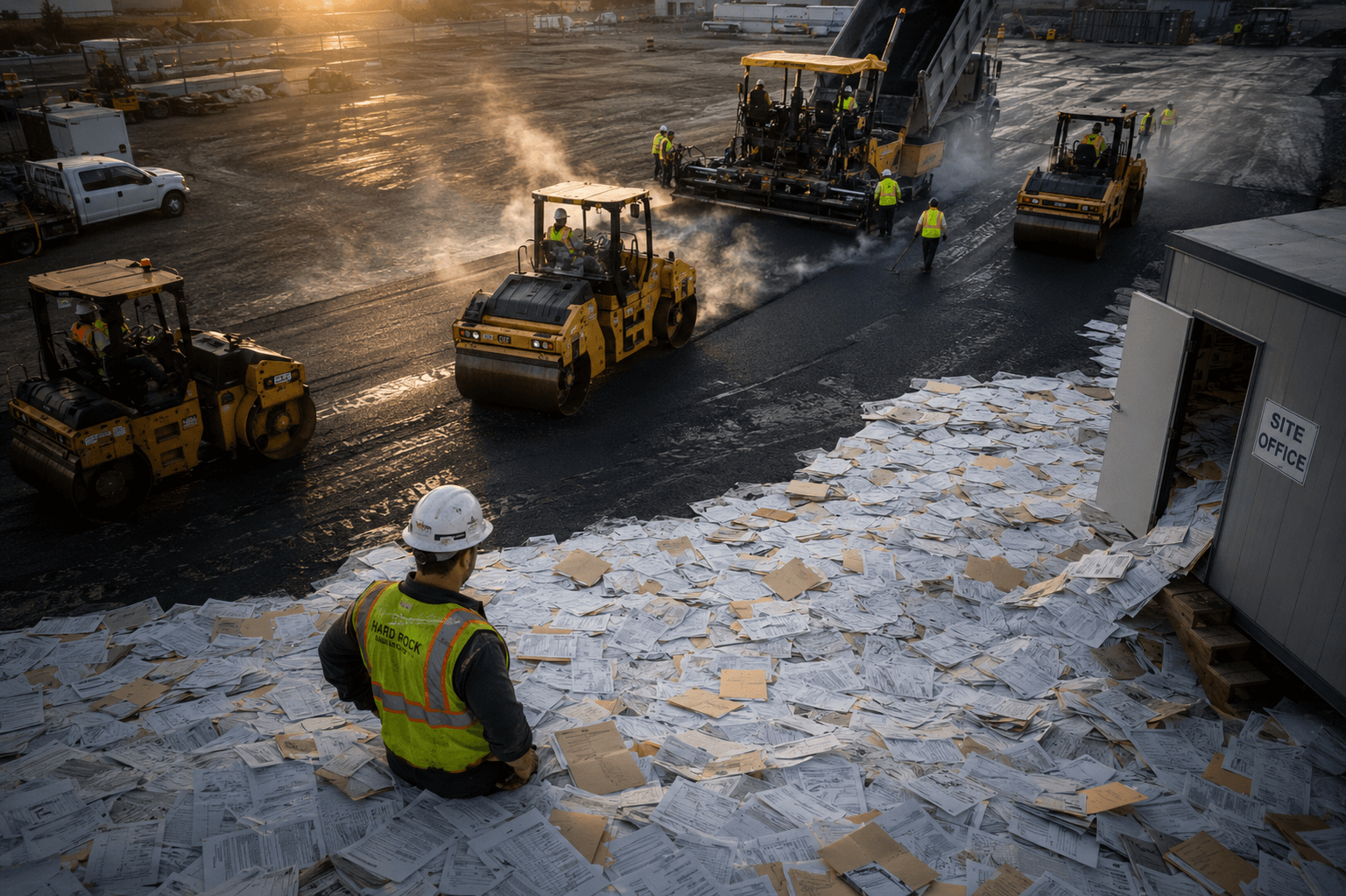
The Office Work Is Eating the Field Work
Mid-market commercial trades — mechanical, electrical, paving, plumbing — keep growing the office to support a field crew that hasn't grown proportionally. The math is upside down. Here's what actually fixes it.
Suppose you run a commercial paving company. Sixteen trucks, three paving crews, six people in the back office — you and your spouse plus an estimator, a scheduler, a bookkeeper, and a project administrator who handles everything that doesn't fit cleanly anywhere else. The company does about $14 million annually. Half of that is private commercial work. The other half is DOT and county work.
You've been trying to add a fourth paving crew for three years. You can find the crew. You can finance the trucks. What you can't do is find a fourth project administrator without doubling the office cost — because the existing four are already drowning.
Here's the ratio that won't leave your head. Your field crews are out at 7 AM, paving. The office is at desks emailing, filing change orders, processing pay applications, sending RFI responses, chasing DOT submittal packages, answering subcontractor questions. By 4 PM the field crews are wrapping up. The office is still going at 6 PM. By 7 PM you're in your truck reviewing tomorrow's schedule because nobody had time to finalize it.
The office work is eating the field work. And every mid-market commercial trades business — mechanical, electrical, paving, plumbing, site work, roofing — is running the same play. The field is the revenue. The office is the friction. And the friction is growing faster than the revenue.
Why this is happening now
A mid-market commercial trades company at $5M to $50M in annual revenue is in the most operationally awkward part of the size curve. They've outgrown the "owner-runs-everything" model that works at $1-3M. They haven't grown into the "VP of Operations + dedicated department heads" model that works at $75M+. They're stuck in the middle, where every back-office function is staffed by one or two generalists who do four things each.
Twenty years ago, the way to scale through this middle band was to keep growing the office linearly. More volume, more change orders, more scheduling complexity, more office hires. The math kind of worked because labor was cheaper, communication was simpler, and the buyer's documentation expectations were lower.
That arithmetic is broken now. Three reasons.
Buyer expectations went up. The DOT, the school district, the commercial developer, the property management company — every customer requires more documentation than they did a decade ago. Pay applications need lien waivers and certified payroll. Change orders need detailed scope language. Submittals need compliance matrices. Closeout packages need O&M manuals and warranty registrations and as-built drawings. Same physical work. Two to three times the office labor per project.
Labor cost went up. A good project administrator in this region used to be in the $40-50K range. Now they're $70-90K plus benefits. The math on "hire your way through the office bottleneck" doesn't pencil out anymore.
Field labor got harder to find. When you can't grow the field, you can't justify growing the office. So the existing office gets more compressed against the existing field. Both sides feel the squeeze.
The result: the office work eating the field work isn't a one-company story. It's the typical experience of mid-market commercial trades in 2026.
What the work actually looks like
Set aside the AI marketing language for a moment. Look at what a project administrator at a mid-market trades company actually does in a Tuesday afternoon:
- Email from the GC at a 4-acre retail site asking when the asphalt subgrade work starts. Look up the schedule. Find the answer. Reply with a date and a context note.
- Email from the bookkeeper asking which crew was on the Highway 70 job last Thursday for the certified payroll. Look up the daily report. Find the crew. Reply with names.
- Phone call from a county engineer asking for a revised submittal on a retention pond material spec. Pull the original submittal. Identify what needs to change. Tell the estimator. Schedule the revision.
- Phone call from a property manager asking when the parking lot striping at a strip mall is happening. Look up the schedule. Find the crew. Reply with a window.
- Email from a controls subcontractor on a mixed-use project asking for the parking lot layout PDF. Pull the project file. Find the PDF. Send it.
- Three quick scope-change requests from the estimator. Each one needs a change order written, priced, formatted, sent.
- The DOT submittal package on a state-funded road project. Started yesterday. Twenty-eight more pages today.
- The end-of-day daily reports from the foremen come in via text. Compile into a spreadsheet. Save the photos. File the timecards. Confirm equipment hours.
That's a normal afternoon. Almost none of that is decision-making. Most of it is information retrieval, document assembly, and routing. The exact kind of work AI agents do without complaint, twenty-four hours a day, without ever losing a Tuesday afternoon to a phone call that interrupted the previous task.
What an AI agent actually does in a trades back office
This is where the AI marketing tends to fail. The marketing imagines an AI that "transforms your business" or "automates your operations." The reality is more boring and more useful. The reality is a configured agent that handles specific named workflows.
For a mid-market commercial trades back office, the workflows that matter are:
RFI and email triage. Most office email is one of five things: scheduling questions, document requests, scope clarifications, payment inquiries, or change-order communication. An AI agent reads the inbound email, identifies which bucket it belongs to, drafts the appropriate response with the right information pulled from your project system, and queues it for human review. The PM gets eight emails to send instead of forty emails to write.
Change order documentation. A scope change gets verbally agreed on a job site. The AI agent takes the foreman's voice note or text description, structures it into the firm's change order format, pulls the underlying contract language to reference, prices it based on the firm's labor + material model, and produces the change order document. The PM reviews and sends instead of writing from scratch.
Submittal package compilation. Commercial mechanical and electrical contractors live and die on submittals. The AI agent assembles the cut-sheets, populates the compliance matrix against the engineer's spec, drafts the sequence of operations, and runs a pre-submission compliance check. (We wrote a whole post on this — see the link at the bottom.)
Daily report consolidation. End-of-day texts and photos from the field get consolidated into the structured daily report format your billing requires. The AI agent pulls the crew, the equipment hours, the materials installed, and the photos into the right format. The project admin reviews and files instead of typing.
Schedule status responses. Every customer asking "when does my project happen" is the same query against the same schedule data. The AI agent answers the routine schedule questions directly, escalates the complicated ones, and updates the customer with proactive status when the schedule changes — instead of waiting for the customer to email and ask.
Pay application + lien waiver assembly. The most painful month-end ritual in commercial trades. The AI agent assembles the pay app from the schedule of values + crew time + materials + retainage, attaches the required lien waivers from your subs, pulls the certified payroll documentation, and produces the complete submission package. The bookkeeper reviews instead of building.
Aging follow-up. Outstanding invoices, aged change orders, stale RFI responses, lingering punch list items. The AI agent drafts the follow-up communications, personalized to the specific customer and project, with the right tone for the situation. The owner clicks send instead of writing thirty individual emails.
These are the kinds of workflows that make sense to configure as agents in a commercial trades operation. Each one is scoped to your firm's specific data, your firm's specific format, your firm's specific customer base.
What this is not
It's not replacing your project administrator. The project administrator becomes the agent's reviewer and the human-in-the-loop for the judgment calls. The work the admin was doing manually — document retrieval, compliance checking, daily report typing, change order writing — becomes review work instead of production work. Same person. Three times the throughput.
It's not a software license. It's not a tool you buy per seat. It's an agent configured to your specific business and your specific workflows, then deployed, then maintained. The procurement model is engagement-based, not subscription-based.
It's not a chatbot interface. The agent runs in the background, processing email, pulling project data, assembling documents, drafting communications. Your office staff sees the agent's output as work that's already started — drafts in their inbox, document packages waiting for review, follow-ups queued for approval. They don't have to "talk" to the AI.
It's not a magic fix. If your firm's project data is scattered across paper files, Excel spreadsheets that don't connect, three different software systems, and the owner's head — the AI agent can only work with what's in the data layer. Sometimes the first engagement is structuring the data so the agent can do its job. That's real work, but it's also work you'd need to do anyway to scale past your current ceiling.
The honest part
Mid-market commercial trades businesses don't have unlimited budget for "AI initiatives." Owners are investing in trucks, in equipment, in a new building, in retention bonuses for the foremen. AI feels like one more thing the marketing emails are pushing.
So here's the honest framing. The investment isn't in AI. The investment is in pulling the office work out from underneath the field work. If you can grow the field by 30% without growing the office, you've paid back the engagement quickly. If you can keep the office stable while adding two new crews, even faster.
The investment also isn't speculative. We don't sell "AI transformation." We scope a specific workflow, ship it, and measure the time delta against the workflow it replaces. Either the number changes or it doesn't.
The firms this works best for:
- $5M to $50M annual revenue
- Mid-market commercial work (DOT, school districts, commercial developers, property management, industrial)
- Existing project management software (any of: Procore, Newforma, BIM 360, Buildertrend, ServiceTitan for the service side)
- An owner or VP-Ops who can authorize a four-to-six-week scoped engagement
- A back office where you can name the two people whose work is most under water
The firms where this is premature:
- Under $5M annual revenue — solo project admin can usually still hold it
- Still on paper and email — needs a data substrate first
- Mid-migration to new software — wait until the new system stabilizes
- Owners who want AI to "replace" office staff — that's not what this does, and the firm where AI works best is the one that retains the office staff and reinvests their time
What happens next
If you're an owner, VP-Ops, or office manager at a mid-market commercial trades firm reading this and recognizing the workflow — the contact form on this site goes to a small consulting firm in the Carolinas (Blue Octopus Technology). The conversation is short. We ask about your software stack, your project volume, your current pain points, and where the office work is most under water.
If it's a fit, we scope a focused pilot on the single workflow that's hurting most. If it's not, we tell you why and point at what would help.
Most of the AI marketing aimed at trades is selling you a tool. We're configuring an agent specifically to your firm and the role that's currently buried. Different product, different procurement, different result.
Related reading:
- The 200-Page Submittal Problem (And the AI That Quietly Fixes It) — deep dive on the submittal workflow specifically, for commercial mechanical + electrical contractors
- AI Won't Replace Your HVAC Tech. It Will Replace Your Scheduler. — for HVAC service businesses on the field-tech side
- AI for Construction and Trades: What Actually Works in 2026 — the cross-trade documentation pain
- Blue Octopus AI Hygiene — the operational standard we ship every engagement with
Stay Connected
Get practical insights on using AI and automation to grow your business. No fluff.