
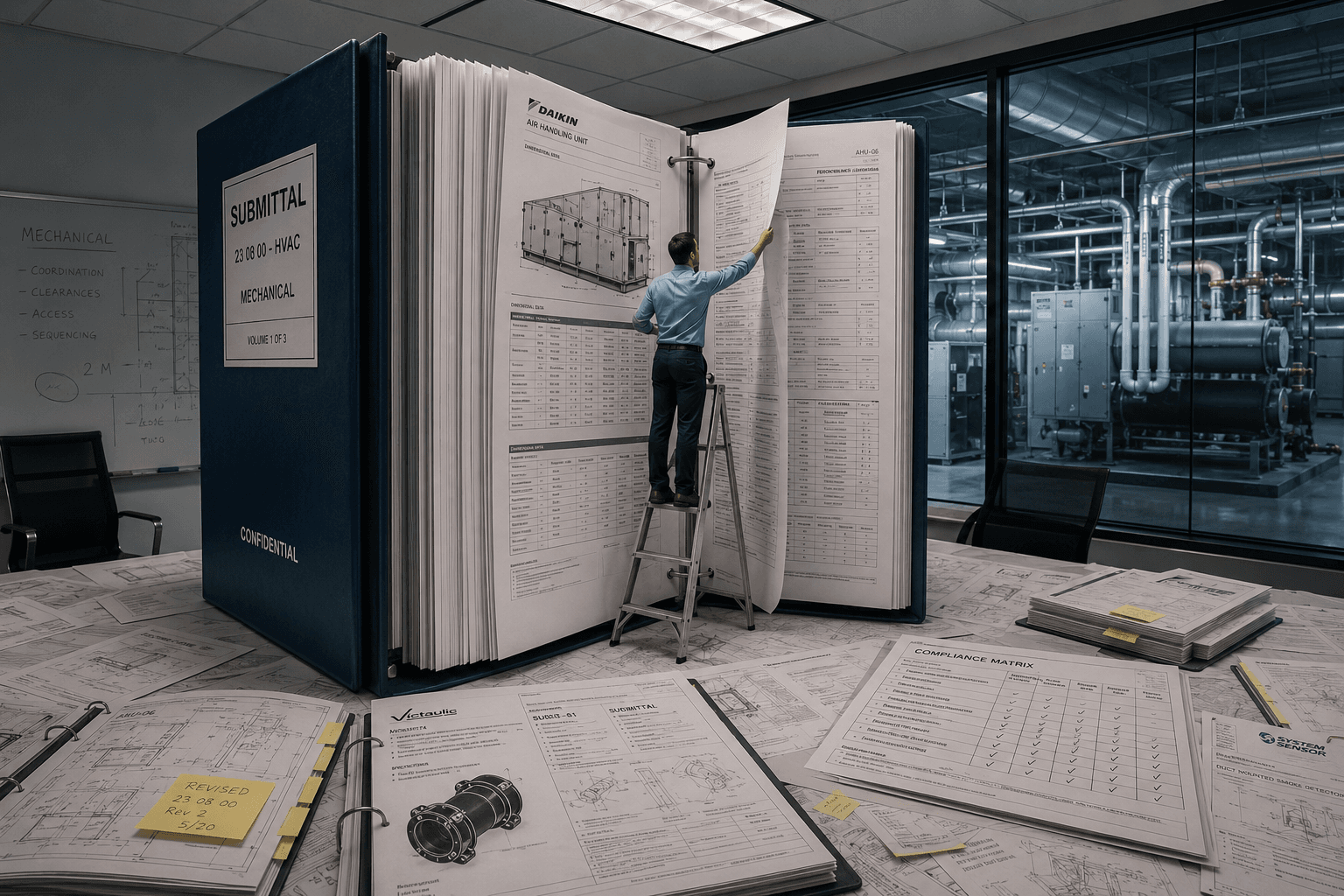
The 200-Page Submittal Problem (And the AI That Quietly Fixes It)
Commercial mechanical and electrical contractors spend two weeks of elapsed time per project assembling submittals. The work itself is six to forty hours of cross-referencing cut-sheets against the engineer's spec. Here's what an AI agent actually does to that workflow.
Suppose you're a project manager at a mid-market mechanical contractor and you've just won a multi-million-dollar HVAC scope on a new K-12 school. Three air handlers, two air-cooled chillers, a variable-refrigerant system for the administrative wing, hydronic distribution, controls integration, the works. You have six weeks before equipment needs to be ordered. The schedule is real — the GC is pouring slab on a fixed date and the steel goes up the week after.
Between today and the equipment order date, somebody on your team needs to assemble the submittal package.
If you've ever held a commercial mechanical submittal in your hand, you know what 200 pages looks like. Sometimes 300. Sometimes 450. Cut-sheets, performance curves, electrical data, dimensional drawings, controls schematics, warranty registrations, sequence of operations narratives, factory test reports, energy compliance documentation, refrigerant management plans, seismic restraint calculations, sound data, and a compliance matrix at the front that maps every line in the engineer's specification to the page in the package where the requirement is met.
Your submittal coordinator — sometimes a dedicated person, sometimes you, sometimes the estimator who quoted the work — sits down at 8 AM Monday and starts pulling documents. By 5 PM Friday, the package is ready for first-pass internal review. By the following Friday, it's back from the engineer with red marks. By the third Friday, it's resubmitted with corrections. By the fourth Friday, it's approved and the equipment is on order.
Two weeks of elapsed calendar time. Six to forty hours of office labor inside that calendar. And it's not the only submittal package you have in flight — depending on size, you might have eight or twelve running at any given time.
This is the work that's eating mid-market commercial mechanical and electrical contractors right now. Not the field labor. The desk labor. And it's where AI agents actually move the number.
What makes a submittal painful
The submittal package is a contract artifact. It's your formal answer to the consulting engineer's question: Are you actually going to install equipment that meets every requirement in my specification? Every line in the spec — sound rating, efficiency curve, refrigerant type, controls protocol, electrical characteristics, warranty terms, manufacturer qualification, ASHRAE compliance, code references — has to be matched in the package, line for line, with documentation.
The work isn't conceptually hard. It's mechanical. It's tedious. And it's high-stakes — a missed requirement means a redline, a resubmission, lost calendar time, and if the equipment was already ordered with a non-compliant spec, a real-money penalty.
Here's where the pain lives, in order of how much time it eats:
Cut-sheet collection. Every piece of equipment needs the manufacturer's official cut-sheet. The mechanical contractor doesn't usually publish these — the manufacturer or the manufacturer's rep does. So your submittal coordinator is emailing the rep, downloading PDFs from vendor portals, version-matching against the actual purchase order configuration, and saving them into a project folder. Average: one to two hours per major piece of equipment.
Compliance matrix. Every line in the engineer's spec has to be mapped to the page in the package where it's satisfied. This is a Word table or Excel sheet with the spec on the left and the page reference on the right. If the spec has 80 line items, that's 80 cross-references, each of which requires opening cut-sheets and finding the spec value. Average: four to twelve hours depending on project size.
Sequence of operations narrative. The controls portion of the submittal needs a written description of how the equipment will operate — when the chiller stages, how the air handler responds to outside air temperature, what the controls do when a sensor fails. This is often written from scratch by the controls subcontractor, or pulled from a similar prior project and edited. Average: two to eight hours.
Compliance check before submission. Before the package goes to the engineer, somebody internal has to read it end-to-end and confirm it's actually compliant — that the unit you selected really does meet 92% IEEW at part load, that the sound rating at 30 feet really is 68 dB, that the controls protocol really is BACnet/IP and not BACnet/MSTP. Average: two to six hours.
Engineer review and redlines. Two weeks of elapsed time, mostly waiting. When the redlines come back, your submittal coordinator needs to address each one — sometimes by re-selecting equipment, sometimes by adding clarification, sometimes by pushing back with a justification. Average: one to four hours of actual work, plus another week of elapsed calendar.
For a contractor running ten to fifteen active projects, this is a half-time office position per project at peak — and the work is bursty, concentrated in the first month of every project.
What an AI agent actually does
Skip the AI marketing language. Here is what a specifically configured AI agent does to a submittal workflow:
1. Spec parsing. The engineer's specification lands as a PDF — usually CSI-format, sometimes 80 to 200 pages. The AI agent parses it, extracts the equipment schedule, pulls every performance requirement and code reference into a structured list, and produces the compliance matrix template with every required line pre-populated. Your submittal coordinator reads the spec once, not three times.
2. Cut-sheet retrieval. Given the equipment selections (from your purchase orders or the rep's quote), the AI agent pulls the manufacturer cut-sheets from the rep's portal or your document library, version-matched against the configuration. If a sheet is out of date or missing, it flags it instead of putting the wrong page in the package.
3. Compliance matrix population. For each line in the engineer's spec, the AI agent searches the assembled cut-sheets for the matching performance value, populates the page reference, and flags any line where the cut-sheet value doesn't meet the spec requirement. Your submittal coordinator gets a pre-filled matrix with the discrepancies surfaced — not a blank table to fill in by hand.
4. Sequence of operations draft. Given the equipment selected and the controls protocol, the AI agent drafts a first-pass sequence of operations narrative based on similar prior project language in your firm's library, marked up with the specific equipment tags from this project. The controls engineer edits instead of writing from scratch.
5. Pre-submission compliance check. Before the package goes to the engineer, the AI agent runs a second-pass review against the engineer's spec — flags missing pages, flags non-compliant values, flags inconsistent unit numbering between the cut-sheets and the schedule. Your submittal coordinator addresses real issues, not formatting tells.
6. Redline turnaround. When the engineer's redlines come back, the AI agent parses them, identifies which line items changed, pulls the updated cut-sheet if needed, and re-populates the matrix. Your submittal coordinator addresses three redlines in twenty minutes instead of three hours.
The work that used to be a forty-hour office job becomes a six-hour coordination job. The two-week elapsed calendar shrinks to four days. The engineer's redline rate drops because the pre-submission compliance check catches the dumb errors before they leave your office.
What this changes for a mid-market contractor
A mechanical or electrical contractor running ten active commercial projects probably has the equivalent of one to two full-time submittal coordinator positions buried in PM time. The work is bursty, hard to staff against, and runs on Excel and Word documents that don't talk to each other.
When AI handles the submittal layer:
- The PM gets their week back. They're in the field reviewing installations, coordinating with the GC, and managing crew assignments instead of buried in cut-sheet PDFs.
- The estimator's quote-to-submittal handoff gets cleaner. The selection logic from the bid lives in the same data layer as the submittal compliance matrix.
- The redline cycle compresses. Two weeks of elapsed calendar becomes four days. Equipment ordering happens earlier. The project schedule has more float.
- The contractor can bid more work. Submittal labor isn't the bottleneck on volume — quote velocity is.
This isn't a hypothetical fairy tale. It's the kind of workflow change that happens when an agent is properly configured against a real project software stack — Procore, Newforma, BIM 360, Buildertrend, the same systems mid-market mechanical and electrical firms in your size class are already running.
What this is not
It's not a chatbot. You can't ask ChatGPT to "do my submittals" and get something usable. The work depends on your firm's catalog, your firm's selection logic, your firm's prior project library, your engineer relationships, your CRM, and your project management system. None of that is in a generic AI tool.
It's not a SaaS subscription. The procurement model that worked for the last fifteen years of construction software — license a tool, train staff, hope it sticks — isn't how this works. The AI agent is configured to your firm's specific workflow, then runs. You don't license it. You commission it.
It's not "AI replacing the submittal coordinator." The submittal coordinator becomes the agent's reviewer and the relationship-holder with the engineer. The work the coordinator was doing manually — cut-sheet matching, compliance matrix population, redline parsing — becomes review work instead of production work. Same person, different output velocity.
It's not magic. A bad spec produces a bad submittal regardless of AI. A non-compliant equipment selection is still non-compliant. The agent's job is to surface the mismatch faster, not paper over it.
The honest part
Not every mid-market contractor has the workflow maturity to benefit from this. If your firm is still emailing cut-sheets as attachments and storing approved submittals in a file share organized by project number, the data layer underneath has to come up first. That's a separate engagement — sometimes a separate vendor.
The firms that benefit immediately:
- Mid-market mechanical or electrical contractors running 8+ active commercial projects
- Submittal volume that's hit the ceiling on a single coordinator
- Existing project management software that has reasonable data export (Procore, Newforma, BIM 360, etc.)
- A bid-to-build pipeline where submittal calendar time is showing up in project schedule slip
- Owner / VP-Ops who can authorize a focused scoped engagement
The firms where this is a year-from-now decision:
- Smaller firms (under $5M revenue) — the submittal work is still solo and manageable
- Firms still on paper and email — the data substrate needs to come up first
- Firms in the middle of a project software migration — wait for the new system to stabilize
What happens next
If you're a PM or owner at a mid-market commercial mechanical or electrical contractor reading this and recognizing the workflow: the contact form on this site is the right next step. We're a small firm in the Carolinas — Blue Octopus Technology. We build the AI tooling the AI-marketing-emails promised but couldn't deliver. We do scoped engagements, not per-seat licensing.
The conversation is short. We ask about your project software, your current submittal volume, your typical project size, and where the work is hurting most. If it's a fit, we scope a focused pilot. If it's not, we tell you why and we point you at what would help.
Related reading:
- The Office Work Is Eating the Field Work — the universal back-office pain that the submittal pipeline is one example of, across mechanical / electrical / paving
- AI for Construction and Trades: What Actually Works in 2026 — the cross-trade documentation pain
- AI Won't Replace Your HVAC Tech. It Will Replace Your Scheduler. — the field-service side of the same AI-for-trades question
- Blue Octopus AI Hygiene — the operational standard we ship every engagement with
Stay Connected
Get practical insights on using AI and automation to grow your business. No fluff.