

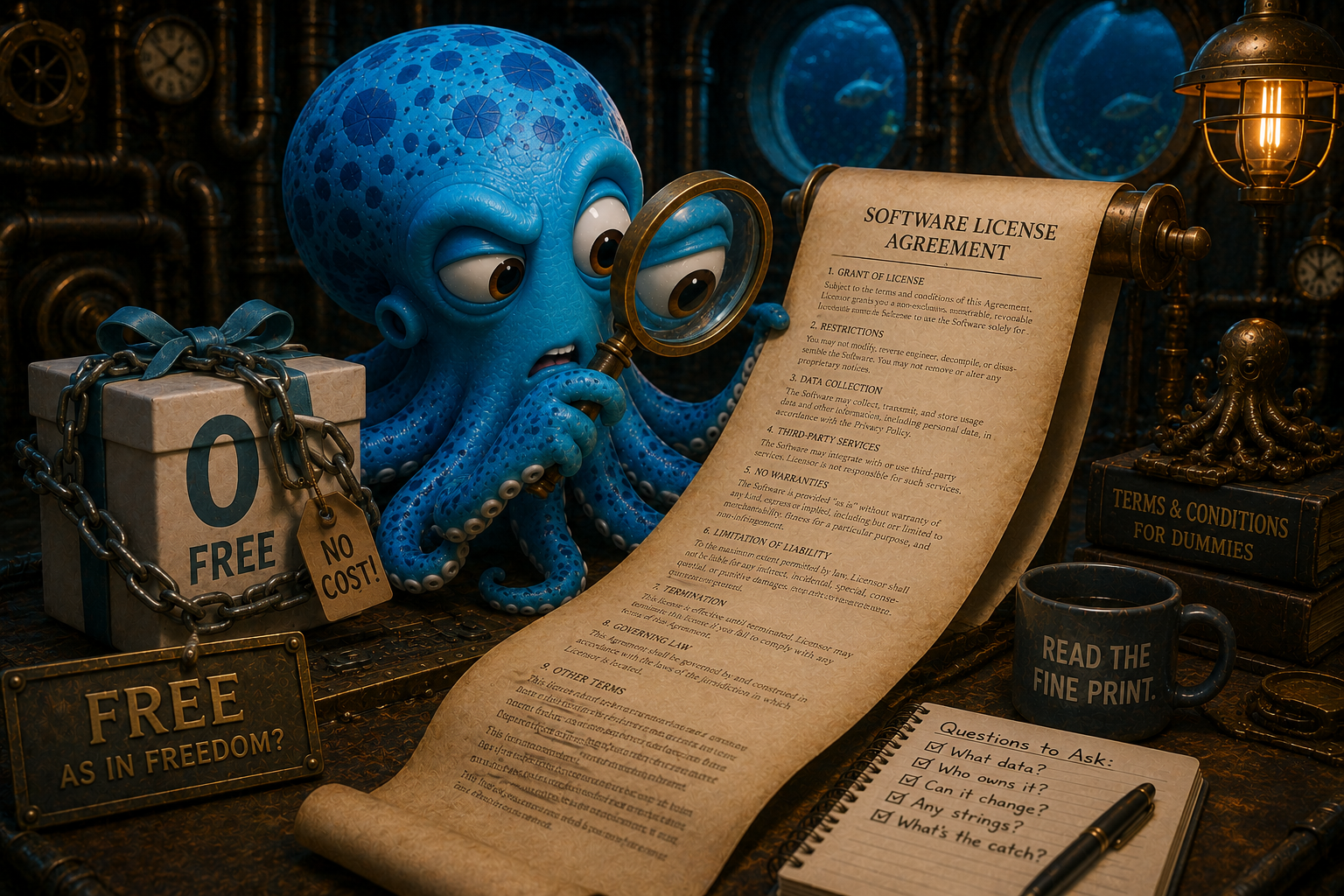
The AI Model Is Free. The License Might Cost You Everything.
'Free to download' and 'free to use in your business' are not the same sentence. The four AI-model license traps we check before any model goes near client work.
Every week there's a new AI model you can download for free. They're genuinely good — vision models, language models, models that do things that cost a fortune two years ago. Someone on your team finds one, it works beautifully in a test, and the natural next sentence is: let's put it in the product.
That sentence is where the trouble starts. Because "you can download it for free" and "you can use it in your business" are two completely different claims, and the second one is hiding in a license file almost nobody reads.
At Blue Octopus Technology we evaluate a lot of these models. Before any of them goes near client work, we bench it and check the license — and we've learned there are four specific traps. Here they are, each with a real example from models making the rounds right now.
Trap 1: There's no license at all
You'd assume a public model on a public code site comes with permission to use it. Often it doesn't. The license field just says, in effect, unspecified.
We looked at a fast, impressive object-detection model whose underlying foundation had exactly this problem — no clear, recognized open-source license at the source. The version most people were grabbing claimed permissive terms, but the thing it was built on had none. That's not a green light. That's a legal question mark, and "we found it on the internet and it didn't say no" is not a defense anyone wants to make later.
No license doesn't mean free. It means undefined — and undefined is a risk you're taking on, not a permission you've been granted.
Trap 2: Free for research, not for business
This is the most common one, and the most quietly dangerous, because the model works identically whether you're a university or a company. Nothing stops you technically. The license does.
A major chip maker released a genuinely excellent vision model — more than ten times faster than its competitors at a useful task. We'd love to use it. We can't. Its license permits "academic and non-profit research purposes only," and says commercial use is not permitted except by the company that made it.
So it's perfect for an experiment, a proof of concept, a "could this even work" test. The moment you ship it to a paying customer, you're in violation. The model didn't change. Your purpose did, and the license cares enormously about your purpose.
Trap 3: The free version and the good version aren't the same license
This one is sneaky because the headline number that made you excited belongs to a version you can't actually use freely.
A well-regarded detection model family is openly licensed — the small and medium sizes are truly free to use commercially. But the biggest, most accurate version, the one behind the impressive benchmark everyone quotes, ships under a separate, restrictive license. So the chart that sold you on the model was drawn by the one variant that isn't free for commercial use, while the freely-usable versions are a step down in capability.
Always confirm that the specific size or variant you plan to ship is the one with the permissive license — not just that the family is "open." The good headline and the open license don't always live in the same box.
Trap 4: You can use it commercially — just not for certain things
Some licenses say "commercial use is fine" and then list fields of use that are forbidden. Read the list.
We looked at a human-body tracking tool with a clean, permissive license on its code — but the actual AI model it depends on carries a license that explicitly prohibits military, warfare, surveillance, and weapons-related uses. For a golf-coaching app, that's no problem at all. For a defense or security application, those weights are off the table no matter how well they work. Same model, same download, completely different answer depending on what you're building.
There's also a quieter version of this: a model whose earlier versions were openly licensed, but whose newest release switched to a vaguer "other" license. People assume the new one inherits the old terms. It doesn't necessarily. Check every release, not just the family's reputation.
Why a business owner should care about any of this
You might be thinking this is a problem for engineers. It isn't, or not only. License risk is business risk, and it lands on the owner, not the developer who picked the model.
If you ship a product built on a model you weren't licensed to use commercially, the exposure is yours: a takedown demand, a forced rebuild, a renegotiation from a weak position, or worst case a legal claim — all after you've already built the thing and sold it. The cost of avoiding that is an hour of reading a license file before you build. The cost of skipping it shows up much later and much larger.
Here's the short checklist we run, and you can hand it to whoever evaluates AI for you:
- Is there a real, named license? "No license" is a red flag, not a free pass.
- Does it allow commercial use, or only research? Test with research-only models; never ship them.
- Does the specific version you'll ship carry the open license — or just the family?
- Are there forbidden fields of use that include what you actually do?
None of this means open models are a trap to avoid. We run openly-licensed models in real work constantly — they're one of the best things to happen to small businesses and AI. It means "free to download" is the start of the question, not the end of it.
The model is free. Find out what the license actually costs before you build your business on it.
Keep reading
More from the field.
Stay Connected
Get practical insights on using AI and automation to grow your business. No fluff.