
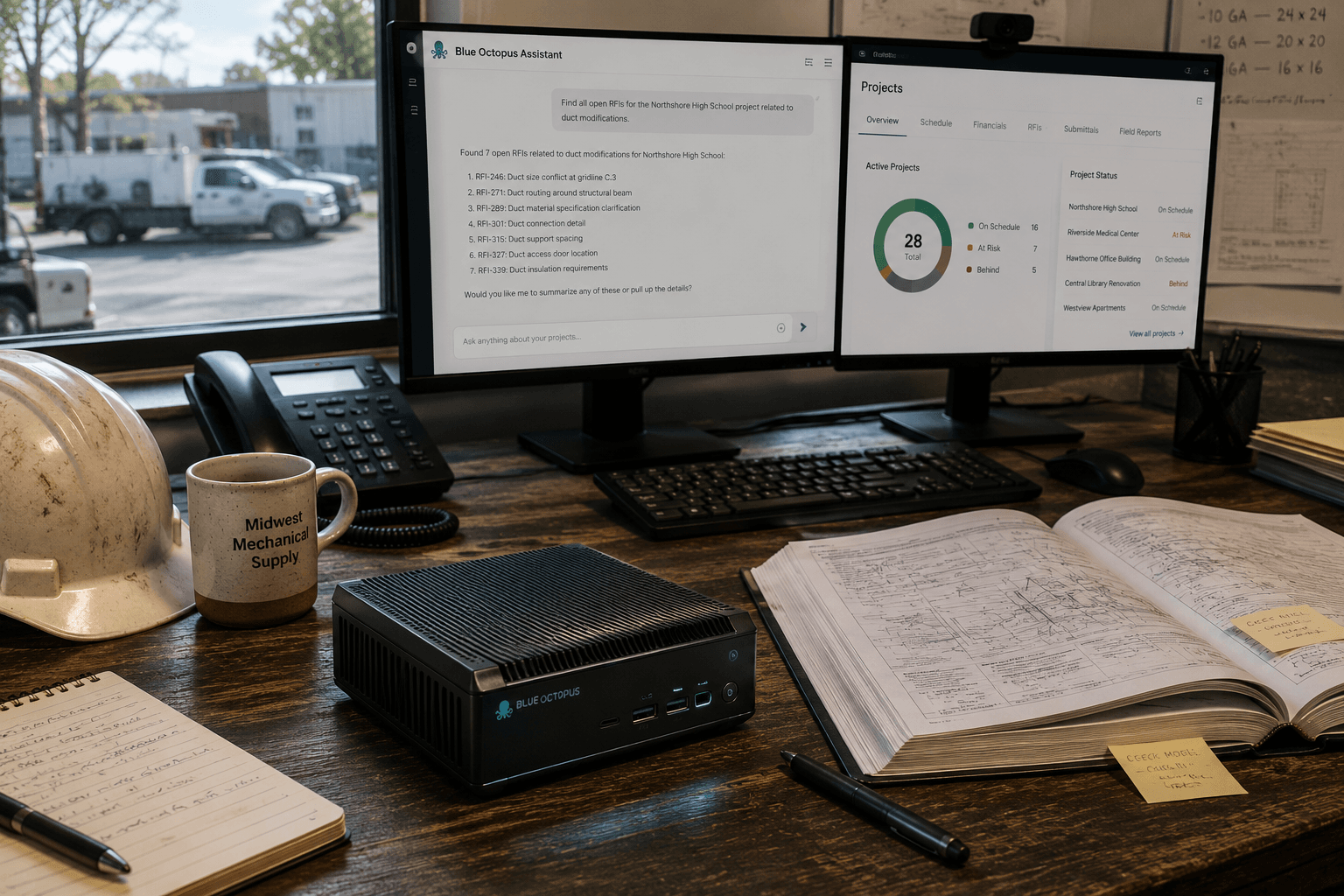
The AI Junior on a Box: What We Actually Sell
We sell a small computer that sits on someone's desk and acts as their personal AI junior — configured to their job, running real models, connected to the cloud when the work needs it. Hardware, engineering, and a recurring relationship. Not a SaaS subscription.
Imagine a small computer about the size of a Mac Mini sitting on the desk of one of your most overworked employees. Inside the box: a modern GPU, a hundred-plus gigabytes of unified memory, enough compute to run real AI models without phoning anything home. On the box: a configured stack of agents that speak the language of that employee's job — their CRM, their project software, their email, their customer history, their daily workflow.
The employee talks to the box. The box does real work. The work that used to take three hours of cut-sheet pulling, document assembly, customer follow-up, or aging-quote chasing happens in twenty minutes. The data the box touches stays under your roof for the routine work. When the task warrants a larger reasoning model, the box reaches out to Claude, OpenAI, or whichever frontier model fits — through your account, on your terms, with your data governance.
This is what we build. We call it an AI Junior on a Box. It's a product, not a SaaS subscription. You own the hardware. You own the configuration. The recurring relationship with us is the maintenance, the new role configurations as you grow, the cloud API budget, and the engineering bench you can call when the workflow needs to evolve.
Why a box and not a cloud service
The cloud-first AI products you've been pitched — ChatGPT Enterprise, Microsoft Copilot, the dozen Claude wrappers on top of that — solve a generic problem. They give a generic AI to a generic worker. They work, mostly. They're cheap, mostly. And they're not what you want for the cases where the work is specific.
The work is specific when:
- The data is sensitive enough that sending it to OpenAI isn't acceptable. (Customer financial records. Patient health information. Project specs covered by an NDA. Internal pricing models. Anything you wouldn't email to a stranger.)
- The work depends on a knowledge base that's yours. (Your equipment catalog. Your customer history. Your project archive. Your firm's specific way of writing a submittal. Your operating procedures.)
- The work needs to be available even when the cloud isn't. (Bad internet, traveling, on a job site, behind a firewall.)
- The work needs to run on your timeline, not somebody else's. (When OpenAI's API rate-limits you mid-month. When a vendor does maintenance at the wrong hour. When generic AI vendor pricing doubles overnight.)
- The work is your differentiator. (Your inside sales rep's knowledge of how engineers in your region actually write specs. Your estimator's pricing logic. Your service tech's diagnostic intuition. These are competitive moats. You don't want them in someone else's cloud.)
A box on the desk solves all of that. The local model handles the bulk of the routine work, fast, without sending anything to the cloud. The cloud connection — when configured — handles the heavy reasoning that benefits from a frontier model. The configuration on top of both is what makes the box yours.
What an AI Junior on a Box actually does
The phrase "AI junior" is deliberate. We don't sell chatbots. We don't sell assistants that wait for you to ask them a question. We configure agents that do the work a junior employee would do in their first two years on the job — except the AI junior never sleeps, never forgets, never quits, and never loses a project file in a folder it doesn't remember creating.
The role configuration is the differentiator. Same physical hardware, same on-box model stack — different configuration depending on who's sitting in front of it.
An inside sales rep at an equipment distributor gets an AI junior that reads incoming RFQs, parses the engineer's basis-of-design, cross-references the equipment catalog, drafts the quote, and manages the aging-quote follow-up cycle.
A submittal coordinator at a mechanical contractor gets an AI junior that assembles the 200-page submittal package, runs the compliance matrix against the engineer's specification, drafts the sequence of operations, and turns around the engineer's redlines. (We wrote a whole post about that workflow — see the related reading at the bottom.)
An estimator at a commercial paving company gets an AI junior that takes the project documents, runs the takeoff against the firm's pricing model, drafts the bid letter, and tracks aging quotes.
A project administrator at a commercial trades firm gets an AI junior that triages incoming email by category, drafts the right kind of response for each, consolidates daily reports from the field crews, and assembles pay applications + lien waivers each month.
A service dispatcher at a commercial HVAC service business gets an AI junior that triages service calls, matches them to the right technician's skill set and location, drafts the work order, and follows up on the customer satisfaction loop after the call.
Different roles. Same box. Same hardware budget. Same recurring relationship. The configuration is where our engineering goes.
What comes with the box
A box ships configured for the role. But it also ships with the orchestration layer that lets the role grow — the same operational system we use ourselves to run our own intelligence and content work.
That includes:
- A research pipeline that processes whatever sources you care about — industry blogs, X bookmarks, YouTube channels, podcast transcripts, industry publications — and structures the intelligence into a knowledge base your team can query.
- A compounding knowledge base that gets smarter the longer you use it. Year one it knows your equipment catalog. Year three it knows your equipment catalog, your historical bid library, your customer's preferences, your submittal review patterns, and the quirks of every consulting engineer you work with.
- A morning briefing skill that surfaces what needs attention today across your active projects, your pipeline, and the items waiting on others.
- Claude Code with a developer directory and starter projects so when you want to extend the box yourself — wire up a new integration, customize the agent's behavior, build a workflow we didn't anticipate — you have the scaffolding to do it without starting from scratch.
- A memory system that learns from your feedback. When you correct the agent's behavior, the correction sticks across sessions. The agent learns your firm's style without needing to be retrained.
The role configuration is the entry. The orchestration layer is what makes the box compound in value over years instead of going stale in months.
Who this is for and who it isn't
This is built for businesses serious enough to put real capital into AI infrastructure the way they'd invest in a new production line, a new fleet truck, or a new vertical-launched product line. The hardware costs real money because it does real work. The engineering costs real money because we're not gluing a chatbot onto your existing software — we're building a configured agent that lives inside your business.
The buyer that's a fit:
- Mid-market commercial business
- Mechanical contractors, electrical contractors, paving and site-work firms, commercial HVAC service businesses, equipment distributors, regional engineering firms, mid-market professional services
- Owner or VP-Ops decision-maker who can authorize a meaningful first-year engagement
- Has at least one role in the business where the cognitive load is breaking a key employee
- Wants to grow without growing office headcount proportionally
- Comfortable owning infrastructure (not allergic to capex)
The buyer that's not a fit:
- Anyone shopping for the cheapest AI tool to "see what happens"
- Businesses still on paper and email — the data substrate needs to come up first, and that's a different vendor's job
- Owners looking to fire half the office and replace them with AI — that's not what this does, and the box works best when the office stays employed and reinvests their time
- Anyone allergic to recurring relationships — the recurring is structural to how the product compounds
We're honest about this because the engagement is wrong for both sides if the fit is wrong.
Why a box beats a cloud-first stack
A cloud-first AI stack at a mid-market commercial business scales linearly with usage and gives you zero ownership of the result. Every month the bill grows. Every model upgrade is somebody else's pricing decision. Every workflow you customize is locked into the vendor's roadmap.
An AI Junior on a Box flips the math. You pay once for the hardware and the engineering. The recurring covers maintenance, model updates, and your cloud API budget for the cases that genuinely need a frontier model. By year three, the box is cheaper than the equivalent cloud-first stack and you have a real asset on your books — depreciable hardware plus a configured agent layer that's specifically yours.
The box also works when the internet doesn't. It works when the cloud vendor changes pricing. It works when your data can't legally leave the building. It works when you want the work to depend on infrastructure you control.
Cloud-first AI is a great fit for generic productivity. A box is a better fit for specific operations.
What happens next
If you're an owner or VP-Ops at a mid-market commercial business and this product shape lines up with where you're stuck — the contact form on this site goes to Blue Octopus Technology in the Carolinas. The conversation is short.
We ask:
- What roles are breaking under the cognitive load right now?
- What's your project / customer / equipment software stack?
- What's your annual revenue and how much of that is recurring versus project-based?
- What's the time horizon — pilot this quarter, or build the full deployment over six to twelve months?
If it's a fit, we scope a pilot. One box, one role, fixed timeline, fixed scope. Either the role's output velocity changes measurably, or we don't move forward to the multi-box deployment. The pilot is the proof. The multi-box deployment is the recurring partnership.
If it's not a fit, we tell you why. Usually it's data substrate — your project files live in paper and Excel and there's no querying layer for the agent to read against. That's a six-month project on its own and we point you at firms that do it.
We don't sell a subscription. We sell a box, the engineering that makes it useful, and a recurring relationship that compounds. The product is the box and what's on it. The business is the relationship.
Related reading:
- The Office Work Is Eating the Field Work — the operational pain that the box is the answer to, across mechanical / electrical / paving
- The 200-Page Submittal Problem (And the AI That Quietly Fixes It) — one specific role configuration on the box, deep-dived
- AI Won't Replace Your HVAC Tech. It Will Replace Your Scheduler. — for HVAC service businesses on the field-tech side
- Blue Octopus AI Hygiene — the operational standard every box ships with
Stay Connected
Get practical insights on using AI and automation to grow your business. No fluff.