

Forward Deployed Engineering in 2026 — What the Role Actually Does
Aaron Levie called it one of the most in-demand roles in tech. Nader Dabit said every major AI company is hiring for it. The job has a name now — Forward Deployed Engineer — and the description is a near-perfect match for what a working AI consultancy actually does. Here's what the role looks like in practice.
Two posts from credible voices landed within a week of each other in May.
Aaron Levie, the CEO of Box (a company that has spent the last decade selling enterprise software to companies that don't have any AI talent of their own), wrote this: "Forward deployed engineers, or equivalent, are about to become one of the most in-demand jobs in tech. And one of the most important functions for AI rollouts. Deploying agents is far more technical of a task than most people realize."
Nader Dabit, a developer-relations veteran who's been watching the AI hiring market more closely than most, wrote this: "Forward Deployed Engineer is the hottest, and one of the most in-demand, jobs right now. Every major AI company is hiring including OpenAI, Cognition, Anthropic, Google."
Two independent signals, same week, same conclusion. The role has a name now.
This is the same role we've been doing for two years without a tidy label. We've called ourselves a consultancy. We've called the work "AI deployment." We've called the model "retainer." All of those are accurate but none of them are crisp. "Forward Deployed Engineer" is crisp, and the framing is going to make the next 18 months of business development conversations easier than the last 18 were.
This post is what the role actually does, what makes it different from the AI work that came before, and why almost every business that adopts AI in the next two years is going to need one — either as an employee or as a vendor.

What a Forward Deployed Engineer is not
The first job of any well-named role is to kill the badly-named roles it replaces. Forward Deployed Engineer is replacing three of those.
It is not "AI Consultant." An AI consultant gives PowerPoint decks. A Forward Deployed Engineer ships a working agent that handles a specific business process by the end of the engagement. The consultant's deliverable is the deck. The Forward Deployed Engineer's deliverable is the agent doing the thing the customer paid for.
It is not "Prompt Engineer." A Prompt Engineer is a single-skill specialist for a problem that turned out to last about 18 months. (Prompt design is now mostly automated; the model gets a one-paragraph description of the goal and figures out the prompts itself.) A Forward Deployed Engineer's job spans the entire stack — model selection, prompt scaffolding, tool integration, data pipelines, deployment, monitoring, recovery. The prompt is the smallest piece.
It is not "MLOps Engineer." An MLOps engineer manages the infrastructure that trains, hosts, and monitors machine learning models — the data-center version of the role. A Forward Deployed Engineer works at the customer site, on the customer's actual workflow, often with no machine learning infrastructure at all (just an API key and a CLAUDE.md file). The work is in the business process, not the model.
The naming change matters because the customer is finally able to ask for what they actually want. They don't want "an AI strategy." They don't want "a prompt library." They don't want "MLOps." They want one engineer who shows up, looks at how their business actually runs, builds an agent that handles a chunk of it, ships it, and stays around long enough to make it work in production. That's the role.
The five things the role does in practice
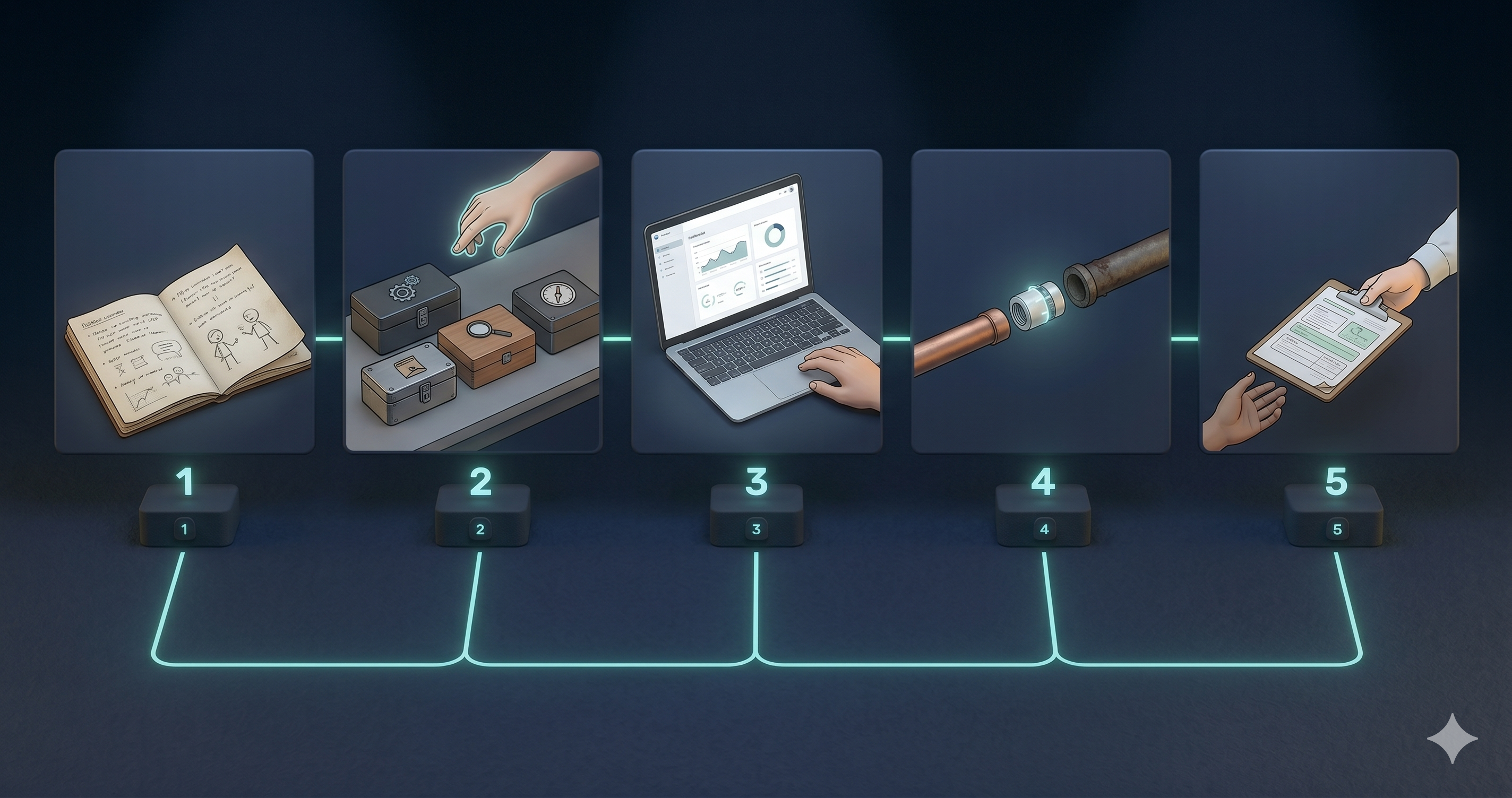
In our practice, every Forward Deployed Engineering engagement looks roughly like this.
1. Workflow archaeology. Before any code, the engineer maps the workflow the customer actually does — the one in their head, in their email chain, in their hand-written notebook. The thing nobody wrote down. The thing the customer says they do versus the thing they actually do (those are different documents; the actual workflow is usually messier, faster, and more clever than the written one). This is the part of the job that looks the least like "engineering" and is the most important. We covered the underlying skill in a separate piece on why context is the moat.
2. Tool selection. Given the workflow, which tools fit? Which AI model? Which agent framework, if any? Which automation platform — Zapier, n8n, Make, custom code, or some combination? Which existing tools does the customer already pay for that we should integrate with rather than replace? This is the part of the job where the senior practitioner saves the customer the most money, because the customer is otherwise going to buy six tools and need three.
3. The minimum-viable agent. Build the agent that does the smallest version of the workflow the customer pays for. Not the impressive version. Not the version with all the edge cases. The version that handles 70% of cases and fails loudly on the other 30%. We wrote about why this matters in the agent-complexity-trap piece: the customer needs a working agent in production, not a perfect agent in development. Perfect agents in development drift back to PowerPoint.
4. The integration with the customer's actual systems. This is where most "AI consultants" tap out. The agent has to talk to the customer's CRM, the customer's accounting system, the customer's customer-facing portal, the customer's data lake. None of those have AI-ready APIs by default. Most of them have some API, hidden behind authentication the customer's IT department either understands or doesn't. The Forward Deployed Engineer's job is to make the agent and the systems talk to each other, in production, with real data. This is engineering. There's no way to skip it.
5. The handoff and the monitoring. The customer's team takes the agent over. The Forward Deployed Engineer stays close enough to fix it when it breaks. The agent doesn't get "deployed and forgotten" — it gets monitored, retrained, prompts updated, edge cases added, tools swapped as the model providers evolve. This is the retainer relationship that pays for the rest of the practice.
The work spans archaeology, system selection, software engineering, integration, deployment, and ongoing operations. It is not one job, and it is not done by one role at most companies. The Forward Deployed Engineer is the single person who does all of it, because most customers can't hire five specialists to cover the same ground.
Why now
The reason the role is in demand right now is that the cost of the agent itself has collapsed faster than the cost of getting the agent into a business. This is the Jevons paradox applied to AI work: when the underlying capability gets cheaper, the demand for the capability goes up, and the bottleneck moves to whatever's next in the workflow.
A working AI agent in 2023 cost an enterprise about $250,000 in engineering time, six to twelve months, and a custom model fine-tune. A working AI agent in 2026 costs about $5,000 in API spend, three to six weeks, and an off-the-shelf model.
But that's only the cost of the agent. The cost of integrating the agent into the customer's actual business — the workflow archaeology, the system integration, the handoff — has not dropped at the same rate. Those are still human-scale tasks that require someone who understands the customer's business, the AI tooling, and the connecting plumbing. That person is the Forward Deployed Engineer.
The economics now look like this: every business that adopts AI has, behind the scenes, a 5-to-1 or 10-to-1 ratio of integration cost to agent cost. The agent is the cheap part. The forward deployment is the part you pay for.
This is the same economic shift we wrote about in our piece on why AI is making knowledge cheap and insight expensive. The pattern repeats across categories: the underlying capability commoditizes, and the connective tissue — the part that ties the capability to a specific business — becomes the scarce, valuable, paid-for resource.
What this looks like in our practice
We're a small consultancy in Western North Carolina. We have not historically described ourselves as a Forward Deployed Engineering shop, but reading the Levie and Dabit posts, that's exactly what we are.
Here's what an engagement looks like in practice.
A small business owner reaches out — usually because an existing process is breaking down at scale, or because they've watched a competitor adopt AI and want to understand what's possible, or because they have a specific stuck-task they want automated.
The first conversation is workflow archaeology. We talk about what the business actually does, where the friction is, where the money is being lost or made, and what the operator's day actually looks like. No technology yet. (We are skeptical of any AI vendor whose first conversation is about technology. The technology is at most the third conversation.)
If we agree there's a real fit, the next two to four weeks is the minimum-viable agent. We build the thing that handles the smallest version of the workflow that has real business value, and we ship it. Usually that's an agent that handles inbound inquiries, or one that drafts proposals from a small set of templates, or one that triages incoming work. Sometimes it's a custom dashboard or an automation pipeline that doesn't even use an AI agent. The goal isn't the most impressive thing we can build; it's the smallest thing that earns the customer's trust enough to deploy the next one.
If that lands, we move to a retainer relationship. Usually $2,500 to $5,000 per month, depending on scope. We are on call. We add capabilities as the business needs them. We swap out underlying tools as the AI ecosystem evolves (the agent that used GPT-4 last year uses Claude Sonnet or Gemini 3.5 now — same agent, new model). We do the next workflow archaeology session when a new bottleneck shows up. The relationship is a long-running one.
This is the Forward Deployed Engineering model. It doesn't have a catchier name yet. It might be called Agent Operator, AI Manager, or any of three other terms we've seen in the wild in 2026. The role is the same.

What it means for hiring (or vendor selection)
If you're a business considering AI adoption, here are the filters we'd suggest:
Don't hire a generalist consultant. The hourly rate is wrong for the actual work. The strategic-advisor model worked for cloud migrations because the cloud work was the same across customers. AI deployment is specific to your workflow, which means a generalist will burn hours on the archaeology phase that a specialist already knows how to do.
Don't hire a Prompt Engineer. That role is a 2024 artifact. The work has moved.
Hire (or contract with) a Forward Deployed Engineer. Look for someone who can describe a previous engagement in terms of the specific workflow they shipped, not the AI strategy they wrote. The good ones can describe the bug they hit on the third Tuesday, the data they had to clean, the API they had to authenticate against, the system that didn't have the field they needed. The bad ones describe their methodology.
Pay them on retainer, not by the hour. Hourly billing creates the wrong incentives — fewer hours when the agent is working, more hours when it's broken. Retainer aligns the engineer with keeping the agent working, which is the outcome the customer actually wants.
Expect 12 to 24 months of the relationship. AI tooling shifts every quarter. The agent you ship in May is going to need to be reworked in November. The engineer who shipped it is the one who can rework it. Hire (or contract with) someone you'd want to be doing this work with a year from now.
The roads-not-taken note
There's an obvious tension in this post that we want to name. We are simultaneously claiming that the agent is the cheap part and that the integration is the expensive part. If both of those are true, why does our retainer pricing not reflect a much higher delta from a hobbyist AI builder?
It does. Most hobbyist builders quote $1,500-3,000 for an "agent project" and disappear after delivery. We quote $2,500-5,000 per month, indefinitely, because the agent does not stay working without ongoing engineering, and the customer who tried the hobbyist path twice already knows this.
The price differential is between the deliverable and the relationship. Hobbyists ship deliverables. Forward Deployed Engineers ship relationships. The customer who buys an agent ends up paying twice — once for the agent and once for the engineer who shows up later to fix it. The customer who buys the relationship pays the right amount, once, monthly, and the agent stays working.
This is the consulting model the new economy actually pays for. We didn't invent it. Levie and Dabit named it.
If you're an operator looking for an engineer who fits this profile — someone who shows up, learns your business, ships the working version of an agent for one of your processes, and stays around to make it work — get in touch. We're a small practice with capacity for two to three new retainer relationships at any given time, and we're in the right phase of our business to be careful about the next one.
Related reading:
- Why Your AI Agent's Biggest Problem Isn't the Model — It's the Context — the workflow-archaeology phase, in more depth
- The Agent Complexity Trap: Why Your Business Needs Level 2, Not Level 5 — the minimum-viable-agent argument, expanded
- Zapier vs n8n vs Make in 2026 — the tool-selection phase, with three concrete tradeoffs
- Blue Octopus AI Hygiene: A Drop-in CLAUDE.md for Anyone Letting an Agent Touch Their Code — the engineering-hygiene foundation underneath the deployment work
Stay Connected
Get practical insights on using AI and automation to grow your business. No fluff.