
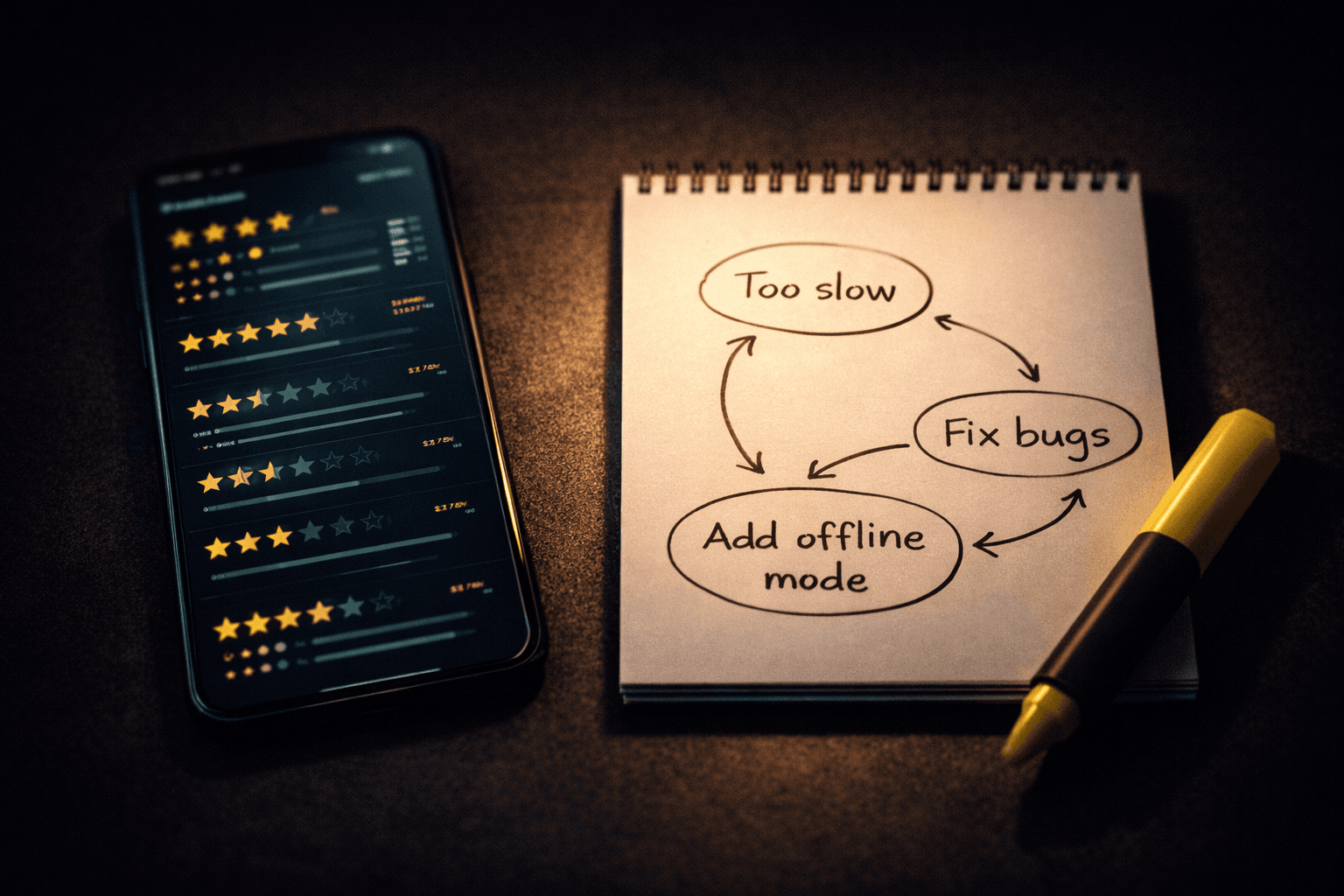
How to Find Your Next Product Feature in App Store Reviews
Your competitors' customers are publishing free market research every day. Every one-star review is someone describing exactly what they wish existed. Here's a 30-minute workflow that turns competitor reviews into your next competitive advantage.
A meal planning app has 423 reviews on the App Store. Someone pulled all 423, dropped them into an AI, and asked one question: what do these people want that they're not getting?
Ninety-one reviews mentioned the same missing feature. Not a vague sentiment. A specific capability that users described in their own words, over and over, across months of reviews. Ninety-one people took the time to write about it.
That feature doesn't exist in any competing app. Not in this one. Not in the five closest alternatives. Ninety-one people describing a gap, and nobody has filled it.
Someone will. The question is whether it'll be the developer who reads this data or the one who doesn't.
The Insight Hiding in Plain Sight
Every business has competitors. And every competitor has customers. And some percentage of those customers are unhappy about something specific — and writing about it in public.
On the App Store. On Google Maps. On Yelp. On Amazon. On G2 and Capterra. On every review platform where people go to share what they loved, what they hated, and what they wished was different.
This is free market research. Published daily. By the exact people you want to serve.
Most businesses never look.
Not because they don't care. Because reading reviews is tedious. One review is a data point. Ten reviews are a trend maybe. But 423 reviews? Nobody has time to read 423 reviews, categorize the complaints, count the frequencies, and extract the patterns. So nobody does.
That's what changed. AI made the tedious part fast.
The 30-Minute Workflow
This isn't complicated. It doesn't require coding. It doesn't require special tools. If you can copy and paste and type a sentence, you can do this.
Step 1: Find Your Competitors' Reviews
Pick a category. Your category. The thing you sell, the service you provide, the market you're in.
If you're a software company, go to G2 or Capterra and find your competitors' review pages. If you're a local service business, go to Google Maps or Yelp and find your competitors' profiles. If you sell physical products, go to Amazon and find the competing products.
You're looking for competitors with at least 50 reviews. Fewer than that and you're reading anecdotes, not patterns. More is better — 200 or more is ideal.
Pick two or three competitors. Not twenty. You want depth, not breadth.
Step 2: Export the Reviews
This is the manual part, and it's simpler than it sounds.
For App Store and Google Play reviews, tools exist that can export all reviews from a specific app into a spreadsheet or text file. Some are free, some are paid. A search for "export app store reviews" will turn up current options.
For Google Maps and Yelp, you can copy reviews directly from the page. It's tedious for large volumes, but for 50-100 reviews, it takes about fifteen minutes of copying and pasting into a document.
For Amazon, the same approach works — copy the review text into a file. Focus on the one-star, two-star, and three-star reviews. The five-star reviews tell you what's working. The low-star reviews tell you what's missing. That's what you want.
For G2 and Capterra, many profiles show reviews publicly. Copy the text. Focus on the "Cons" and "What do you dislike?" sections — those are where the gaps live.
You'll end up with a text file or spreadsheet containing dozens to hundreds of reviews. It doesn't need to be formatted perfectly. It just needs to be readable.
Step 3: Feed It to AI
Open ChatGPT, Claude, Gemini — whatever AI tool you use. (Not sure which one? We compared the options in free AI tools every business owner should know about.) Paste the reviews in, and give it a prompt like this:
"I'm pasting [number] customer reviews from [competitor name], a [type of product/service]. Analyze these reviews and identify: (1) The most frequently mentioned complaints or missing features, ranked by how often they appear. (2) Specific unmet needs that multiple reviewers describe. (3) Any patterns in what customers say they wish the product/service did differently. For each finding, tell me how many reviews mentioned it and give me a direct quote from a review that illustrates the point."
Then let it work.
Step 4: Read What Comes Back
The AI will return something like this:
Finding 1: No meal prep for families with different dietary needs (47 of 423 reviews) "I love this app for my own meals but my husband is keto and my daughter is vegetarian. I need one plan that handles all three of us, not three separate subscriptions." — 2-star review
Finding 2: Grocery list doesn't account for ingredients you already have (31 of 423 reviews) "Every week it tells me to buy olive oil. I have olive oil. I always have olive oil. There's no way to tell it what's in my pantry." — 3-star review
Finding 3: Recipes assume you have 45 minutes on a Tuesday night (28 of 423 reviews) "The 'quick meals' are 30-40 minutes. That's not quick. Quick is 15 minutes. I need actual fast meals for actual busy nights." — 1-star review
That's not a focus group you paid $15,000 for. That's AI for small business doing what it does best — making expensive processes accessible. That's not a survey with a 3% response rate. That's 423 real people describing real problems with real products — organized and ranked in about two minutes.
This Works for Every Kind of Business
The meal planning example is from the tech world, but the technique works anywhere customers leave reviews. Which is everywhere.
A Plumber Reads Competitor Reviews on Google
Say you're a plumber in Asheville. You search Google Maps for "plumber Asheville NC." You find your five main competitors. You read their Google reviews — not the five-star ones, the ones and twos and threes.
A pattern emerges. Across all five competitors, the number one complaint isn't quality of work. It's communication. "Never called back." "Showed up two hours late with no warning." "Couldn't get anyone on the phone." "Had to leave three messages before someone responded."
You count them up. Out of 187 combined reviews across five competitors, 61 mention communication problems. That's one in three unhappy customers complaining about the same thing.
You don't need to hire a marketing consultant to figure out your positioning. Thirty-three percent of your competitors' unhappy customers just told you: answer your phone, show up on time, and send a text when you're on the way. That's your competitive advantage. Not better plumbing. Better communication.
You update your Google Business Profile: "We answer every call. We show up when we say we will. We text you before we arrive." That's not a marketing claim. It's a direct response to what the market said it wanted.
A Restaurant Owner Reads Yelp Reviews
Now imagine you run a fast-casual restaurant in Charlotte. You pull the one-star and two-star Yelp reviews from the three restaurants you consider your closest competition. All three are in the same category — fast-casual, lunch-focused, business district.
The surprise isn't the food complaints. Every restaurant gets food complaints. The surprise is what shows up in the three-star reviews — the "it was fine, but..." reviews. Twenty-two of them mention the same thing: slow service at lunch.
"Food is great but I can't wait 25 minutes for a sandwich when I have a 45-minute lunch break."
"Love this place for dinner. Won't go for lunch anymore because it takes too long."
"The line moves so slowly. If they could figure out the lunch rush, this would be a five-star place."
Twenty-two people didn't leave one-star reviews. They left three-star reviews. They like the restaurant. They just can't afford to wait. They're telling the owner — and anyone who's listening — exactly what would turn them from an occasional visitor into a regular.
The smart move? Build your lunch service around speed. Online ordering with a guaranteed 10-minute pickup. A dedicated lunch menu with items that can be prepared in advance. Don't compete on food quality — compete on the thing the market said it cared about: not wasting their lunch break.
A Software Company Reads G2 Reviews
A B2B software company looks at their three biggest competitors on G2. All of them have 200+ reviews. They export the "What do you dislike?" sections and drop the whole batch into AI.
The analysis comes back with a clear pattern: 38% of negative feedback across all three competitors mentions the same problem — the reporting is inflexible. Users can't customize dashboards. They can't build the specific reports their managers ask for. They end up exporting data to Excel and building reports manually, which defeats the purpose of having the software.
That's not a bug report. That's a product roadmap. Thirty-eight percent of unhappy users across three competing products want the same thing. Build it, and you have a clear, data-backed differentiator. Not a feature you think people want. A feature that hundreds of people have publicly said they need.
How to Tell Real Gaps from Noise
Not every complaint is an opportunity. Some reviews are written by angry people having a bad day. Some complaints are about things that genuinely can't be fixed, or shouldn't be. You need to separate signal from noise.
Here's how.
Volume is the first filter. One person complaining about a thing is an anecdote. You can't build a business on one person's bad experience. But when 47 out of 423 reviews mention the same missing feature — that's 11% of your sample saying the same thing independently. That's a pattern.
The rough thresholds:
- 5 reviews mentioning something = interesting, investigate further
- 50 reviews mentioning something = real pattern, worth acting on
- 500 reviews mentioning something = market-wide gap, significant opportunity
Specificity is the second filter. "This app sucks" tells you nothing. "This app doesn't let me plan meals for multiple people with different diets" tells you everything. The more specific the complaint, the more actionable it is. Vague complaints are venting. Specific complaints are product specifications written by your future customers.
Repetition across competitors is the third filter. If the same complaint shows up in reviews of three different competing products, it's not a product-specific problem. It's a market gap. Nobody has solved it. That's the most valuable kind of finding because it means the opportunity isn't just to be better than one competitor — it's to be the first to solve a problem the entire category has ignored.
Check the dates. A complaint from 2024 might have been addressed in a 2025 update. Look at recent reviews to confirm the gap still exists. AI won't always know the difference between a current complaint and a historical one that's since been resolved.
Watch for the "I would pay for this" signal. Sometimes reviewers will explicitly say what they'd do if the gap were filled: "I'd upgrade to the premium plan if it had X." "I'd switch from [competitor] in a heartbeat if someone built Y." "Take my money if you add Z." These are the strongest signals in the dataset. Someone is literally telling you they're ready to be your customer.

What the AI Won't Tell You
AI is good at counting and categorizing. It's not good at judgment.
The AI will rank complaints by frequency. It won't tell you which ones align with your business's strengths. That's your job.
If 47 reviews mention a missing feature and building it would take 18 months and $500,000 in engineering, that's not an opportunity for a five-person company. It might be a signal to watch, not a signal to act on.
If 31 reviews mention a workflow problem and you've solved exactly that problem before in a different context, that's a strong match — even if fewer people mentioned it.
The AI also can't tell you about the market dynamics behind the reviews. Maybe the complaint about slow lunch service exists because the restaurant is chronically understaffed — a problem the owner knows about and can't solve because of the labor market. The review says "fix the speed." The reality is "fix the hiring pipeline in a tight labor market." The AI doesn't know that. You do.
Use the AI for what it's good at: processing volume, finding patterns, counting frequencies. Use your own judgment for what it's not good at: deciding which patterns matter for your specific business.
What to Do With the Intelligence
You've done the research. You've found the patterns. You have a ranked list of gaps in your market. Now what?
Don't try to address everything. The temptation is to build a product or service that fixes all the complaints. That's how you end up with a bloated product that does everything poorly and nothing well. Pick one gap. Maybe two. The ones that align with what you're already good at.
Validate before you build. The reviews told you what people complain about. They didn't tell you what people will pay to fix. Before investing serious time or money, test the concept. Talk to potential customers. Describe the thing you're thinking of building. See if their eyes light up or glaze over. Reviews are a starting point, not a business case.
Use the exact language your customers used. This is a subtle but powerful advantage. When you're writing your marketing copy, your product descriptions, your pitch — use the words from the reviews. Not because it's a trick. Because it's how your customers actually describe their problem. "Plan meals for my whole family even though we all eat differently" is better copy than "multi-profile dietary preference management." The first one is how a human talks. The second one is how a product manager talks.
Set up a recurring process. Don't do this once and forget about it. We built an entire intelligence system around exactly this principle — recurring analysis that compounds over time. Reviews change. New complaints emerge. Old ones get solved. Run this analysis quarterly. It takes 30 minutes. The insights compound over time as you start tracking which gaps are growing, which are shrinking, and which are being addressed by competitors.
The Caveat About Negative Reviews
Negative reviews are not a representative sample of all customers. They're a sample of customers who were annoyed enough to write something. Happy customers, satisfied customers, customers who think the product is fine — they mostly stay quiet.
This means the data skews toward problems. Which is what you want when you're looking for gaps. But it also means you can overweight the severity of an issue.
If 11% of reviews mention a missing feature, that doesn't mean 11% of all users want it. It means 11% of the people who bothered to write a review mentioned it. The actual demand could be higher (most people don't write reviews) or lower (angry people are more motivated to write).
The point isn't to take the numbers as gospel. The point is to use them as directional signals. "A meaningful number of people care about this" is a useful finding even if you can't calculate the exact percentage of the total market.
Start With 30 Minutes
Here's the minimum viable version of this technique. No special tools. No budget. Just you, a browser, and a free AI tool.
- Pick one competitor. Your most direct competitor.
- Go to their review page — Google, Yelp, App Store, G2, Amazon, wherever their customers leave feedback.
- Copy the text of their 50 most recent reviews. Just the negative and neutral ones.
- Paste them into ChatGPT or Claude.
- Ask: "What are the most common complaints and unmet needs in these reviews? Rank by frequency."
- Read the output.
That's it. Thirty minutes. Zero dollars. And you'll know something about your market that most of your competitors have never bothered to find out.
If the output is interesting — and it almost always is — expand. Add more competitors. Add more reviews. Run the analysis quarterly. Build a simple spreadsheet that tracks the top gaps over time. Watch which ones persist, which ones get solved, and which ones are growing.
The Business That Stops Guessing
None of these examples require a market research budget. No consultants. No commissioned studies. Just one evening reading what your competitors' customers are already saying — publicly, for free, in their own words.
The patterns are obvious once you look. Speed at lunch. Communication in the trades. Onboarding friction in software. People across multiple competitors saying the same thing in different ways.
Build your strategy around those insights. Don't guess what the market wants. The market is already telling you. You just have to read it.
And once you've done it once, do it again. Run the analysis quarterly. Expand to new competitors. Apply it to different parts of your business. Each round of reviews surfaces new patterns, new gaps, new things customers are asking for and nobody is providing.
You don't need to be a data scientist. You just need to discover that your competitors' unhappy customers are doing your market research for free.
Your competitors' customers are writing reviews right now. About what's working. About what's missing. About what they wish someone would build.
You can keep guessing what the market wants. Or you can spend 30 minutes reading what it's already telling you.
Need Help Turning Insights Into Action?
Blue Octopus Technology helps businesses build competitive intelligence workflows — from identifying market gaps to implementing the tools and processes that act on them. We don't just find the patterns. We help you build systems that turn them into revenue.
If you've got a market worth understanding better, let's talk about what we can find.
Blue Octopus Technology helps businesses work smarter with AI — without the complexity. See what we build.
Stay Connected
Get practical insights on using AI and automation to grow your business. No fluff.