
Your Pool Company Doesn't Need an App — It Needs an Automation
A pool company owner spends 3 hours every morning routing technicians by hand. The automation that could replace it takes 11 minutes to build. So why do businesses keep reaching for custom apps?
Here is a scenario that plays out across thousands of service businesses. A pool company owner spends three hours every morning routing technicians, sending appointment reminders, and making sure everyone knows where they're going. Phone calls, spreadsheets, text messages. Three hours before anyone touches a pool.
He does this for years. That's thousands of hours spent on scheduling — not cleaning pools, not growing the business, not taking a morning off. Just routing.
The automation that replaces this takes about 11 minutes to set up with today's self-healing AI tools. The system catches a timezone bug on its own and fixes it. It runs from there.
The instinct most people have when they hear a scenario like this is "he should build an app." That instinct is wrong, and it's costing business owners a lot of money.
The App Trap
Here is what happens when a small business decides they need "an app."
First, they spend weeks describing what they want. Then they get a quote — usually somewhere between $30,000 and $150,000, depending on how many features they think they need. They pick a developer or agency. The project takes three to six months. Maybe longer.
When it's finally done, they have a custom application that does exactly what they described six months ago — which may or may not match what they actually need today. It needs hosting, updates, security patches, and someone who understands the codebase when something breaks. That someone is usually the developer they hired, at $150 to $250 per hour for maintenance.
For a pool company. For routing technicians and sending text reminders.
The problem isn't the technology. The problem is using a sledgehammer where a screwdriver would work. Most small business operational pain doesn't need a custom application — our guide on custom software vs. off-the-shelf explains when each approach makes sense. What most businesses actually need is a workflow that connects the tools you already use and automates the repetitive parts.
What Automation Actually Looks Like
Let's take the pool company example and break it down. Every morning, the owner was doing a handful of tasks:
- Look at the day's appointments
- Figure out which technician is closest to each job
- Build a route for each technician
- Send each technician their schedule
- Send each customer a reminder with the technician's name and estimated time
That's not an app. That's a workflow. And modern automation platforms can handle every step of it — pulling appointments from a calendar, optimizing routes, sending texts, updating a shared dashboard — without writing a single line of code. If you are wondering which platform to use, our comparison of Zapier, n8n, and Make covers the main options.
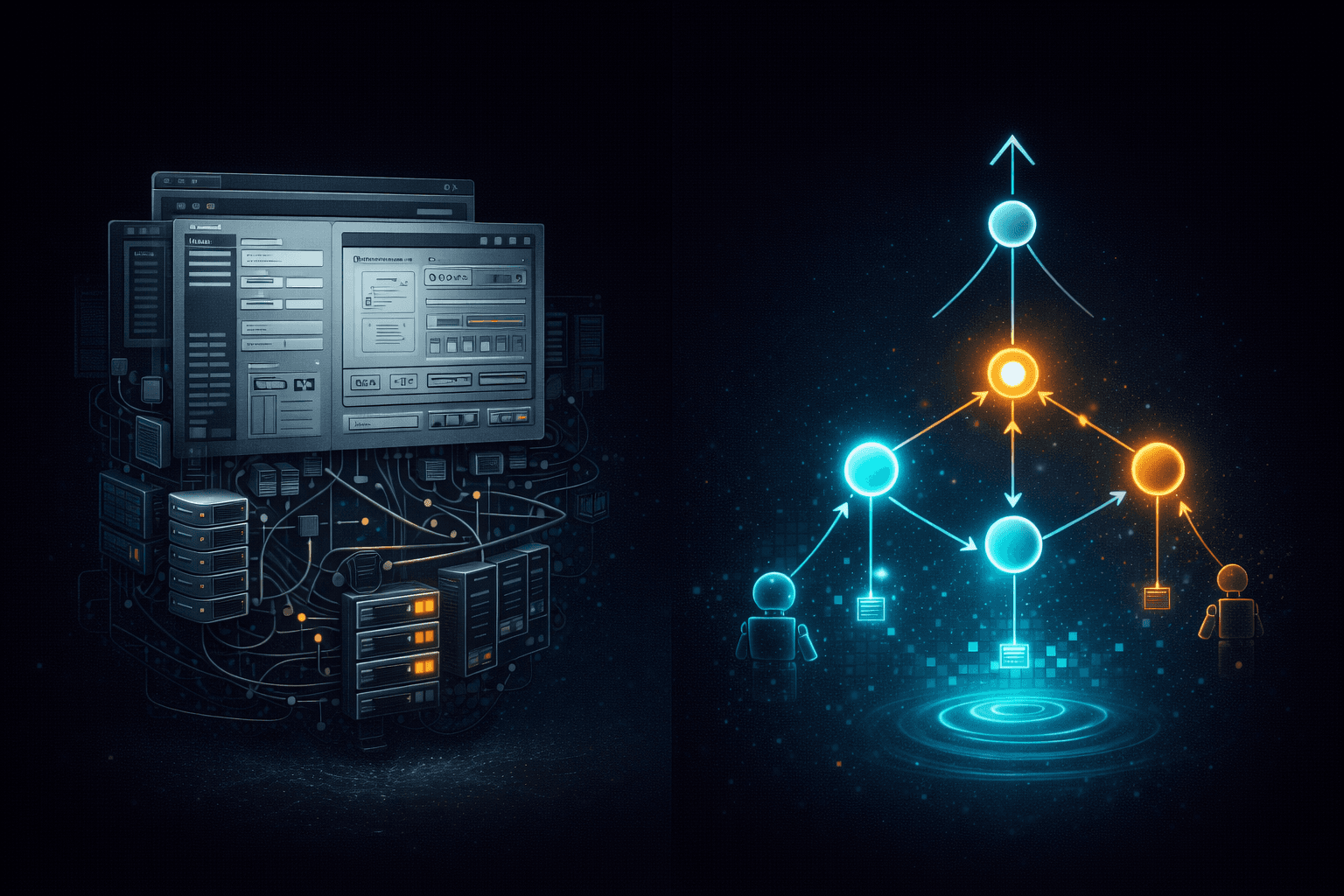
The real difference between an automation and an app is that automations are built from the outcome backward. You describe what needs to happen, and the system figures out how to connect the pieces. An app is built from the architecture up — databases, user interfaces, authentication, hosting. Ninety percent of that infrastructure is wasted on problems a small business doesn't actually have.
The Numbers Don't Lie
Consider the property management problem. A typical firm handles tenant maintenance requests by hand — receiving requests, categorizing urgency, finding the right contractor, confirming with tenants, escalating if nobody responded, and generating weekly reports for property owners.
The old approach to automating that: three weeks of setup, a team of developers, around $16,000.
The new approach: 28 minutes. Five connected workflows. Two hit errors on the first run and fix themselves automatically. Buyer cost in the $9,000 range — and that's generous pricing.
The math gets more dramatic at scale. Public accounts of automation agencies that have adopted this approach describe firms that went from 15 employees handling 40 projects a month to 5 employees handling 55, with revenue run rates above $7 million annually and zero full-time developers on staff. (Take the specific dollar figures with appropriate skepticism — some come from operators selling self-healing tooling — but the structural argument holds up regardless of the headline numbers.)
That last part is worth repeating: in the new model, an automation company can produce real revenue with no developers on staff. The automations build and debug themselves.

Why This Works Now (and Didn't Two Years Ago)
Two things changed.
First, AI got good enough to understand business problems described in plain language. You don't need to write code or draw flowcharts. You can say "when a tenant submits a maintenance request, categorize the urgency, find the nearest available contractor who handles that type of issue, text the tenant with the contractor's name and ETA, and escalate to management if nobody responds in two hours." That's a paragraph, not a specification document. And it's enough.
Second, automation platforms learned to test themselves. The old approach was: build the workflow, deploy it, wait for something to break, get an error message, figure out what went wrong, fix it, redeploy. That debugging cycle is what made automation expensive. Not the building — the fixing.
New tools can deploy a workflow, fire a test, catch the error, search for documented solutions, apply the fix, and retest — automatically. We wrote a deep dive on this in Self-Healing AI Workflows: When Your Automations Fix Themselves. The pool company's timezone bug? The system found it, looked up the fix, applied it, and moved on. No human involved.
Who This Is Really For
The businesses that benefit most from automation are the ones nobody in tech thinks about. Tech companies build tools for other tech companies. Startups build apps for millennials in cities. Meanwhile, there are millions of businesses run by people who are great at their trade and drowning in operational busywork.
Pool cleaners who spend their mornings on routing instead of in the field. Funeral directors who spend four hours a day on scheduling, family follow-ups, and paperwork — and have been doing it for over a decade. Landscapers chasing invoices. Plumbers playing phone tag with customers.
These business owners don't want "automation solutions." They want their Tuesday mornings back.
They don't need a pitch deck about digital transformation. They need someone to look at their daily routine and say, "that three-hour thing you do every morning? We can make it happen automatically while you drink your coffee."
What You Should Actually Build
If you're a business owner reading this and thinking about your own version of the three-hour morning routine, here's the honest advice.
Don't start with an app. Start by listing the five things you or your staff do every day that are repetitive, follow a pattern, and don't require human judgment. Things like:
- Sending appointment reminders
- Routing field crews
- Following up on invoices
- Acknowledging customer inquiries
- Generating weekly reports for yourself or your clients
Those are automation candidates. Each one can probably be set up in under an hour. You won't need a developer, a database, a hosting provider, or a six-month timeline.
Don't start with "what software should I buy." Start with "what's eating my time." The tools are interchangeable. The clarity about what needs to happen is the hard part — and it's the part where most business owners actually have deep expertise, even if they don't think of it that way. Nobody knows your daily operations better than you do.
Don't try to automate everything at once. Pick the one task that annoys you the most or costs you the most time. Automate that. Live with it for a week. Then pick the next one. Stacking small automations is more reliable and more flexible than building one big system.
The Bottom Line
A pool company doesn't need an app. Neither does a funeral home, a law firm, a dental practice, or a landscaping company. What they need are automations that handle the repetitive work so the people who run the business can focus on the work that actually requires them.
The technology to do this exists today. It's faster to set up than most people expect, it's dramatically cheaper than custom software, and it doesn't require you to become a tech company to use it.
The real question isn't whether you should automate. It's how much of your time you're willing to keep spending on tasks a machine could handle in the background.
If you're spending your mornings on routing, scheduling, and follow-ups instead of doing the work you actually started the business to do, we should talk.
Keep reading
More from the field.
Stay Connected
Get practical insights on using AI and automation to grow your business. No fluff.