
Self-Healing AI Workflows: Patterns That Actually Work
Self-healing workflows detect when they break, diagnose the cause, and fix themselves — no human in the loop. Patterns, tools, and what to build first.
The automation consulting industry was built on two moats.
The first: "We know how to build this. You don't." That moat started leaking in 2024, when AI tools got good enough to generate working automations from plain English descriptions.
The second: "We know how to debug this. You don't." That moat held longer. Building something is one thing. Knowing what to do when it breaks at 2 AM on a Sunday — that's where the real consulting dollars lived.
Both moats are now collapsing. Not because AI got smarter at building. Because it learned to fix its own mistakes.
What Self-Healing Actually Means
The term "self-healing" gets thrown around loosely in tech, so let's be specific about what's happening here.
A traditional automation workflow follows a straight line: you describe what you want, someone builds it, you deploy it, and when it breaks, you call the person who built it. They charge you to fix it. This cycle repeats forever.
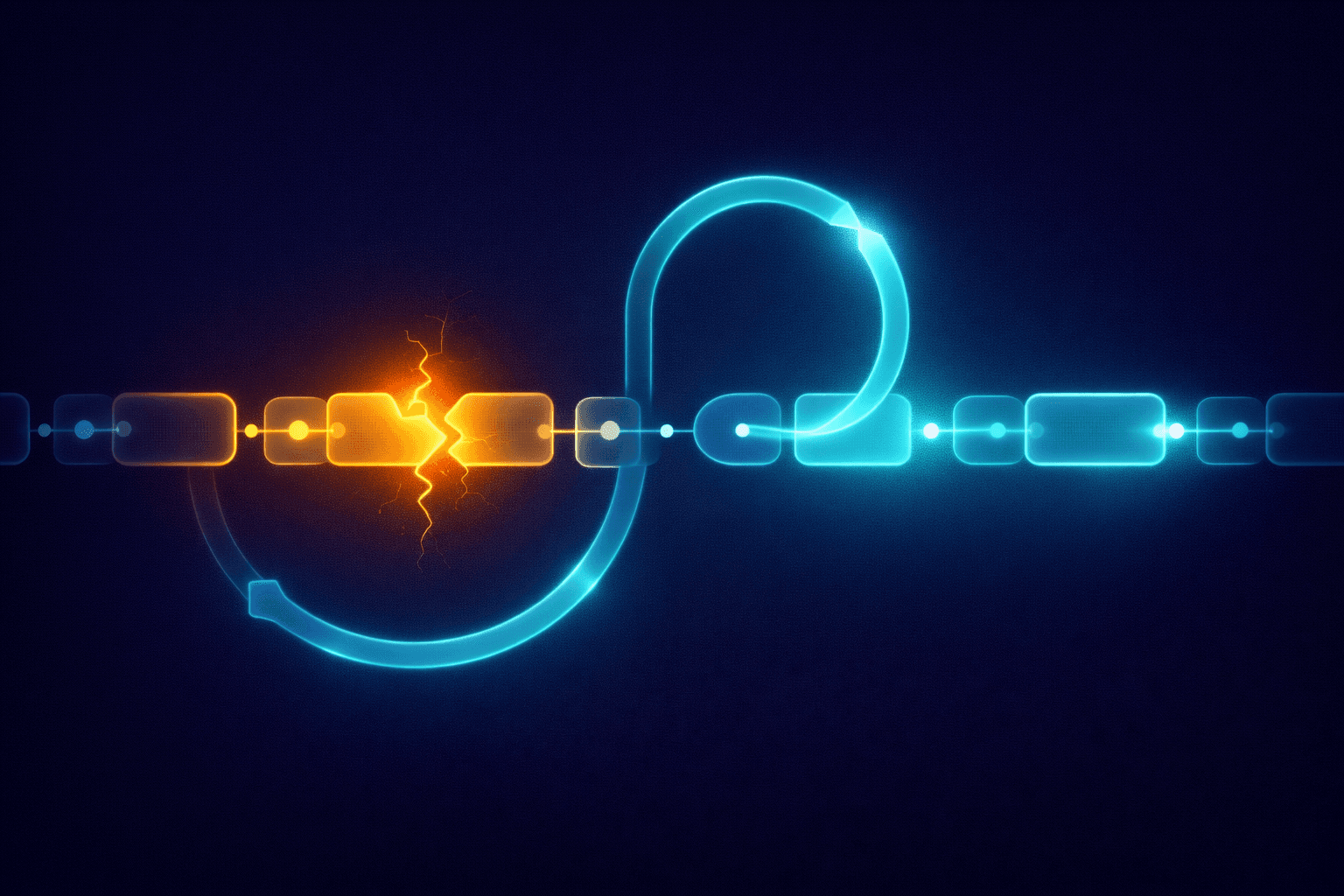
A self-healing workflow follows a loop:
- You describe the workflow in plain English
- The AI asks clarifying questions to fill gaps
- It researches current documentation (not stale training data — live docs)
- It builds the workflow and deploys it directly to your automation platform
- It fires the workflow to test it — with real data, not mock data
- When something fails (and something always fails), it captures the error
- It searches for documented solutions to that specific error
- It applies the fix
- It re-tests
- It loops until every step executes cleanly
The critical difference: steps 6 through 10 happen without human intervention. The system debugs itself. The loop that used to require a $200/hour consultant now runs in minutes.
The $600K/Month Case Study (With Caveats)
An automation agency operator recently published a detailed breakdown of his business model. The numbers are worth examining, even with appropriate skepticism.
His agency runs on 5 employees: two client success managers, two project managers, and himself. No full-time developers. Zero. They handle roughly 55 projects per month and claim $600K in monthly revenue — $7.2 million annualized.
Compare that to a traditional automation consultancy: 15 employees (developers, project managers, support staff), $1.2 million in annual payroll, and $1.5 million or more in revenue just to break even.
Now, should you take $600K/month at face value from someone selling a self-healing tool? Probably not. The article is partially an advertisement for a specific product called Synta MCP. The revenue figures may be inflated or represent peak months rather than averages.
But the structural argument holds up regardless of the specific numbers. When you eliminate debugging labor from the equation, the economics of automation consulting change fundamentally. Fewer people can handle more projects at higher margins. That part isn't hype — it's math.
The Build Time Numbers
This is where the data gets more concrete and harder to dismiss.
Building a mid-complexity automation workflow — say, a tenant maintenance routing system for a property management company — used to take about 105 hours spread across three weeks. That was the pre-AI reality. You'd scope it, build it, test it, debug it, test again, debug again.
With AI-assisted building (the 2024-2025 era), that dropped to roughly 2 hours: 30 minutes to build, 90 minutes to debug. A massive improvement, but the debugging still required human expertise.
With self-healing, that same workflow now takes about 9 minutes total, including the automated debug cycles. That's a 13x improvement over AI-assisted building and a 700x improvement over the manual era.
The property management example is a real case: receive maintenance requests via webhook, AI-categorize urgency, route to the nearest available contractor by issue type, send tenant confirmation with ETA, escalate if no response in two hours, generate weekly summary reports for the property owner. Five workflows, two had errors on first run, both self-healed automatically. Previously billed at $16,000. Now billed at $9,200 — less for the client, more profitable for the builder.

The Stories That Actually Matter
The big agency numbers are interesting. The stories about small business owners are devastating.
Consider a pool cleaning company owner who spends 3 hours every morning routing his technicians and sending appointment reminders. Every morning. For years. (We explored this scenario in Your Pool Company Doesn't Need an App.) That's thousands of hours spent on a task that today's self-healing tools can automate in minutes. The self-healing loop even catches timezone issues automatically — the kind of bug that would have taken a developer an hour to track down.
Or a funeral home director spending 4 hours every day managing scheduling and family follow-ups. Checking arrangements, sending condolences, scheduling viewings, reminding families about paperwork, following up after services. Done manually for years. The entire administrative workflow could be automated in under half an hour with these tools.
These aren't Silicon Valley companies with engineering teams. These are local businesses run by people who grind through the same manual process for years because the cost of automation was always too high or too complicated to justify.
That's the real story here. Not the $600K/month agency. The service business owner who gets their mornings back.
What's Ready Today vs. What's Hype
Time for honesty.
What's real right now:
- AI can build working automation workflows from natural language descriptions. This is production-ready and has been for over a year.
- Self-healing loops exist and work for common error patterns — API authentication failures, data format mismatches, timezone bugs, missing fields. The straightforward stuff.
- Build times have genuinely collapsed. The 9-minute figure might be cherry-picked, but even if average builds take 30-45 minutes with self-healing, that's still a radical improvement.
- n8n, Make, and Zapier all have mature ecosystems with hundreds of integrations. The infrastructure is real.
What's still hype or early:
- "Zero manual interventions for 3 months" — this claim deserves heavy skepticism. Complex integrations with legacy systems, unusual API behaviors, and edge cases still require human judgment. Self-healing works best on well-documented, common platforms. Throw it at a poorly documented proprietary API and it will struggle.
- The specific self-healing tools (like Synta MCP) are new and unproven at scale. The concept is sound. Whether any particular tool delivers reliably across hundreds of use cases is a different question.
- Claims about completely eliminating technical expertise are overblown. Someone still needs to understand what the business actually needs, evaluate whether the output makes sense, and handle the cases where self-healing fails. That's not nothing.
- Security implications are underexplored. Self-healing systems test with real data and real credentials in production environments. That's powerful, but it means an AI system has direct access to your live business data. For many industries, that raises compliance questions that haven't been fully answered yet. If you're deploying AI agents, our guide on how to secure your AI agents covers the risks you should address first.
What This Means for Your Business
If you're running a business with repetitive daily tasks — routing, scheduling, follow-ups, data entry, report generation — the gap between what you're doing manually and what workflow automation can handle just got dramatically wider.
Three things to understand:
The cost barrier is falling fast. Automation projects that cost $15,000-$20,000 two years ago now cost a fraction of that. And they get built in days, not months. If you priced out automation before and decided it wasn't worth it, the math has changed. For a deeper look at keeping AI spending under control, see how to run AI agents without going broke.
The skill that matters now is clarity, not code. The quality of an automated workflow is directly proportional to how clearly you can describe what you need. "Build me something that handles leads" produces garbage. "Build me a workflow that captures leads from my website form, scores them by budget and timeline, sends hot leads to my phone immediately, and queues warm leads for a Tuesday email" produces something useful. You don't need to know how to code. You need to know your own business well enough to describe it precisely.
The maintenance model is changing. The old automation model was: pay to build, then pay again every time it breaks. Self-healing doesn't eliminate maintenance entirely, but it handles the routine failures automatically. The 80% of issues that used to generate support tickets — API timeouts, format changes, authentication refreshes — increasingly resolve themselves.
There's a quote from the original case study that cuts through all the technical details: "They don't want automation solutions. They want their Tuesday mornings back."
That's the real test. If you're spending hours every day on tasks a system could handle — and you've been doing it for years because automation seemed too expensive or too complicated — the gap between your reality and what's possible just became embarrassing.
The tools are ready. The costs are down. The question is how many more Tuesday mornings you're willing to give up before you make the switch.
If you're spending hours on tasks that should be automated, let's get you those mornings back.
Blue Octopus Technology builds automations that work — and fix themselves when they break. See what we offer.
Stay Connected
Get practical insights on using AI and automation to grow your business. No fluff.