
AI Agent Teams: How One-Person Companies Run Like Ten
One person can now run a team lead plus three to five specialist AI agents working in parallel. Here's what that actually looks like, what it costs, and where it breaks down.
The one-person company just got a workforce.
Not a hypothetical, not a pitch deck, not a "coming soon." The tools exist today that let a single person coordinate three to five AI agents working simultaneously on different parts of the same project. One agent researches competitors. Another drafts copy. A third reviews both of their work and pokes holes in it. They message each other, share findings, and argue about the best approach — while you watch.
The question is not whether this is possible. It is whether it is practical. We covered the $28/month architecture that makes this real in a previous post. The answer is nuanced, and the nuance matters more than the hype.
What Agent Teams Actually Are
You are probably familiar with AI assistants that handle one conversation at a time. You ask a question, the AI responds, you follow up. That is a single session.
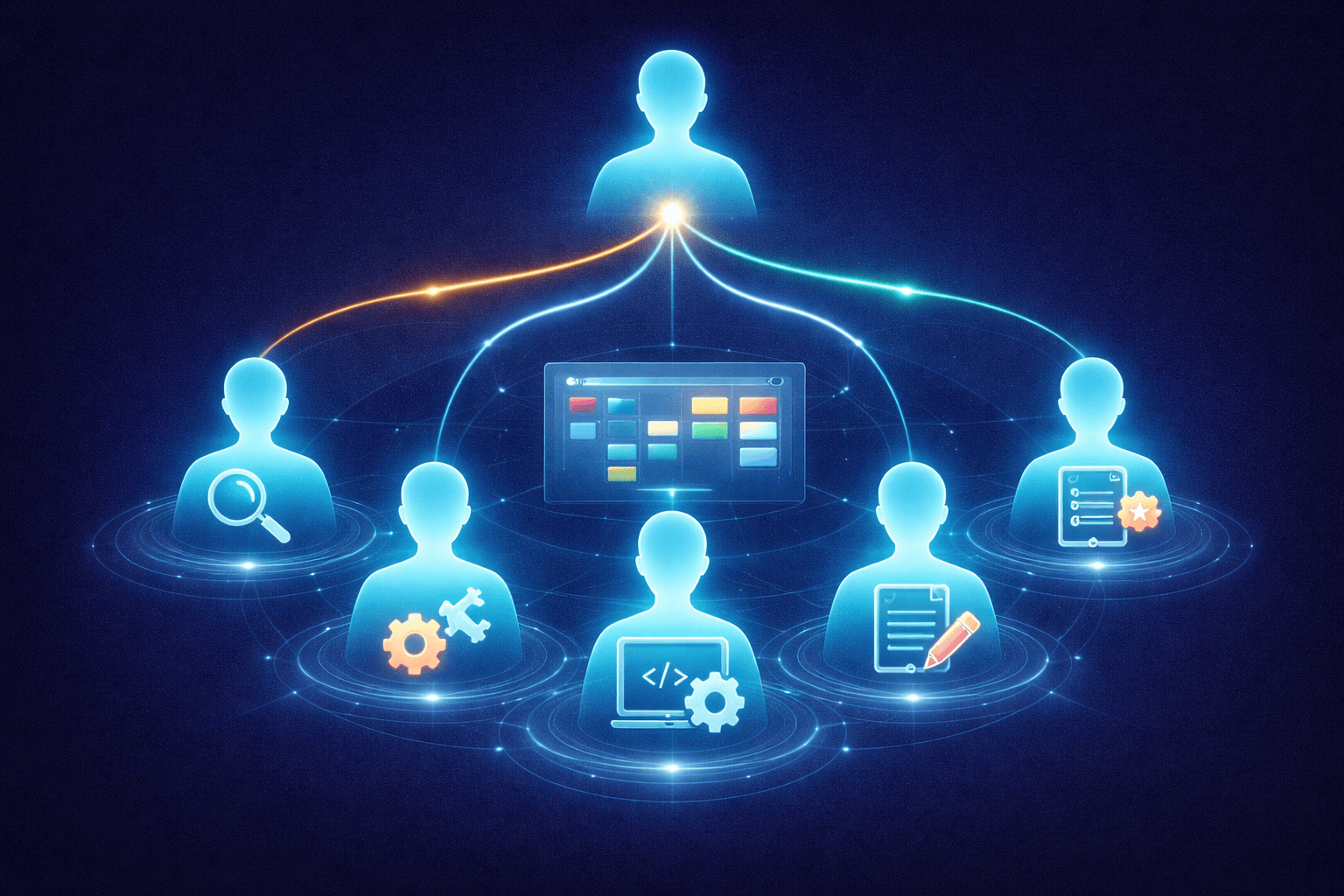
Agent teams are different. You describe a complex objective, and the system spins up multiple AI instances — each with a specialized role — that work on it in parallel. One instance acts as team lead. It breaks the work into tasks, assigns those tasks to teammates, and synthesizes the results. The teammates communicate directly with each other, not just back to the leader.
Think of it less like a chatbot and more like a small project team. The team lead is the project manager. The teammates are specialists. They each see the project's documentation and available tools, they claim tasks from a shared list, and they coordinate when their work overlaps.
This is fundamentally different from what most people have seen AI do.
Teams vs. Subagents: A Key Distinction
Before agent teams, AI tools could already delegate subtasks internally. These are called subagents — the AI spawns a helper, the helper does one thing, reports back, and disappears. That still exists, and for most tasks it is the right tool.
Agent teams are a different architecture entirely. Here is how they compare:
| Subagents | Agent Teams | |
|---|---|---|
| Communication | Report back to parent only | Direct peer-to-peer messaging |
| Lifecycle | Spawn, complete task, disappear | Stay alive, coordinate continuously |
| Context | Share parent's context window | Independent context windows |
| Cost | Low — runs within one session | ~5x single-session token usage |
| Best for | Quick, independent subtasks | Work that requires collaboration |
The practical implication: subagents are your interns. They go fetch something and bring it back. Agent teams are your department. They have their own conversations, challenge each other's work, and produce something none of them could have produced alone.
What a One-Person Company Can Do With This
Here are four scenarios where agent teams change the math on what one person can accomplish.
Research sprints. You need to evaluate three competing approaches to a business problem. Instead of researching them sequentially — which takes three times as long and means your analysis of option C is colored by having already committed mental energy to options A and B — you spin up three agents. Each investigates one approach. They share findings with each other and actively challenge each other's conclusions. The result is a comparison that does not suffer from anchoring bias.
Feature development. You are building a software product. One agent works on the API layer, another on the database schema, a third writes tests. They coordinate on the interfaces between their components, but they do not step on each other's code. What used to be a sequential process — build the database, then the API, then the tests — becomes parallel.
Marketing department. One agent researches competitor positioning. Another drafts landing page copy. A third plays the role of skeptical buyer and tears the copy apart. The friction between them produces better output than any single agent working alone. As one practitioner put it: "The friction is where the insight lives." We wrote about how to build your own marketing department with AI agent teams using exactly this pattern.
Debugging. Something is broken and you do not know why. Instead of testing one hypothesis at a time, you spin up four agents — each investigating a different theory. One profiles memory usage. One audits recent code changes. One writes tests to reproduce the bug. One reviews production metrics. The one that finds the answer shares it with the others. Parallel hypothesis testing is dramatically faster than sequential.

The Real Costs
Honesty about costs matters more than enthusiasm about capabilities.
Agent teams use roughly five times the tokens of a single AI session, proportional to the number of teammates. If a complex single-session task costs you a dollar, running the same scope of work as a five-agent team costs roughly five dollars. Each teammate runs in its own context window, doing its own reading and reasoning.
For everyday business use — research sprints, content production, code development — expect to spend $5 to $15 per day if you use agent teams regularly. That is the cost of a few coffee runs, for what amounts to a small project team working in parallel.
At the extreme end, Anthropic demonstrated what is possible with the release of Claude Opus 4.6 and its agent teams feature — using 16 parallel agents over two weeks to build a 100,000-line C compiler from scratch. The project consumed 2 billion input tokens and cost approximately $20,000. The resulting compiler could compile the Linux kernel, FFmpeg, SQLite, Postgres, Redis, and Doom, with a 99% pass rate on standard test suites. That is not a typical use case. But it demonstrates the ceiling.
The sweet spot for most users is three to five teammates. Beyond that, coordination overhead starts eating into productivity gains. More agents does not mean more output — it means more time spent managing communication between agents, more potential for conflicting work, and more tokens burned on coordination rather than production.
What Works and What Does Not
Agent teams are not universally better than a single session. They are better for specific types of work.
Works well:
- Tasks that split cleanly into independent pieces
- Research where competing perspectives improve the result
- Multi-component projects where each component has clear boundaries
- Situations where you want adversarial review — one agent building, another critiquing
Does not work well:
- Sequential tasks where step two depends entirely on step one
- Work that involves editing the same file (agents have file locking, but contention slows everything down)
- Simple, focused tasks where the overhead of coordination costs more than it saves
The decision rule is straightforward: can this be split into independent pieces? If the answer is yes, agent teams will likely save you time. If the answer is no, a single focused session will be faster and cheaper.
The Limitations Nobody Mentions
This technology is experimental, and the limitations are real.
No session resumption. If you close the session, the team state is gone. There is no saving and picking up where you left off tomorrow. You need to complete the work in one sitting, or accept that restarting means rebuilding context from scratch.
No nested teams. The architecture is two levels only — a team lead and its teammates. A teammate cannot spin up its own team. For deeper hierarchies, teammates can use subagents internally, but you cannot have teams of teams.
Teammates start with a blank slate. They inherit the project's documentation and available tools, but they do not inherit the team lead's conversation history. If you spent 20 minutes discussing the problem with the lead before spawning teammates, those teammates know nothing about that discussion unless the lead includes it in their task assignments.
The feature could change. This is explicitly experimental. The interface, capabilities, and pricing could all shift as the technology matures. Building your entire business workflow around it today carries risk. Using it as a productivity multiplier while staying adaptable is the smarter play.
What This Means for Your Business
The one-person company has always had a scaling problem. You can only do one thing at a time. Hiring is expensive, slow, and introduces management overhead. Freelancers help but require coordination, onboarding, and quality control.
Agent teams do not eliminate those challenges entirely. But they compress them. The coordination overhead of managing AI teammates is measured in seconds, not days. The onboarding is a well-written prompt. The cost is dollars per day, not thousands per month.
This is not about replacing human expertise. The person running the team still needs to know what good output looks like, still needs to define the right tasks, still needs to evaluate the results critically. The AI handles volume and parallelism. The human handles judgment and direction.
If you run a small operation and you have ever thought "I need three of me," this is the closest that technology has gotten to delivering on that idea. It is early. It is imperfect. And for the right use cases, it is already worth the investment. Our 2026 State of AI Agents report covers the full cost and capability picture if you want to dig deeper.
If you want to put AI agent teams to work in your business but aren't sure where to start, let's talk.
Blue Octopus Technology builds AI-powered workflows for small businesses that need to do more with less. See how we work.
Keep reading
More from the field.
Stay Connected
Get practical insights on using AI and automation to grow your business. No fluff.