
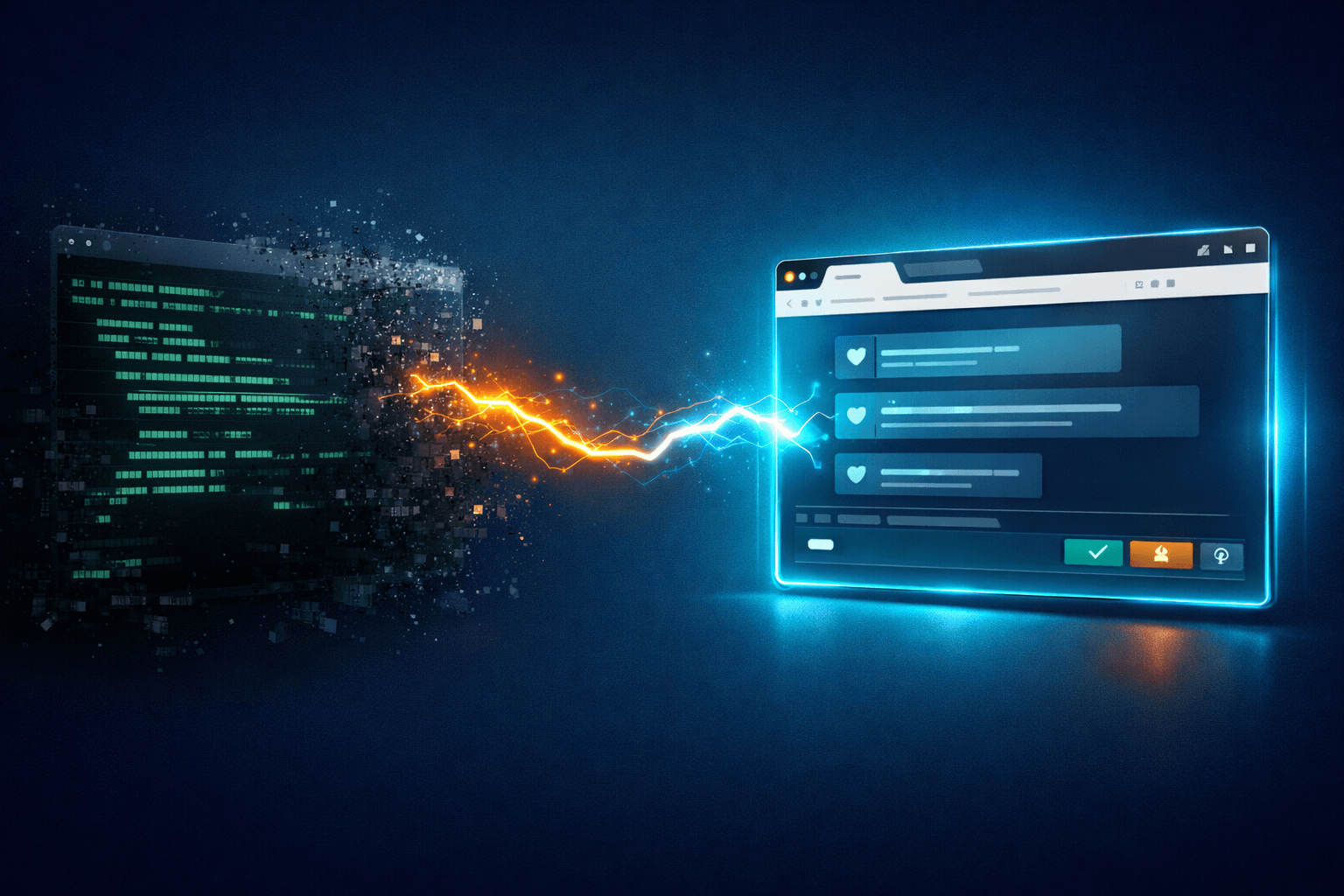
Claude Code Just Escaped the Terminal
The most powerful AI coding tool now runs in a browser. Here's what that means for your business.
Claude Code is the most powerful AI development tool available right now. It reads your entire codebase, writes production-quality code, runs tests, commits changes, and manages complex multi-file refactors — all from a conversation. If you have been following Anthropic's updates, the recent Claude Opus 4.6 release made these capabilities even more potent. If you've seen what AI-assisted development looks like in 2026, there's a good chance Claude Code was behind it.
One problem: it runs in a terminal. That black window with the blinking cursor. The thing most business owners close immediately because it looks like it's about to launch nuclear missiles.
For developers, the terminal is home. For everyone else — product managers, clients, team leads, founders who want to watch AI build their product — the terminal is a wall. You can't demo it without intimidating your audience. You can't let stakeholders observe without training them. You can't manage multiple AI sessions without juggling terminal tabs.
Then someone found a hidden flag that changes everything.
What Just Happened
Stan Girard is a YC W24 founder who built Quivr, an enterprise AI framework with 28,000 stars on GitHub. He's not a hobbyist poking around binaries for fun. He builds AI infrastructure for a living.
His team reverse-engineered the Claude Code CLI binary and discovered an undocumented flag: --sdk-url. When you pass a WebSocket address to this flag, Claude Code stops reading from the terminal. Instead, it connects to whatever server you point it at, sends its full capability inventory, and waits for instructions over WebSocket.
In plain English: one hidden flag turns Claude Code from a terminal application into a network service that any browser can talk to.
Within three days, the open-source browser UI built on this discovery hit 772 stars on GitHub. The announcement tweet got 2,291 likes and 151 replies. Developers had been waiting for this.
What This Actually Looks Like
Instead of a black terminal window, you get a modern web interface. Think of it like going from command-line email to Gmail. The functionality is the same. The accessibility isn't even close.
Multi-session management. Run five Claude Code instances on five different tasks — all visible in one browser window. One agent refactors your authentication. Another writes tests. A third updates documentation. You watch all three in real-time without alt-tabbing between terminal windows.
Visual tool approval. When Claude Code wants to edit a file, delete something, or run a command, the terminal shows you a text prompt and waits for you to type "y" or "n." The browser version shows you a visual diff with syntax highlighting, a clear description of what's about to happen, and approve/deny buttons. A product manager can understand what they're approving.
Live cost tracking. Every session shows real-time token usage, dollar cost, and context window consumption. No more guessing what a session costs until the bill arrives — a critical feature for anyone trying to run AI agents without going broke.
Token-by-token streaming. You watch the AI think in real-time. Characters appear as they're generated. It's the difference between waiting for a finished document and watching someone write — and it turns out watching AI code is genuinely compelling to non-technical stakeholders.
The underlying technology is clean. Bun for the runtime, Hono for the server, React 19 for the frontend, Zustand for state management. It's the same modern stack that production web applications use. This isn't a hack held together with duct tape.
Why This Matters for Your Business
If you're a business owner who's hired developers or worked with an agency, you've probably experienced the black box problem: you pay someone to build something, and you have no idea what's happening until they show you a demo two weeks later.
AI development tools make this worse. A developer says "I'm using Claude Code to build your feature" and you nod, having no way to verify, observe, or understand what that means. You're trusting the process because you have no visibility into it.
A browser-based interface changes three things.
Client demos stop being terrifying. You can show a client their product being built by AI in real-time through a browser they already understand. No terminal. No command line. Just a clean UI showing code being written, files being created, tests passing. The client sees progress happening. They ask questions. They feel involved instead of excluded.
Team visibility becomes real. A product manager can watch an AI agent work on their feature. A QA lead can observe what's being built before it hits the testing pipeline. A founder can check in on three different development streams from one browser tab during their morning coffee. The wall between "technical work" and "business oversight" gets a lot shorter.
Multi-agent orchestration becomes practical. This is the direction AI agent teams are heading — multiple specialized agents coordinating on a shared goal. Running multiple Claude Code sessions in separate terminal windows is like managing employees through sticky notes. A browser dashboard that shows all active sessions, their costs, their progress, and their permission requests — that's a management tool. As AI agents become a bigger part of how software gets built, the teams using them need interfaces designed for coordination, not just execution.

The Protocol Under the Hood
You don't need to understand the technical details to use this. But the technical details explain why this matters more than a typical open-source project.
Claude Code and the browser UI communicate using NDJSON — newline-delimited JSON. Each message is a single line of JSON. There are 13 different message types covering everything from sending prompts to approving permissions to canceling requests to managing session state.
Here's the part that caught our attention: this protocol is identical to the one used by Anthropic's official Claude Agent SDK. The hidden --sdk-url flag and the official SDK share the same transport layer. The same message format. The same control flow.
That's not a coincidence. It means Anthropic built Claude Code with external connectivity in mind from the start. The terminal interface is the default, but it's not the only interface the system was designed for.
When an open-source project discovers an undocumented feature, that's interesting. When the undocumented feature uses the exact same protocol as the vendor's official SDK, that's a signal about where the product is heading.
The Honest Truth
We'd be doing you a disservice if we stopped there. Here's what the enthusiastic tweets don't mention.
This is a legal grey zone. The hidden security risks of vibe coding apply doubly here. Anthropic's terms of service prohibit reverse engineering their products. In April 2025, Anthropic sent a DMCA takedown notice to a similar project that reverse-engineered Claude Code's internals. That project was removed from GitHub. In January 2026, Anthropic "tightened safeguards against spoofing the Claude Code harness." They're aware of these projects and they've acted against them before.
There's no official support. If the next Claude Code update changes the --sdk-url behavior, breaks the protocol, or removes the flag entirely, there's no recourse. You're building on an undocumented feature that the vendor has no obligation to maintain.
The bypass mode is dangerous. The browser UI exposes a bypassPermissions mode that auto-approves every tool call — including file deletion, command execution, and system modifications. In a terminal, you're at least physically present when Claude Code asks for permission. In a browser that might be running in a background tab, auto-approval is a loaded gun on a hair trigger.
There's no built-in authentication. The WebSocket server runs locally with no auth layer. That's fine for personal use on your laptop. It's not fine for anything exposed to a network. For a deeper look at how to secure your AI agents before deploying them, our security guide covers the essentials.
For personal learning and local exploration, this is genuinely interesting and instructive. You'll learn more about how Claude Code works internally from the published protocol specification than from any official documentation.
For client deployments, production use, or anything involving real business data: use the official Claude Agent SDK instead. Same protocol. Same capabilities. Anthropic's blessing.
Where This Is Really Heading
Zoom out from the specific project and look at the pattern.
Anthropic built Claude Code with a WebSocket mode that uses the same protocol as their official SDK. They haven't documented it publicly, but they haven't removed it either — even after taking action against other reverse engineering efforts. The Agent SDK is officially supported and uses the same NDJSON message format.
The demand signal is clear. 772 stars in three days. 2,291 likes on the announcement. Developers want browser-based Claude Code. Teams want visibility into AI development. Businesses want management interfaces for AI agents.
The question isn't whether Anthropic will ship an official browser interface for Claude Code. It's when. And when they do, it will likely use the same protocol that's already been documented by the open-source community.
The companies that will benefit most are the ones that already understand what this interface enables — not the technical details of WebSocket protocols, but the operational shift. AI development moves from a solo developer activity to a team-visible, manager-accessible, client-demonstrable process.
That shift matters more than any specific tool.
What You Should Do About It
If you're a developer: Try it locally. Run bunx the-vibe-companion and spend an hour exploring. The published protocol specification is the best available documentation of Claude Code's internal messaging architecture. Even if you never use the browser UI, understanding the protocol makes you better at building on top of Claude Code through official channels.
If you're a business owner: You don't need to install anything. What you need to understand is this — the most powerful AI development tool just became accessible to people who don't live in terminals. Within six months, watching AI build your software through a browser will be as normal as watching a shared Google Doc being edited.
Start thinking about what that means for your business. How does your team interact with AI assistants today? Is it through chat windows that feel disconnected from actual work? When your development partner uses AI to build your product, can you observe the process? Can your team?
The terminal wall is coming down. The businesses that prepare for accessible AI development tools — not just for developers, but for everyone who needs to understand, approve, and direct AI work — will move faster than the ones still waiting for a finished demo.
If you want help navigating this transition, we should talk. Blue Octopus Technology helps businesses adopt AI tools without the complexity — and without the risk of building on undocumented features that might disappear tomorrow.
Blue Octopus Technology builds AI-powered systems for businesses that don't have engineering teams. See what we build.
Stay Connected
Get practical insights on using AI and automation to grow your business. No fluff.