
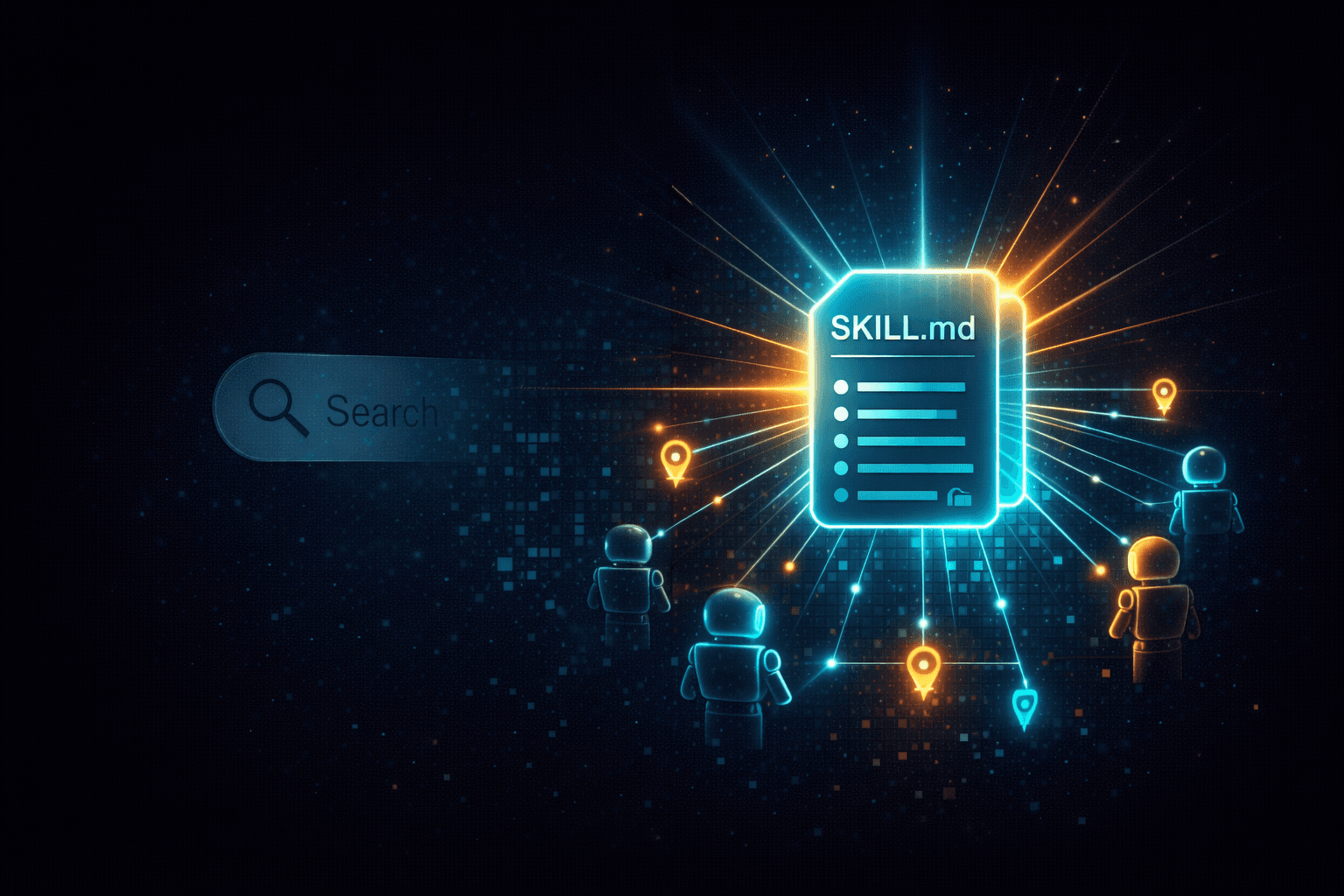
SKILL.md: The New SEO — for AI Agents
Google ranks you for humans. SKILL.md makes you discoverable by AI agents. Here's why that matters for your business.
For two decades, businesses have poured time and money into one question: how do we show up when someone searches Google? SEO — search engine optimization — became an entire industry around that question.
A new version of the same question is emerging, and almost nobody is talking about it yet: how does your business show up when an AI agent is looking for a service to use? We covered the human side of this problem — how to make ChatGPT recommend your business — but there's an even bigger shift happening on the agent side.
The answer is a simple file called SKILL.md. And the businesses that understand it early will have the same kind of head start that early SEO adopters had in 2005.
What Is SKILL.md?
SKILL.md is a standardized file that teaches AI agents what your business does, when to use your services, and how to interact with your tools. It sits in a folder alongside optional scripts, reference documents, and templates — everything an AI agent needs to work with you.
Think of it this way:
- A website tells humans what you do.
- SEO helps humans find you on Google.
- SKILL.md tells AI agents what you do.
- Agent discoverability helps AI agents find and use your services.
The format is straightforward. It is a markdown file with a short header that describes who you are and what you offer, followed by instructions an AI agent can follow. No special programming language. No complex API documentation. Just structured text that both humans and AI can read.
Why Should Business Owners Care?
Here is the shift that is happening right now. Instead of a person opening Google, searching for "accountant near me," visiting five websites, and picking one — an AI agent does that research for them. The person says "find me an accountant who handles small business taxes and can start this week," and the agent goes to work.
The agent does not read your website the way a human does. It does not admire your homepage design or scroll through your testimonials. It looks for structured information it can act on. If your business has a SKILL.md file that clearly explains your services, your availability, and how to engage with you, the agent can find you and recommend you. If you do not have one, you are invisible to it.
This is not hypothetical. Both Anthropic (the company behind Claude) and OpenAI (the company behind ChatGPT) have adopted the SKILL.md format. Both point to agentskills.io as the open standard. Skills built for one platform work on the other. There are already over 20,000 skills on the community marketplace.
A Real Example: Unusual Whales
Unusual Whales is a financial data company that tracks stock market activity. They recently created a SKILL.md file for their API. Now, when someone asks an AI agent to "analyze unusual options activity in tech stocks this week," the agent can discover Unusual Whales' service, understand what data it offers, and pull the information — all without the user ever visiting the Unusual Whales website.
That is a sale that happened without a Google search, without an ad click, without a landing page. The AI agent found the service, evaluated it, and used it.
This is where commerce is heading. Not next decade — now.
How Skills Actually Work
The technical details are simpler than you might expect. A skill is a folder with a few files:
SKILL.md — The main file. It has two parts: a short header (name and description) and a body with detailed instructions. The header is what AI agents read first to decide if your skill is relevant. The body is only loaded when the agent decides to engage with you.
This is an important design choice. An AI agent might have hundreds of skills available to it, but it only reads the full details of the ones it actually needs. Your header is your elevator pitch — it has to be clear and specific about what you offer and when someone should use it.
Scripts — Optional executable files for tasks that need to happen the same way every time. Think: submitting a form, running a calculation, formatting a report.
References — Optional documentation the agent can consult. Your service catalog, pricing tiers, compliance policies, FAQs.
Assets — Optional templates and materials. Proposal templates, intake forms, brand guidelines.

Why This Is Like Early SEO
In the early 2000s, most businesses did not think about search engines. They had a website, maybe a Yellow Pages listing, and that was enough. The businesses that figured out SEO early — optimizing their sites for Google, creating useful content, building authority — gained an enormous advantage that compounded over years.
SKILL.md is at that same inflection point. Right now, most businesses have no idea this exists. The ones that create well-structured skills will be the ones AI agents recommend first, just like the businesses that optimized for Google were the ones that showed up on page one.
And just like SEO, the early movers will be hard to catch. Once an AI agent learns that your skill is reliable and well-structured, you become a preferred option. That is a compounding advantage.
What This Means for Different Types of Businesses
Service businesses (law firms, accounting practices, medical offices, contractors) — A skill can describe your specialties, service areas, availability, and intake process. When an AI agent is helping someone find a service provider, yours shows up with structured, actionable information instead of a generic website blurb.
Software companies — If you have an API or a digital product, a skill lets AI agents use it directly. This opens up an entirely new distribution channel. Your product becomes available to every AI agent, not just human users who find your website.
E-commerce and retail — Skills can describe your product catalog, shipping policies, and return processes. An AI agent helping someone shop can evaluate your offerings alongside competitors in seconds.
Consultants and agencies — A skill can outline your methodology, past work categories, and engagement models. When an AI agent is helping a business owner find a consultant, structured information beats a pretty portfolio site.
The Three Things That Matter Most
If you take one thing away from this article, it should be this: the description in your SKILL.md header is the single most important line. It is the equivalent of your Google search result title and meta description combined. If your description does not clearly state what you do and when someone should use you, no AI agent will ever load your full details.
Here is what makes a good skill:
1. A specific, honest description. Not "we are a full-service digital agency." Instead: "Tax preparation and advisory services for small businesses with 1-50 employees. Specializes in S-corp, LLC, and sole proprietor filing. Available January through April for new clients."
2. Structured, actionable information. AI agents do not want marketing copy. They want facts they can act on. What do you offer? What are the boundaries? How does someone engage? What is the process?
3. Progressive detail. Your header is a quick summary. Your body has the full instructions. Your reference files have the deep documentation. This layered approach means agents only load what they need, which makes your skill efficient and reliable.
What You Should Do Now
You do not need to be a developer to start preparing for this shift. Here are practical steps:
1. Document your services clearly. Write down exactly what you offer, who it is for, and what the process looks like. You will need this content whether you create a skill today or six months from now.
2. Think about how an AI agent would describe your business. If someone asked an AI to find a business like yours, what words would they use? Those words should be in your skill description.
3. Create your first skill. We wrote a full walkthrough in how to package your business knowledge for AI. The format is simple enough that anyone who can write a markdown document can create a basic SKILL.md. Anthropic has published a detailed guide and even ships a skill-creator tool that walks you through the process in 15 to 30 minutes.
4. Consider professional help for complex skills. If your business has multiple services, complex workflows, or integrations with other tools, a well-structured skill requires some expertise to get right. This is where working with a technology partner pays off — the same way working with an SEO specialist pays off compared to doing it yourself.
The Bigger Picture
We are in the early stages of a fundamental shift in how businesses get discovered and how work gets done. AI agents are not replacing search engines — they are adding a new layer on top. Businesses will need to be discoverable by both humans (through Google and social media) and AI agents (through skills and structured data).
The companies building these AI platforms have already converged on the standard. Anthropic and OpenAI both support SKILL.md. The Linux Foundation now governs MCP, the protocol that connects AI agents to external tools. There are over 20,000 skills in the public marketplace, and that number is growing rapidly.
This is not a niche technology experiment. It is infrastructure that is being built right now, and your business can either be part of it or be invisible to it.
The Bottom Line
SKILL.md is the SEO of the AI agent era. It is a simple, standardized way to make your business discoverable and usable by AI agents. The format is open, supported by the two largest AI companies, and already being adopted by forward-thinking businesses.
The window for early-mover advantage is open right now. Just like the businesses that invested in SEO in 2005 are still reaping the benefits, the businesses that create well-structured skills today will have a compounding advantage as AI agent adoption accelerates.
You do not need to understand the technical details. You need to understand the opportunity: there is a new way for customers to find you, and most of your competitors have not heard of it yet.
If you want help making your business discoverable by AI agents, explore our AI integration services — we build custom skills that put your business where the agents are looking.
Blue Octopus Technology helps businesses navigate the AI landscape — from agent setup and management to custom skill development. Let's talk about making your business AI-discoverable.
Stay Connected
Get practical insights on using AI and automation to grow your business. No fluff.