
AI Agents Are Replacing Manual Lead Generation — Here's What's Actually Working
A real estate company replaced 40 hours/week of manual prospecting with an AI pipeline that processes 12,000 listings in 90 minutes. Here's how it works, what it costs, and what the limitations are.
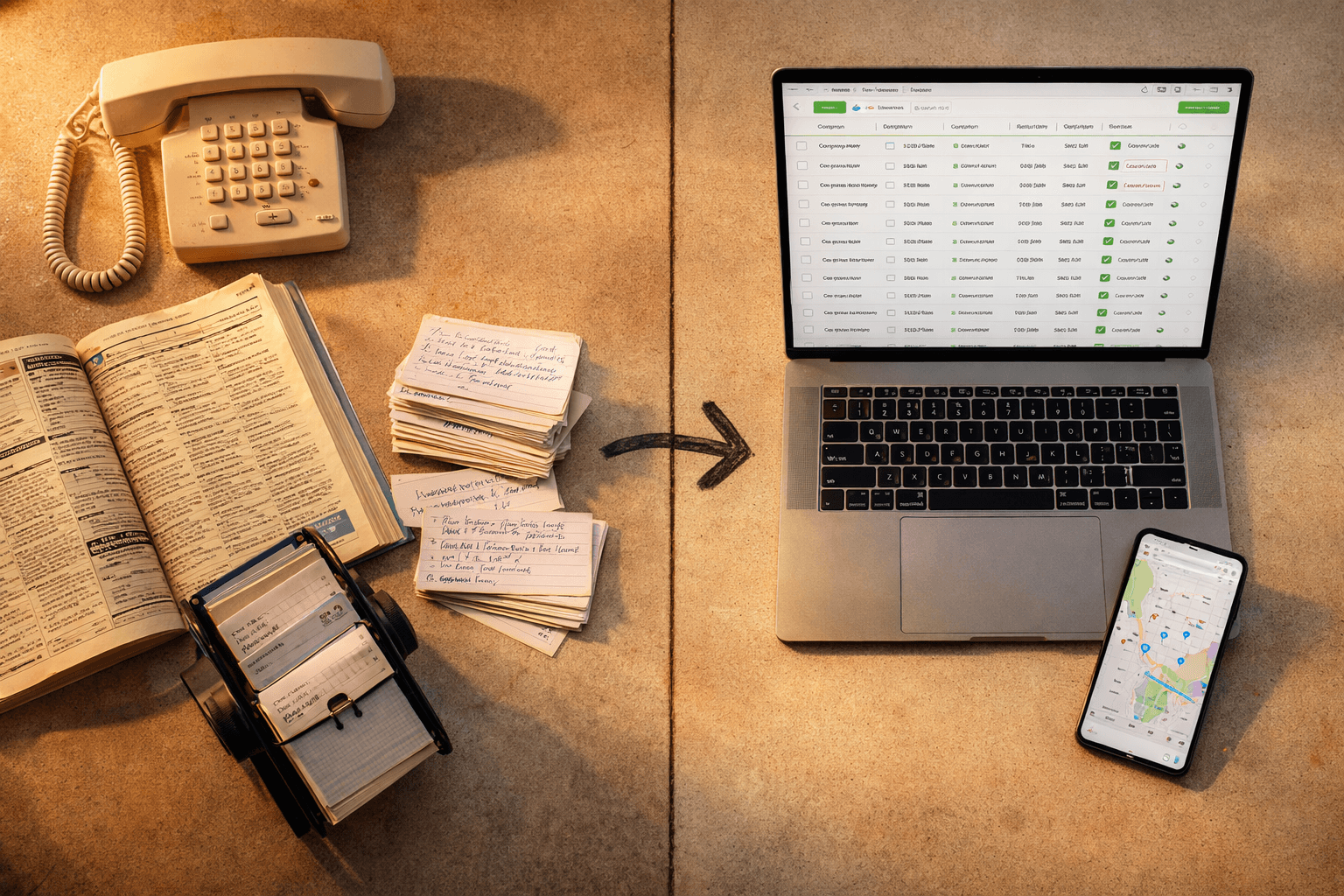
A real estate company had a team spending 40 hours every week on lead prospecting. Scrolling through listing sites. Copying agent names into spreadsheets. Cross-referencing contact info. Building profiles one at a time.
They replaced all of it with an AI pipeline that processes 12,000 listings across 314 ZIP codes in 90 minutes. Not a demo. Not a prototype. A production system that runs weekly and delivers qualified leads to their CRM.
The annual cost? Roughly $2,500. The labor it replaced? Over $100,000.
We've been tracking AI-powered lead generation for the past several months — the tools, the case studies, the claims. Some of it is real. Some of it is hype dressed up in a demo video. This is what we've found actually works, what it costs, and where the honest limitations are.
What Changed
The individual pieces of automated lead generation have existed for years. Web scrapers. Email finders. CRM imports. None of this is new.
What's new is AI agents that chain these pieces together autonomously. An agent that can browse a website, understand what it's looking at, extract the relevant data, decide what to do next, and move on to the next source — without a human telling it what to click.
The real estate pipeline we mentioned above uses Claude as its orchestrator. It doesn't follow a hardcoded script. It reads a strategy document that describes what to look for, then makes decisions about how to extract and enrich each listing. When a page looks different than expected, the agent adapts instead of crashing.
That's the shift. Not smarter scrapers. Smarter decision-making about how to use them.
Three Approaches That Actually Work
We've evaluated dozens of lead generation tools and methods over the past year. Three approaches stand out — not because they're the flashiest, but because they solve different problems and we've seen real results from each.
1. Cloud Browsers + AI Orchestration
This is what the real estate case study uses. The setup: cloud-hosted browser instances (in this case, Browserbase) controlled by an AI agent (Claude Code) that reads strategy documents and decides what to do.
How it works:
The system spins up dozens of cloud browsers simultaneously. Each one navigates to a target website, searches by location, scrolls through results, and extracts listing data — addresses, prices, agent names, brokerages, contact info. Then it deduplicates the results and enriches each profile by cross-referencing other sources: brokerage websites, business profiles, professional networks.
From 12,105 raw listings, the system produced 4,446 qualified agent profiles. That's a 37% unique rate — most agents had multiple listings, which itself is a useful data point for prioritization.
The numbers:
| Metric | Value |
|---|---|
| ZIP codes covered | 314 |
| Listings processed | 12,105 |
| Qualified profiles delivered | 4,446 |
| Total pipeline time | 90 minutes |
| Manual time replaced | 40 hours/week |
| Estimated annual cost | $1,700 - $2,500 |
| Estimated annual labor savings | $100,000+ |
Best for: Complex, multi-source data gathering where you need to visit real websites and extract information that isn't available through an API. Real estate, insurance, professional services — anywhere the prospects have a web presence worth analyzing.
What it costs: $100-200/month for the cloud browser infrastructure, plus $5-15 per run in AI API costs. At scale, this approach has a 40-60x ROI against manual prospecting.
2. Google Maps Data Extraction
This approach is simpler and cheaper. Open-source tools can extract 34 data points per business listing from Google Maps — including phone numbers, websites, ratings, review counts, hours, and whether the business has claimed its listing.
That last one matters. An unclaimed Google Business Profile is a strong signal that a business needs digital help.
How it works:
You feed the tool a list of search queries — "plumbers in Asheville NC," "dentists in Charlotte," whatever your target market is. The tool runs headless browsers against Google Maps and extracts structured data at roughly 120 businesses per minute.
For perspective: searching 100 keywords with 16 results each takes about 13 minutes. A thousand keywords takes two and a half hours. You can cover an entire metro area's worth of local businesses in a single afternoon.
Best for: Local market research and finding businesses that don't have much of a web presence. If you sell to local service businesses — contractors, restaurants, professional practices — this is the fastest way to build a prospect list with real data attached.
What it costs: The core tool is free and open-source. You'll want proxies for any serious volume ($20-50/month). Total cost for comprehensive local market coverage: under $100.
The honest caveat: Scraping Google Maps violates Google's Terms of Service. API-based alternatives exist that are ToS-compliant (SerpApi is one, at $50-250/month), and for client-facing work, that's the right call. For internal market research, the risk-reward calculation is yours to make.

3. AI-Personalized Cold Email
A developer documented a pipeline that turns 233 startup leads into 500 personalized cold emails for about $10. Total time: 10 minutes.
The stack: a startup directory for lead data, a web scraping service (Firecrawl) to pull each company's actual website content into clean markdown, and Claude's API to write personalized emails using that context.
Why this matters: Generic cold email is dead. "Hi {FirstName}, I noticed {CompanyName} is doing great things..." gets deleted instantly. Everyone knows it's a template.
But when the email references a specific product feature from the company's website, mentions the exact customer segment they serve, and connects that to a relevant capability — that reads differently. Not because the AI is pretending to care. Because the AI actually read their website and found a genuine connection.
The constraints that make it work:
- Maximum four sentences per email
- Must reference specific information from the company's website
- Must connect the sender's experience to the recipient's actual problems
- Must sound human, not templated
Best for: Converting research into actual conversations. This is the outreach layer that sits on top of the data gathering from approaches one and two. (For a deeper look at how to do this without burning your reputation, see our guide to AI outreach that isn't spam.)
What it costs: Roughly $10 per 500 emails for the AI generation. The lead sourcing and web scraping add another $2-10 depending on volume. Call it $20 for 500 genuinely personalized emails.
The Honest Limitations
We could stop here and make this sound like magic. But we track this stuff because we want to give honest assessments, not hype. So here's what these tools don't solve.
Cold email at scale risks your domain reputation. Sending 500 personalized emails is fine. Sending 5,000 without proper warming, authentication, and deliverability infrastructure will land you in spam folders — and potentially get your domain blacklisted. The AI handles the writing. It doesn't handle SPF records, DKIM signing, domain warming, or inbox placement.
AI personalization is getting recognized. Recipients are starting to notice when an email is "too good" at referencing their business. The four-sentence format that works today might feel formulaic in six months as more people adopt this approach. The window of advantage is real but not permanent.
The data gathering tools have real compliance questions. Google Maps scraping violates ToS. Scraping business websites for enrichment data operates in a gray area. Sending cold email is regulated by CAN-SPAM (US), GDPR (EU), and CASL (Canada). None of the tools we evaluated handle compliance for you. That's on you.
You still need something worth selling. We see this constantly: businesses get excited about AI lead generation before they've figured out their offer. No amount of AI prospecting fixes a weak value proposition. If your email gets a response and you can't clearly articulate why someone should hire you, the pipeline didn't fail — the offer did.
The pipeline was validated, not battle-tested. The cold email approach was documented by a developer who built it but explicitly did not send the emails. The real estate pipeline is production-proven. But published response rates, conversion metrics, and long-term deliverability data are still sparse across the industry. Expect to iterate.
What This Means for Your Business
If you're a service business that relies on outbound sales or lead generation, here's the reality: your competitors are starting to adopt this. Not all of them. Not yet. But the early adopters are already running pipelines that find, research, and contact prospects while they sleep. Lead generation is just one piece of a broader shift — we mapped out the whole picture in building an AI marketing department.
The businesses that figure this out first will have a structural advantage. Not because the technology is expensive or hard to access — it isn't — but because it forces a level of clarity that most businesses avoid.
Building an AI lead gen pipeline requires you to answer uncomfortable questions:
- Who exactly are you targeting? Not "small businesses" — which ones, where, in what condition?
- What specifically do you offer them? Not "we do marketing" — what problem do you solve, and what's it worth?
- Why should they talk to you instead of the ten other people emailing them this week?
The AI doesn't answer those questions. You do. But once you have clear answers, the AI can execute on them at a scale that would take a human team weeks to match.
If You Want to Try It
Start small. Pick one data source, one target audience, one offer. Run the pipeline against 50 prospects, not 5,000. Read the emails the AI writes. Are they good? Do they accurately represent what you do? Would you respond to one?
Test before you scale. Send those 50 emails manually from your regular email account. Track responses. If 5 people respond, you have a working pipeline worth scaling. If nobody responds, the problem is your targeting or your offer — not the technology.
Build the operational layer. The AI handles research and writing. You still need: proper email authentication (SPF, DKIM, DMARC), a sending tool with deliverability features, a follow-up sequence, and a CRM that actually thinks to track conversations. The generation is the easy part. The infrastructure is what separates a demo from a system.
The Ethics of AI Prospecting
We'll keep this brief because the principles aren't complicated.
Public business data is fair game. A business listed on Google Maps has a public profile. Scraping that data to understand the market isn't ethically different from driving around town and writing down business names.
Personalization should add value. If your AI-written email helps someone understand a problem they actually have, that's useful outreach. If it's faking familiarity to get a response, that's manipulation. The difference is whether you'd stand behind the email if the recipient asked how you wrote it.
CAN-SPAM compliance is non-negotiable. Real business address in every email. Unsubscribe link that works. Honor opt-outs within 10 days. This isn't optional and the AI won't do it for you.
There's a line between smart outreach and spam. We don't know exactly where it is, and anyone who claims they do is selling something. But the test is simple: if you're embarrassed to explain your process, you're probably on the wrong side of it.
Where This Is Going
The tools are getting cheaper and more capable every quarter. Cloud browser infrastructure that cost hundreds per month two years ago now starts at $20. AI that couldn't reliably extract structured data from a webpage last year does it consistently today. Open-source alternatives to every paid tool in the stack are either available now or in active development.
Within a year, the basic version of this pipeline — find prospects, research them, send personalized outreach — will be a standard small business tool, not a competitive advantage. The advantage will shift to the businesses that combine AI prospecting with genuine expertise, real relationships, and offers worth responding to.
The technology is here. The question is whether you'll use it thoughtfully or wait until everyone else has figured it out first.
Need Help Building This?
Blue Octopus Technology builds AI-powered lead generation systems for businesses that don't have engineering teams. We handle the pipeline architecture, the data sources, the compliance layer, and the integration with your existing tools — so you get qualified prospects in your inbox without managing the infrastructure.
If your team is still building prospect lists by hand, let's talk about what an AI pipeline could look like for your business.
Blue Octopus Technology helps businesses work smarter with AI — without the complexity. See what we build.
Keep reading
More from the field.
Stay Connected
Get practical insights on using AI and automation to grow your business. No fluff.