
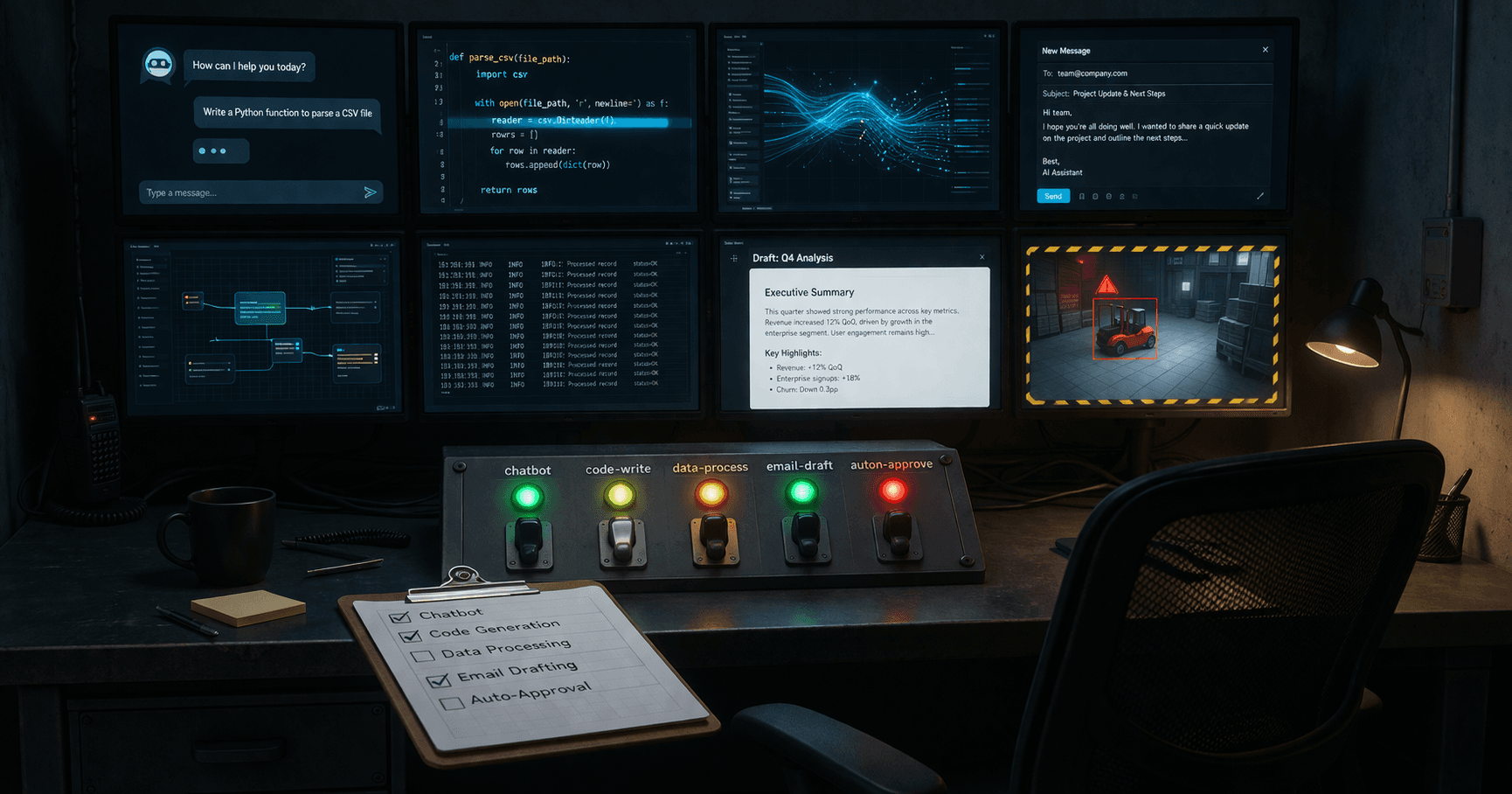
Who Watches the AI? The Rise of Agent Governance
As AI agents gain access to more business systems, a new category of tools is emerging to control what they can and can't do. Here's why agent governance matters and what the first tools look like.
A year ago, the biggest concern with AI in business was whether it would give wrong answers. Today, the concern is different: AI agents now have access to your email, your databases, your file systems, and your APIs. The question isn't just "is the answer correct?" It's "what is the AI allowed to do with access to everything?"
That shift — from AI as a question-answering tool to AI as an autonomous actor in your business systems — has created a gap. The agents are getting more capable. The controls haven't kept up.
A new category of tools is starting to fill that gap.
The Problem: Agents with Keys to Everything
When you connect an AI agent to your CRM — through protocols like MCP — you're giving it the ability to read customer data, modify records, and potentially send communications. When you connect it to your file system, it can read, create, and delete files. When you connect it to an API, it can make requests on your behalf.
Each of those connections is useful. That's why you set them up. But each one is also a potential problem if the agent does something unexpected — whether because of a bad instruction, a prompt injection attack, or a simple misunderstanding.
The more tools an agent has access to, the more damage a mistake can cause. And most businesses don't have a systematic way to define, monitor, or enforce limits on what their agents can do.
What Agent Governance Looks Like
Several approaches are emerging:
Policy-based controls. SurePath AI launched MCP Policy Controls in March 2026, giving security teams real-time control over which MCP servers and tools an AI agent can access. Think of it like a firewall for AI — instead of controlling which websites your employees can visit, it controls which tools your AI agents can use.
The idea is straightforward: define policies that say "this agent can read from the CRM but not write to it" or "this agent can access the calendar but not the email system." The policies are enforced at the protocol level, so the agent physically can't exceed its permissions.
Validation hooks. Some teams are building automated checks that run after every action an AI agent takes. The agent edits a file, and a validation script checks whether the edit introduced any problems. The agent generates a response, and a scanner checks it for sensitive information before it's sent.
These hooks are deterministic — they use pattern matching and rules, not AI. We wrote about this pattern in depth in Self-Validating AI Agents: The Feature That Changes Everything. That's intentional. You don't want an AI system policing another AI system if you can avoid it. Rules-based validation is predictable and auditable.
Audit trails. Enterprise buyers are starting to require logs of every action an AI agent takes — what it accessed, what it changed, when, and why. This isn't just about security. It's about compliance. Regulated industries need to demonstrate that their AI systems operate within defined boundaries.
Why This Matters for Small Businesses
You might think governance is an enterprise concern. It isn't.
If you have an AI assistant that can access your business email, and someone sends it a cleverly crafted message that tricks it into forwarding sensitive information, that's a governance problem. If your AI tool connects to your accounting system and makes an error that nobody catches for a week, that's a governance problem.
The difference between a useful AI agent and a dangerous one is often just the question of scope: what is it allowed to touch, and what checks exist to catch mistakes?
A few practical principles:
Least privilege. Give your AI agents access only to what they need for their specific task. A scheduling assistant doesn't need access to your financial data. A content generator doesn't need access to your customer database.
Review connections periodically. MCP and similar protocols make it easy to connect AI agents to new tools. Those connections tend to accumulate. Every quarter, review what your agents have access to and remove anything that's no longer needed.
Keep humans in the loop for high-stakes actions. Automated responses to customer inquiries? Probably fine. Automated changes to billing records? Probably needs a human approval step.
Log what matters. You don't need to record every token an AI processes. But you should be able to answer: "What did the AI do with access to our systems today?" If you can't, you have a visibility gap.
The Direction
The governance tools available today are early. Most are built for enterprise teams with dedicated security staff. Simpler, more accessible versions are coming — the same way antivirus software went from enterprise-only to something every computer has.
In the meantime, the principles are more important than the tools. Know what your AI can access. Define what it should and shouldn't do. Check that those limits actually work.
The agents are getting more capable every month. The question isn't whether you need governance. It's whether you set it up before or after something goes wrong.
Related: A Supply Chain Attack Just Hit the Tool That Powers Most AI Applications and How to Secure Your AI Agents Before They Become a Liability.
Keep reading
More from the field.
Stay Connected
Get practical insights on using AI and automation to grow your business. No fluff.