
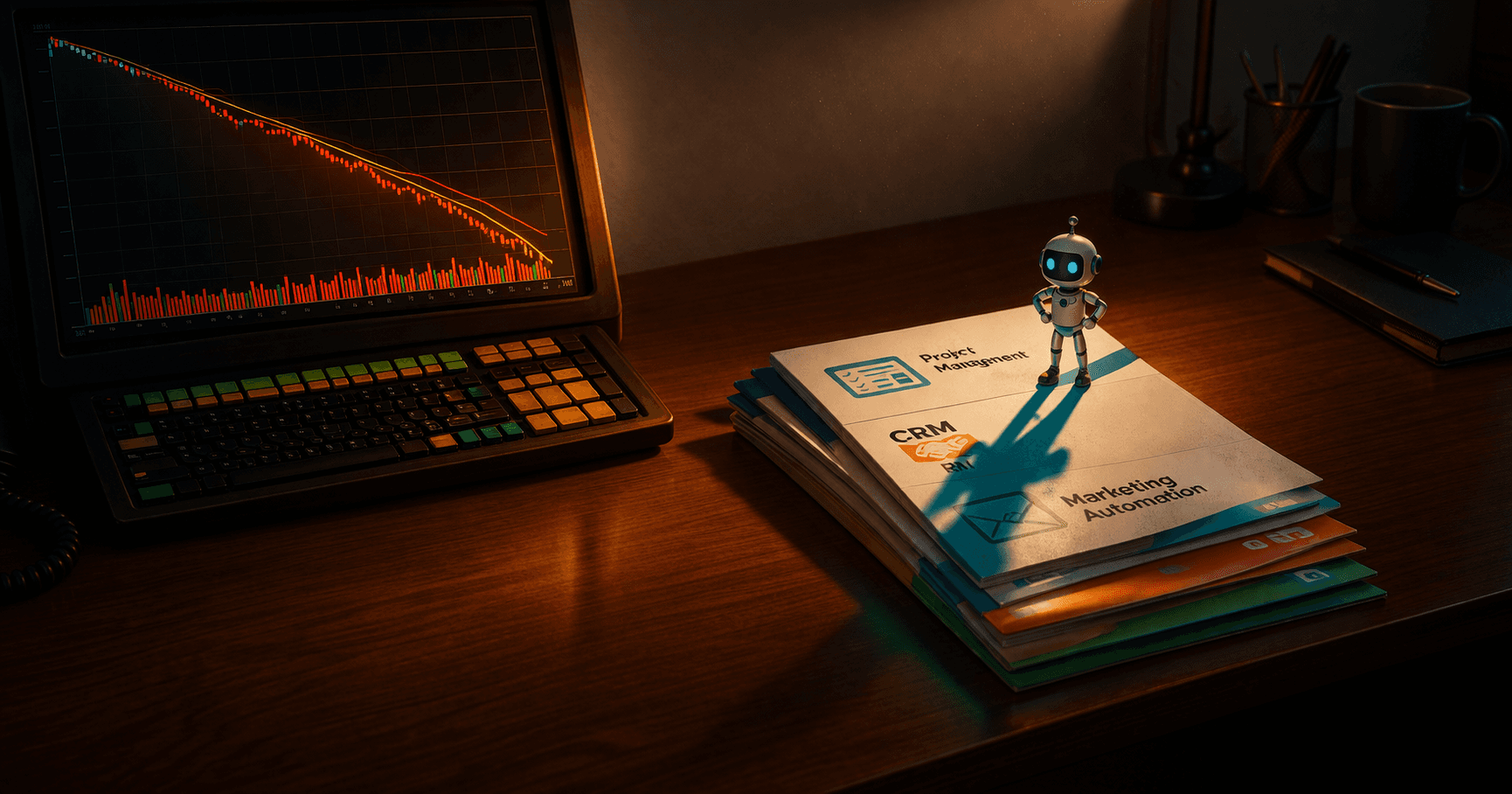
SaaS Stocks Are Down 80%. AI Agents Are Why.
Ninety percent of SaaS stocks have fallen 30-80% from their highs. The shift from dashboard-driven software to agent-driven automation is reshaping how businesses buy and use technology.
Something unusual is happening in the software industry. The companies that built the tools your business probably runs on — project management platforms, CRM systems, marketing dashboards, HR portals — are watching their stock prices fall off a cliff.
Ninety percent of SaaS stocks are down 30-80% from their 52-week highs. That's not a correction. That's the market saying something fundamental has changed.
What SaaS Got Right (and What It Assumed)
Software-as-a-service was a brilliant model. Instead of buying expensive software and installing it on your own servers, you paid a monthly fee and accessed it through a browser. No IT department required. Updates happened automatically. Pricing scaled with your team.
But SaaS was designed for human users. Every product assumed a person would log in, look at a dashboard, click buttons, and interpret data. The entire interface — the menus, the charts, the notification badges — was built for human eyes and human decision-making.
That assumption is breaking.
What AI Agents Do Differently
An AI agent doesn't need a dashboard. It doesn't need a clean interface or helpful tooltips. It needs an API — a way to send and receive data programmatically. We explored this shift in Software Is Dead. Custom AI Is What Comes Next.
Consider how a small business handles lead follow-up today. A lead comes in through a form. Someone gets a notification in the CRM. They open the CRM, read the lead details, draft a response, send it. Maybe they update the lead status. Maybe they forget.
An AI agent does that entire sequence without opening a browser. It watches the form submissions, evaluates each lead against criteria you've defined, drafts a personalized follow-up, sends it within minutes, and updates the record. No dashboard. No login. No human in the loop for routine cases.
The CRM still has value — the data matters. But the dashboard? The interface built for a person to sit and click through? That's the part becoming optional.
Why the Market Is Reacting
Investors aren't stupid. They see the same pattern playing out across categories:
Scheduling software — AI agents book meetings by reading email context and checking calendars. No scheduling interface needed.
Project management — Agents can create tasks, update statuses, and flag blockers by monitoring code commits and communication channels.
Marketing platforms — Content generation, A/B testing, and campaign optimization are increasingly handled by AI without someone manually configuring them in a dashboard.
Customer support — Chatbots evolved into agents that resolve issues, process returns, and escalate only the genuinely complex cases.
Each of these categories has billion-dollar SaaS companies built around the assumption that a human operator is essential. When that assumption weakens, so does the business model.
What This Means for Small Businesses
If you're paying for SaaS tools, this shift creates both opportunity and risk.
The opportunity: Some of the tasks you're paying software subscriptions to help with can now be handled by AI agents at lower cost. If you're paying $200/month for a marketing platform and using 10% of its features, an AI agent that handles those specific tasks might cost less and work faster.
The risk: The SaaS tools you depend on are going to change. Some will add AI features. Some will pivot entirely. Some will disappear. If you've built your business processes around a specific tool, it's worth understanding how stable that tool's business model is.
The Transition Won't Be Instant
SaaS isn't dying overnight. Millions of businesses have workflows built around these tools, and switching costs are real. Many SaaS companies are adding AI features to stay relevant — your CRM might already have an "AI assistant" built in.
But the direction is clear. Software built for human operators is being supplemented — and in some cases replaced — by software built for AI agents. The dashboard era peaked. The API era is here.
For businesses, the practical move is simple: before signing a new annual contract with any SaaS tool, ask whether the problem it solves could be handled by an AI agent instead. We put together a practical framework for this in AI Agents on a Budget: Cost Optimization Guide. Not every problem can. But more can than you might think.
The companies that built great dashboards for humans are scrambling to build great APIs for agents. The ones that figure it out will survive. The ones that don't are the reason the stock charts look the way they do.
Related: Software Is Dead. Custom AI Is What Comes Next. and AI Agents on a Budget: Cost Optimization Guide.
Keep reading
More from the field.
Stay Connected
Get practical insights on using AI and automation to grow your business. No fluff.