
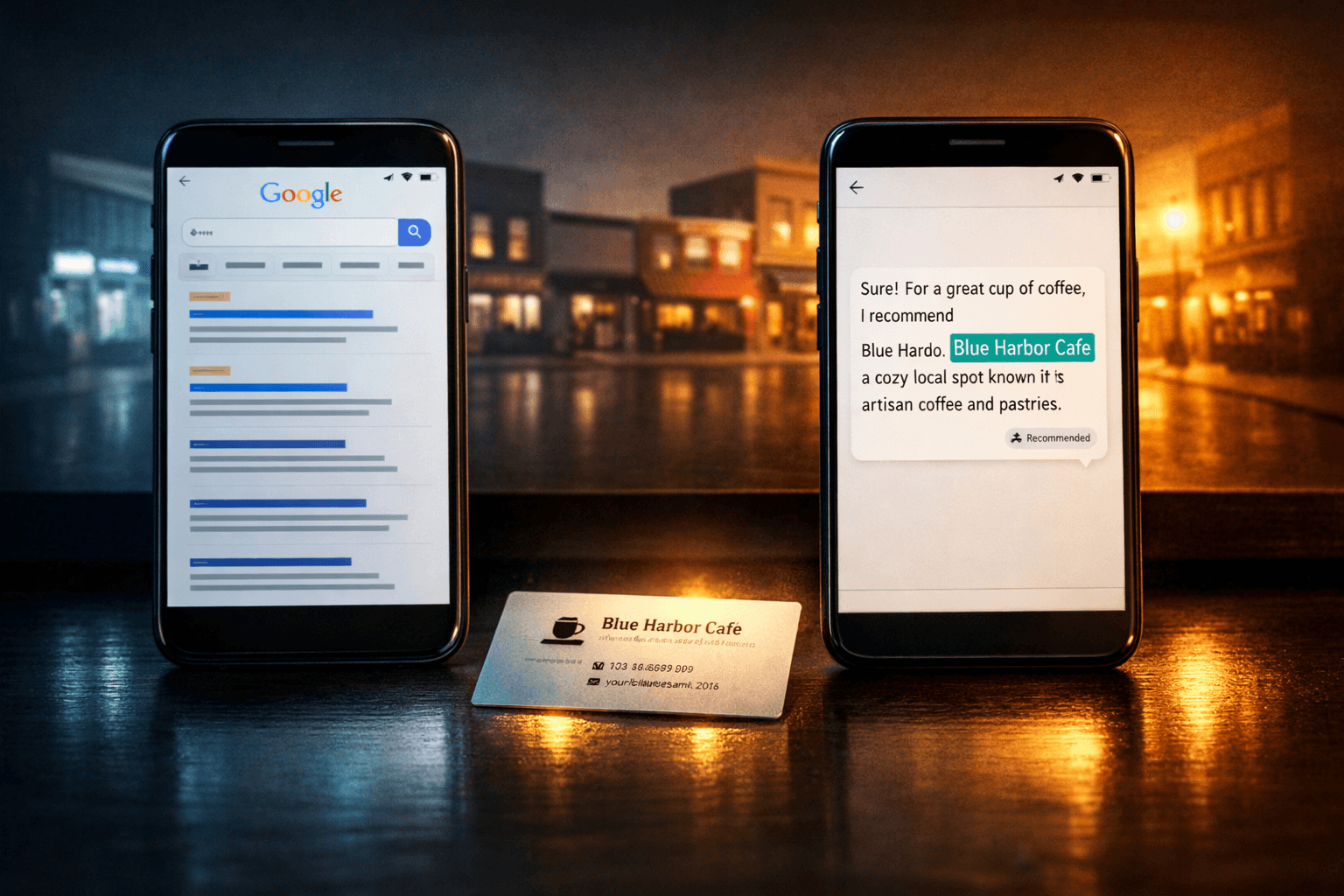
The LLM SEO Playbook: Get Your Business Mentioned by ChatGPT
An ecommerce brand went from zero AI mentions to 41 out of 50 — and $400K/month in new revenue. Here's the 7-layer system behind it, and how it applies to any local business.
A marketing team ran an experiment. They opened ChatGPT, Perplexity, and Claude, and asked 50 questions that their customers would ask — things like "best [product] for [use case]" and "what should I buy for [problem]."
Their brand showed up in zero of the 50 answers. Not once.
Six months later, they ran the same test. Their brand appeared in 41 of the 50 answers and ranked first in 28 of them. The result — reported by SEO practitioner @Nate_Google_ — was $400,000 per month in revenue directly attributable to AI assistant recommendations.
That is not a typo. And the conversion rate from those AI referrals was 4.4x higher than Google organic search.
Why AI Referrals Convert Better
Think about the difference between a Google result and a ChatGPT recommendation. Google gives you ten blue links. You click around, compare, bounce back, compare again. By the time you buy, you've done the work yourself.
When ChatGPT recommends something, it has already done the comparison. It synthesized reviews, specs, pricing, and third-party opinions into a single answer. The user trusts the recommendation the way they'd trust a knowledgeable friend — and they act on it faster.
ChatGPT now sees 5 billion visits per month. Perplexity fields over 500 million queries per month. That is a lot of people asking AI tools "what should I buy" and "who should I hire" — and getting specific brand recommendations in response.
If your business is not in those answers, you are invisible to a growing share of your market. We wrote about what that looks like in practice — and how to measure it — in Your Business Is Invisible to AI.
This post is about how to fix it.
Answer Engine Optimization Is Not Regular SEO
Traditional SEO gets your website onto a list of links. Answer Engine Optimization — or AEO — gets your business cited as a factual source inside a generated answer. The difference matters.
SEO says: rank higher so people click your link.
AEO says: become so well-documented, so clearly structured, so independently verified that when an AI synthesizes an answer, it reaches for you.
The mechanisms are different. AI models favor sources that are frequently cited by other credible sources, factually dense, neutrally written, and structured in ways that are easy to parse and quote. Marketing language actually hurts you here — AI models are trained to recognize the difference between a credible resource and a sales page.
The system that produced those results has seven layers. Here is each one, in plain language, with what you can actually do about it.
Layer 1: Map What AI Is Already Saying About You
Before you build anything, you need to know what is happening right now. Open ChatGPT, Perplexity, and Claude. Ask 50 variations of the questions your customers would ask — "best dentist in Asheville," "who should I hire for HVAC repair in [city]," "compare [your business] vs [competitor]."
Log every answer. Who gets mentioned? Who gets recommended first? What format does the answer take — a list, a comparison, a narrative?
You are building an answer intent map. It shows you where your competitors are getting cited, where nobody is getting cited (that is your opening), and how AI frames recommendations in your category.
This step takes a few hours. Do not skip it. Everything downstream depends on knowing where the gaps are.
Layer 2: Build an Answer Hub
This is the single highest-leverage page you can create. In the case study above, the Answer Hub page alone accounted for roughly 60% of all AI citations the brand achieved.
An Answer Hub is a comprehensive guide page — something like "/guides/best-dentists-in-asheville-2026" or "/guides/best-hvac-companies-for-older-homes" — that directly answers the questions you mapped in Layer 1.
The structure matters. It needs:
- A short summary at the top — 60 to 90 words, neutral, factual, no marketing language. This is the paragraph AI is most likely to quote.
- A ranked list comparing you to real competitors with honest trade-offs.
- A comparison table with real specs and real data.
- A "how to choose" section based on the customer's situation, not on why you are the best.
- An FAQ section pulling questions directly from your answer intent map.
- External citations — links to reviews, studies, and third-party sources.
Here is the counterintuitive part: including real competitors honestly is what makes AI models trust and cite the page. A page that only praises your business reads as marketing. A page that says "Company X is the better choice if you need same-day service, but we handle complex installs that most competitors won't touch" reads as a credible resource.
AI models can tell the difference.
Layer 3: Create a Brand-Facts Page
AI models need a canonical, neutral-fact source for your brand — the equivalent of a Wikipedia article. If you do not create one, AI will piece together facts from wherever it can find them. That might be an outdated Yelp page or a three-year-old blog post that gets your hours wrong.
Create a /brand-facts page on your site. Write it in Wikipedia style — neutral, no adjectives, no marketing. Include a one-sentence description of what you do, a key facts table (founded date, service area, certifications, contact info), and links to your profiles on other platforms.
This page is boring by design. It is not for your human visitors. It is for every AI system that needs to answer "tell me about [your business]."
Layer 4: Give AI a Machine-Readable File
Put a JSON file at /.well-known/brand-facts.json on your website. This is a structured data file that AI retrieval systems can parse directly — no guessing, no inference, just clean facts about your business.
Include your name, category, service area, key offerings, certifications, and a lastUpdated date. That last field matters — models that do live retrieval use recency as a quality signal.
If the technical side of this sounds intimidating, it is actually one small file. Any web developer can set it up in under an hour.
Layer 5: Add Schema Markup
Schema markup is structured data embedded in your website's code that tells search engines and AI exactly what each page contains. It is invisible to your visitors but critical for machines.
Your Answer Hub page needs ItemList and FAQPage schema. Your Brand-Facts page needs Organization schema. If you sell products, your product pages need Product schema with pricing, availability, and reviews.
This is the same structured data we flagged in our AI readiness scoring project — it was one of the signals most businesses were missing entirely. And it is free to add.
Layer 6: Get Cited by Third Parties
Everything in Layers 2 through 5 is on your own website. That is necessary but not sufficient. AI models also care about whether anyone else talks about you.
The single highest-signal move here is creating a Wikidata entry for your business. Wikidata is a machine-readable knowledge graph that feeds Wikipedia, Google, and AI training pipelines. It is free to create. You add your business name, description, website, founding date, industry, and social accounts. This gives AI models a verified, structured third-party reference for your brand.
Beyond Wikidata, pitch niche review sites in your industry — not TechCrunch, but the small, high-authority publications specific to your trade. Build a press page on your site that aggregates any coverage you have received. Create honest comparison pages ("/your-brand-vs-competitor"). Engage authentically on Reddit and community forums in your category.
The pattern: credible third-party mentions reinforce what your own site claims. AI treats independently corroborated facts as more reliable.
Layer 7: GPT Shopping Eligibility
This layer applies mainly to businesses that sell products online. ChatGPT's shopping feature pulls from structured product data — valid product identifiers, current pricing, verified reviews, and fast page load times. If you are an ecommerce business, this is where the $400K/month result came from.
For service businesses — dentists, attorneys, contractors — Layers 1 through 6 are where the value is. Layer 7 is optional.
This Works for Local Businesses Too
The case study that produced those numbers was an ecommerce brand. But the same system applies to local service businesses — and in some ways, the opportunity is even bigger.
When someone asks ChatGPT "who are the best HVAC companies in [city]" the AI pulls from the same signals: structured data, third-party citations, schema markup, Wikidata entries, neutral factual content. Most local businesses have none of these. The bar is remarkably low.
Say you run a dental practice. Your three biggest competitors have basic websites with no structured data, no schema markup, no Wikidata entry, and no Answer Hub. If you build even half of this system, you become the dentist that AI recommends — not because you are the best dentist, but because you are the only dentist AI can confidently cite.
We covered the broader technical signals — SSL, email authentication, mobile responsiveness, and the rest — in our SEO Playbook. AEO builds on top of those basics. Get the foundation right first.
Where to Start If This Feels Like a Lot
You do not need all seven layers on day one. Here is a practical sequence:
- Run the answer intent map. Ask AI tools 50 questions your customers ask. See where you stand. This costs nothing but time.
- Add schema markup to your existing site. Organization schema on your homepage, FAQ schema on your services page. Free, one-time effort.
- Create a Brand-Facts page. One afternoon of writing in neutral, factual tone.
- Build an Answer Hub. This takes real effort — a few days to do well. But it accounts for the majority of AI citations, so it is the highest-return investment.
- Create a Wikidata entry. Free, takes about 30 minutes, disproportionate impact.
- Deploy the machine-readable JSON file. One small file, one hour of developer time.
- Start building third-party citations. This is ongoing work — pitching reviewers, engaging in communities, building your press page.
The ecommerce brand that went from 0 to 41 out of 50 did not do this overnight. It took sustained, methodical work across all seven layers. But the returns compounded — once AI models start citing you, the citations reinforce themselves across future training data and retrieval results.
The Window Is Open
Right now, most businesses — especially local ones — are not doing any of this. They are optimized for Google, if they are optimized at all. The businesses that build AEO infrastructure now, while the competition is absent, will have a compounding advantage that gets harder to replicate every month.
This is not about gaming an algorithm. It is about making your business clearly, factually, and independently documented so that when an AI is asked "who should I hire for this" or "what should I buy," it has a real answer to give — and that answer is you.
Not the technology. Not the algorithm. The plumber who got his phone ringing from a channel he did not know existed.
This post draws on research from @Nate_Google_, @boringlocalseo, @fba, and @bloggersarvesh. For the technical foundation — the 13 signals AI uses to decide if your business is real — read Your Business Is Invisible to AI.
Stay Connected
Get practical insights on using AI and automation to grow your business. No fluff.