
Build Your Own Marketing Department with AI Agent Teams
You don't need to hire a marketing team to run professional marketing. AI agent teams can handle content, email, SEO, and social — here's how it works.
Marketing is the thing most small business owners know they need to do well but can't afford to staff properly. You need someone writing blog posts. Someone managing social media. Someone keeping an eye on SEO. Someone putting together email campaigns. Hire all those people and you're looking at well over six figures a year in salary and benefits — before they've produced a single piece of content.
So most small businesses compromise. The owner writes a blog post when they find time (which is never). Someone on the team posts to social media when they remember. Email newsletters go out sporadically, if at all. And SEO is something you know matters but nobody has time to think about.
There's a new approach that changes this math. AI agent teams — multiple AI agents working together, each handling a different marketing function — can give a small business real marketing capabilities at a fraction of the cost of hiring. This isn't theoretical. The technology exists today, and it's accessible enough that businesses are already using it.
What Are AI Agent Teams?
If you've used ChatGPT or Claude, you've interacted with a single AI handling one task at a time. AI agent teams take that further. Instead of one AI doing everything, you set up multiple agents, each specialized in a different job. They work in parallel, coordinate with each other, and deliver results that would normally require a team of people.
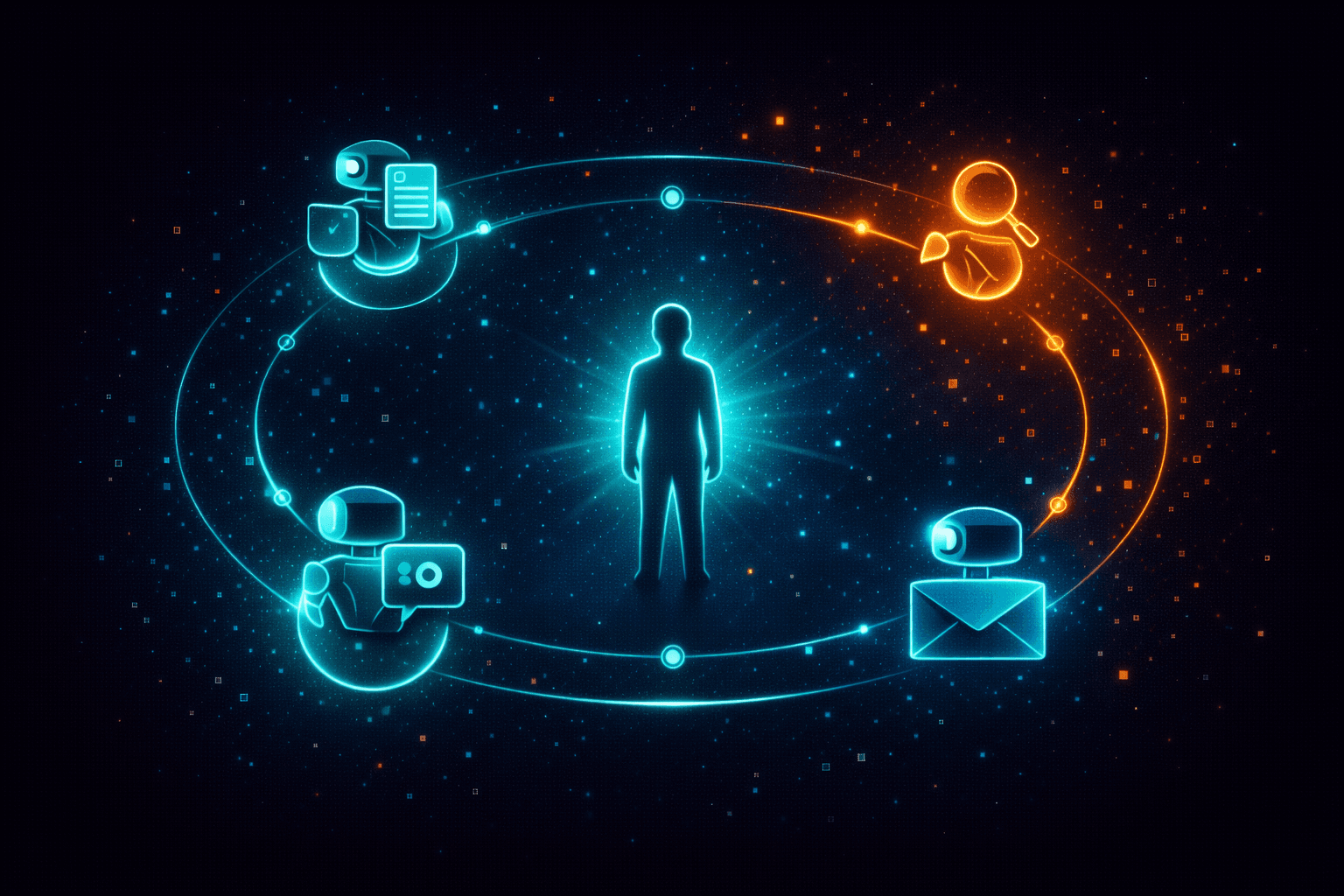
Think of it like hiring a small marketing agency, except instead of four people in an office, you have four AI agents running on your computer or in the cloud. One focuses on content. Another handles SEO analysis. A third manages email drafts. A fourth creates social media posts from your existing content.
These agents don't just work independently — they share context. The content agent writes a blog post, and the social media agent automatically creates posts promoting it. The SEO agent identifies a keyword opportunity, and the content agent incorporates it into the next article. The email agent pulls highlights from recent blog posts to build a newsletter.
This kind of coordination is what makes agent teams more useful than just having four separate AI tools that don't talk to each other.
What a Small Business AI Marketing Setup Looks Like
Here's what a practical AI marketing pipeline looks like when it's built around agent teams.
Content Agent
This agent handles the bulk of your content creation. It researches topics relevant to your industry, drafts blog posts, suggests headlines, and can even outline content calendars weeks in advance. You provide the direction — what topics matter to your customers, what questions they ask, what problems they face — and the agent does the research and writing.
The key word here is "drafts." You still review everything before it goes live. The agent gets you to an 80 percent finished product in minutes instead of hours. You spend your time editing and adding your personal perspective rather than staring at a blank page.
SEO Agent
Search engine optimization is one of those things that's critically important but mind-numbingly tedious to do manually. An SEO agent can analyze your existing website content, identify pages that are underperforming, suggest keyword opportunities based on what your competitors rank for, and flag technical issues like broken links or missing meta descriptions.
It can also track your rankings over time and alert you when something changes — good or bad. Instead of paying an SEO consultant to run monthly audits, you have an agent that monitors things continuously.
Email Agent
Email marketing consistently delivers one of the highest returns of any marketing channel, but only if you actually send emails regularly. It can also power your AI-driven outreach without being spammy. An email agent can draft newsletter content, suggest subject lines, segment your subscriber list based on engagement patterns, and recommend send times based on when your audience is most active.
You still decide what to say and when to say it. The agent handles the time-consuming parts: writing the first draft, formatting the layout, pulling in relevant content, and preparing everything so you just need to review and hit send.
Social Media Agent
Creating social media content from scratch every day is exhausting. A social media agent takes a different approach: it repurposes your existing content. Got a new blog post? The agent creates a series of social media posts pulling out key points, quotes, and takeaways. It can suggest hashtags, recommend posting times, and even draft replies to common types of engagement.
This turns one piece of content into a week's worth of social media activity without anyone on your team spending hours on it.
What AI Agent Teams Are Good At
Let's be honest about where this approach shines and where it doesn't.
AI marketing agents are excellent at the execution layer of marketing — the 80 percent of the work that's necessary but doesn't require creative genius. Specifically:
First drafts. Whether it's a blog post, an email, or a social media caption, AI agents can produce solid first drafts that save you hours of writing time. They're not going to win literary awards, but they'll give you something you can work with.
Research and analysis. Agents can process large amounts of data quickly. Competitor analysis, keyword research, audience engagement patterns, content performance metrics — these are all tasks where AI saves you from spreadsheet purgatory.
Repurposing content. Taking a blog post and turning it into social media posts, email content, and a LinkedIn article is exactly the kind of repetitive transformation that AI handles well.
Consistency. The hardest part of marketing for most small businesses isn't doing it well — it's doing it at all, week after week. AI agents don't forget, don't get busy with other priorities, and don't take vacation. They show up every day.
Data-driven suggestions. Agents can analyze what's working and what isn't across your marketing channels and make recommendations based on patterns, not gut feelings.

What AI Agent Teams Are NOT Good At
Here's where you still need to be the human in the room.
Brand voice. Your brand voice is what makes your marketing sound like you and not like a generic business. AI agents can learn to approximate your tone if you give them enough examples, but they need ongoing guidance. Left unsupervised, they'll drift toward generic corporate-speak.
Strategy. AI agents can execute a marketing plan, but they can't create one from scratch. You need to decide what your business stands for, who your audience is, and what message you want to put in front of them. The agents handle the how, but you define the what and the why.
Genuine relationship building. Marketing isn't just content and campaigns — it's relationships. Responding to a customer who's frustrated, engaging authentically in your community, building partnerships with other businesses. These require real human empathy and judgment.
Crisis communication. If something goes wrong publicly — a bad review goes viral, a product recall, a PR incident — you do not want an AI agent handling the response. These situations require nuance, empathy, and sometimes just knowing when to pick up the phone.
Anything requiring lived experience. The best marketing content often comes from real stories, real customer interactions, and real expertise. AI can help you tell those stories more effectively, but it can't generate the stories themselves.
The bottom line: AI handles the work. You provide the judgment.
The Power of Iterative Self-Review
One technique that dramatically improves AI marketing output is what's sometimes called recursive self-improvement. The concept is simple: instead of accepting the first thing the AI produces, you set up a process where the agent reviews its own work, identifies weaknesses, and revises.
For example, your content agent writes a blog post draft. Before you even see it, a review step kicks in. The agent evaluates the draft against criteria you've set — Is it clear? Is it on-brand? Does it address the customer's actual question? Are there claims that need supporting evidence? It then rewrites the weak sections and produces a second, stronger draft.
This loop can run multiple times. Each pass catches things the previous pass missed. The result is output that's noticeably better than a single-pass first draft — closer to what you'd get from a skilled human writer who takes time to edit their own work.
This approach has gained serious traction among businesses using AI for content because the quality difference is significant. A single AI draft might be 60 percent ready. After a couple of self-review cycles, you're often looking at something that's 85 to 90 percent ready — meaning your editing time drops dramatically.
How to Get Started
You don't need to build a full AI marketing department on day one. In fact, you shouldn't. Here's a more practical path.
Start with one function. Pick the marketing task that's either the biggest time sink or the one that's simply not getting done at all. For most businesses, that's either blog content or email newsletters. Set up a single agent to handle first drafts and see how the output looks after a couple of weeks.
Build your brand guide. Before scaling up, package your business knowledge for AI — document your brand voice, your target audience, and your key messages. This doesn't need to be a fifty-page brand book — even a one-page summary gives your AI agents the context they need to produce on-brand content.
Add agents incrementally. Once your content agent is producing useful drafts, add an SEO agent to optimize what's being written. Then a social media agent to distribute it. Then an email agent to nurture your audience. Each layer builds on the one before it.
Keep reviewing. AI agents get better over time as you refine their instructions and provide feedback. The businesses that get the most value from AI marketing are the ones that treat it as an ongoing collaboration, not a set-it-and-forget-it tool.
Set realistic expectations. AI marketing agents won't make your business go viral overnight. What they will do is give you consistent, professional marketing output that would otherwise require hiring multiple people. That consistency compounds over time. Just be sure to keep an eye on costs as you scale up, since multiple agents running in parallel can add up quickly.
You Don't Need a Marketing Team to Have Professional Marketing
A few years ago, the only way to run professional marketing was to hire professionals. That's no longer true. AI agent teams give small businesses access to marketing capabilities that were previously reserved for companies with dedicated marketing departments and serious budgets.
You still need to provide the strategy, the brand voice, and the final judgment call. But the execution — the writing, the research, the scheduling, the optimization, the endless repurposing of content across channels — that's work AI agents can handle today.
The businesses that figure this out early will have a real advantage. Not because they're using trendy technology, but because they're getting consistent, professional marketing done every week instead of letting it fall to the bottom of the to-do list. If you want to make sure your business shows up when customers ask AI for recommendations, read our guide on how to make ChatGPT recommend your business.
See how our AI integration services help businesses deploy agent teams for marketing, content, and customer engagement.
Blue Octopus Technology helps businesses set up AI marketing pipelines tailored to their specific industry and audience. If you're curious about what an AI marketing setup would look like for your business, let's talk.
Keep reading
More from the field.
Stay Connected
Get practical insights on using AI and automation to grow your business. No fluff.